
多资源同步阻塞
抽象情境。我们有两个绵羊,我们可以在时间异步使用(信号量(2))和一个门,我们可以在时间上使用。我们想让羊通过门2次(每次我们需要1只羊和1只门,持续1秒)和喂养1次羊(需要1只羊和2秒)。下面是代码示例:
import asyncio


class Sheep:
    _sem = asyncio.Semaphore(2)  # we have 2 avaliable sheeps at time

    def __init__(self, reason):
        self._reason = reason

    async def acquire(self):
        await type(self)._sem.acquire()
        print('acquire sheep ({})'.format(self._reason))

    def release(self):
        print('release sheep ({})'.format(self._reason))
        type(self)._sem.release()


class Gate:
    _sem = asyncio.Semaphore(1)  # we have 1 avaliable gate at time

    def __init__(self, reason):
        self._reason = reason

    async def acquire(self):
        await type(self)._sem.acquire()
        print('acquire gate ({})'.format(self._reason))

    def release(self):
        print('release gate ({})'.format(self._reason))
        type(self)._sem.release()


async def spend(reason):
    sheep = Sheep(reason)
    gate = Gate(reason)
    await asyncio.gather(
        sheep.acquire(),
        gate.acquire()
    )  # block 1 sheep, 1 gate
    await asyncio.sleep(1)  # 1 second
    print('Spend sheep through a gate')
    sheep.release()
    gate.release()


async def feed(reason):
    sheep = Sheep(reason)
    await  asyncio.gather(
        sheep.acquire()
    )  # block 1 sheep
    await asyncio.sleep(2)  # 2 seconds
    print('Feed sheep')
    sheep.release()


async def main():
    await asyncio.gather(
        spend('spend 1'),
        feed('feed 1'),
        spend('spend 2')
    )  # spend 2 times, feed 1 time


if __name__ == "__main__":
    loop = asyncio.get_event_loop()
    loop.run_until_complete(main())
输出:
acquire gate (spend 1)
acquire sheep (spend 1)
acquire sheep (spend 2) <-----
Spend sheep through a gate
release sheep (spend 1)
release gate (spend 1)
acquire sheep (feed 1)
acquire gate (spend 2)
Spend sheep through a gate
release sheep (spend 2)
release gate (spend 2)
Feed sheep
release sheep (feed 1)
[Finished in 3.2s]问题是程序不能以最优的方式工作,在输出的第3行中的原因是:spend 2阻塞绵羊,而不能立即使用它,它应该等待被spend 1阻塞的单门。第二,可以在spend 1浪费时间的情况下饲养的羊:
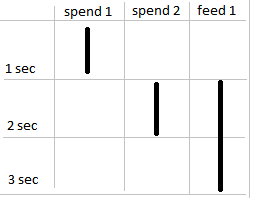
程序应该如何工作的最佳方式:spend 1阻塞1只羊和1只羊,spend 2看到那扇门被阻塞,没有理由立即阻止第二只羊。feed 1可以在spend 1运行时阻塞第二只羊并运行。在这种情况下,程序将在2秒内完成,而不是3秒:
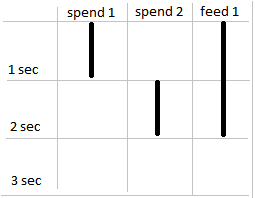
很容易看出你是否改变了main的集合内的顺序。
资源不仅要并行不悖,而且要同步,只有羊和门是可用的,才能封锁羊和门。就像这样:
while sheep.locked() or gate.locked():
    asyncio.sleep(0)
await asyncio.gather(
    sheep.acquire(),
    gate.acquire()
)
但这看起来不像是一个通用的、好的解决方案。是否存在解决这一问题的任何模式或更好的方法?任何想法都欢迎。
回答 2
Stack Overflow用户
发布于 2015-12-02 09:11:34
基于这个解决方案,我为这个示例创建了解决方案。我们需要两件事:
- 将
locked()函数添加到Sheep和Gate中,即检查现在是否可以获取对象 - 添加并使用新的
MultiAcquire任务,该任务将只获取对象,如果所有对象都可以立即获得,则只获取(否则暂停发布事件)
下面是最后的代码,请参阅MultiAcquire -它的主要内容是:
import asyncio


class Sheep:
    _sem = asyncio.Semaphore(2)  # we have 2 avaliable sheeps at time

    def __init__(self, reason):
        self._reason = reason

    async def acquire(self):
        await type(self)._sem.acquire()
        print('acquire sheep ({})'.format(self._reason))

    def release(self):
        print('release sheep ({})'.format(self._reason))
        type(self)._sem.release()

    def locked(self):
        return type(self)._sem.locked()


class Gate:
    _sem = asyncio.Semaphore(1)  # we have 1 avaliable gate at time

    def __init__(self, reason):
        self._reason = reason

    async def acquire(self):
        await type(self)._sem.acquire()
        print('acquire gate ({})'.format(self._reason))

    def release(self):
        print('release gate ({})'.format(self._reason))
        type(self)._sem.release()

    def locked(self):
        return type(self)._sem.locked()


class MultiAcquire(asyncio.Task):
    _check_lock = asyncio.Lock()  # to suspend for creating task that acquires objects
    _release_event = asyncio.Event()  # to suspend for any object was released

    def __init__(self, locks):
        super().__init__(self._task_coro())
        self._locks = locks
        # Here we use decorator to subscribe all release() calls,
        # _release_event would be set in this case:
        for l in self._locks:
            l.release = self._notify(l.release)

    async def _task_coro(self):
        while True:
            # Create task to acquire all locks and break on success:
            async with type(self)._check_lock:
                if not any(l.locked() for l in self._locks):  # task would be created only if all objects can be acquired
                    task = asyncio.gather(*[l.acquire() for l in self._locks])  # create task to acquire all objects
                    await asyncio.sleep(0)  # start task without waiting for it
                    break
            # Wait for any release() to try again:
            await type(self)._release_event.wait()
        # Wait for task:
        return await task

    def _notify(self, func):
        def wrapper(*args, **kwargs):
            type(self)._release_event.set()
            type(self)._release_event.clear()
            return func(*args, **kwargs)
        return wrapper


async def spend(reason):
    sheep = Sheep(reason)
    gate = Gate(reason)
    await MultiAcquire([sheep, gate])  # block 1 sheep, 1 gate
    await asyncio.sleep(1)  # 1 second
    print('Spend sheep through a gate')
    sheep.release()
    gate.release()


async def feed(reason):
    sheep = Sheep(reason)
    await MultiAcquire([sheep])  # block 1 sheep
    await asyncio.sleep(2)  # 2 seconds
    print('Feed sheep')
    sheep.release()


async def main():
    await asyncio.gather(
        spend('spend 1'),
        feed('feed 1'),
        spend('spend 2')
    )  # spend 2 times, feed 1 time


if __name__ == "__main__":
    loop = asyncio.get_event_loop()
    loop.run_until_complete(main())
输出:
acquire gate (spend 2)
acquire sheep (spend 2)
acquire sheep (feed 1)
Spend sheep through a gate
release sheep (spend 2)
release gate (spend 2)
acquire sheep (spend 1)
acquire gate (spend 1)
Feed sheep
release sheep (feed 1)
Spend sheep through a gate
release sheep (spend 1)
release gate (spend 1)
[Finished in 2.2s]Stack Overflow用户
发布于 2015-11-30 12:58:48
您可以实现一个处理多个锁的异步上下文管理器。此对象应确保在等待另一个不可用的锁时不会持有任何锁:
class multilock(asyncio.locks._ContextManagerMixin):

    def __init__(self, *locks):
        self.released = list(locks)
        self.acquired = []

    async def acquire(self):
        while self.released:
            lock = self.released.pop()
            if lock.locked():
                self.release()
            await lock.acquire()
            self.acquired.append(lock)

    def release(self):
        while self.acquired:
            lock = self.acquired.pop()
            lock.release()
            self.released.append(lock)
示例:
async def test(lock1, lock2):
    async with multilock(lock1, lock2):
print('Do something')https://stackoverflow.com/questions/33969075
复制相似问题
腾讯云开发者

Copyright © 2013 - 2026 Tencent Cloud. All Rights Reserved. 腾讯云 版权所有
深圳市腾讯计算机系统有限公司 ICP备案/许可证号:粤B2-20090059  粤公网安备44030502008569号
腾讯云计算(北京)有限责任公司 京ICP证150476号 | 京ICP备11018762号