
Ellipse2D绘图精度不高
我在做空间物理学的应用,所以我做了很多关于轨道的研究。当然,我会遇到Ellipse2D.Double来在屏幕上画出我的轨道。
每当我的JPanel刷新时,我就使用Ellipse2D绘制物体的轨道,以及用不同的方法绘制身体本身。
本质上,我发现当数字变得很大时(不管是轨道的大小变大,或者可视化被放大到很远的地方),身体和Ellipse2D的位置就不会排列在一起。
我使用从极坐标到直角坐标的转换来计算物体的位置,我把Ellipse2D的数学问题留给geom包。
看看这个代码示例。这是我能解决的问题中最自成一体的一个版本,因为这个圈子的规模必须非常大:
import java.awt.Graphics;
import java.awt.Graphics2D;
import java.awt.geom.Ellipse2D;
import java.awt.geom.Line2D;
import java.math.BigDecimal;

import javax.swing.JFrame;
import javax.swing.JPanel;

public class EllipseDemo extends JPanel {
    public static void main(String[] args) {
        JFrame frame = new JFrame();
        frame.setSize(500, 500);
        frame.add(new EllipseDemo());
        frame.setVisible(true);
    }

    @Override
    public void paintComponent(Graphics g) {
        super.paintComponent(g);
        Graphics2D g2d = (Graphics2D) g;

        // These values allow for a very zoomed in view of a piece of the circle
        BigDecimal[] circleCenter = { new BigDecimal(-262842.5), new BigDecimal(-93212.8) };
        BigDecimal circleRadius = new BigDecimal(279081.3);

        // Draw the circle at the given center, with the given width and height
        // x = centerx - radius, y = centery - radius, w = h = radius * 2
        g2d.draw(new Ellipse2D.Double(circleCenter[0].subtract(circleRadius).doubleValue(),
                circleCenter[1].subtract(circleRadius).doubleValue(), circleRadius.multiply(new BigDecimal(2)).doubleValue(),
                circleRadius.multiply(new BigDecimal(2)).doubleValue()));

        // Get a rectangular conversion of a point on the circle at this angle
        BigDecimal angle = new BigDecimal(0.34117696217);
        BigDecimal[] rectangular = convertPolarToRectangular(new BigDecimal[] {
                circleRadius, angle });

        // Draw a line from the center of the circle to the point
        g2d.draw(new Line2D.Double(circleCenter[0].doubleValue(), circleCenter[1].doubleValue(),
                circleCenter[0].add(rectangular[0]).doubleValue(), circleCenter[1]
                        .add(rectangular[1]).doubleValue()));
    }

    public BigDecimal[] convertPolarToRectangular(BigDecimal[] polar) {
        BigDecimal radius = polar[0];
        BigDecimal angle = polar[1];
        BigDecimal x = radius.multiply(new BigDecimal(Math.cos(angle.doubleValue())));
        BigDecimal y = radius.multiply(new BigDecimal(Math.sin(angle.doubleValue())));
        return new BigDecimal[] { x, y };
    }
}
上面的代码实际上在屏幕上画了一个圆圈,非常远,半径很大。我选择了这个尺寸,这样在小窗口中就可以看到圆圈的一部分。
然后画一条线,从圆心到在窗口可见的圆上的一个点:我选择了一个在窗口上可见的角度,用几何把这个角度和圆圈半径转换成直角坐标。
这是程序显示的内容:
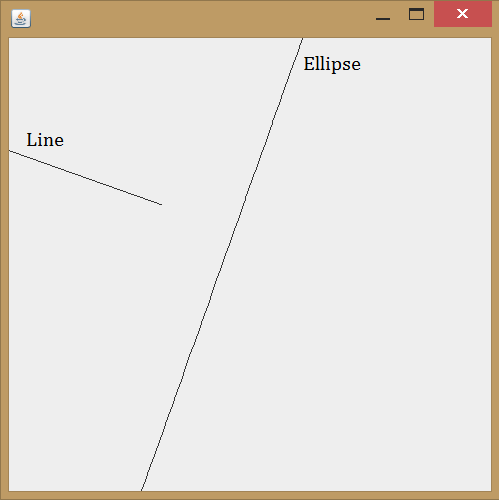
注意,这条线实际上并没有接触到椭圆。现在,我决定我必须找出是我计算的点还是椭圆是不正确的。我在计算器上算了一下,发现这条线是正确的,椭圆是不正确的:
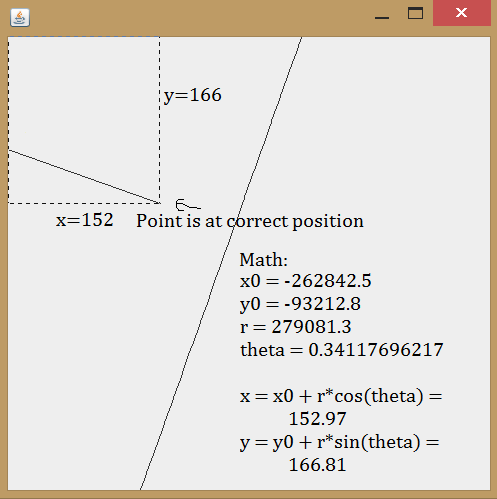
考虑到计算器可能没有错,我不得不相信Ellipse2D绘制得不正确。然而,我尝试了许多其他的角度,这就是我发现的模式:
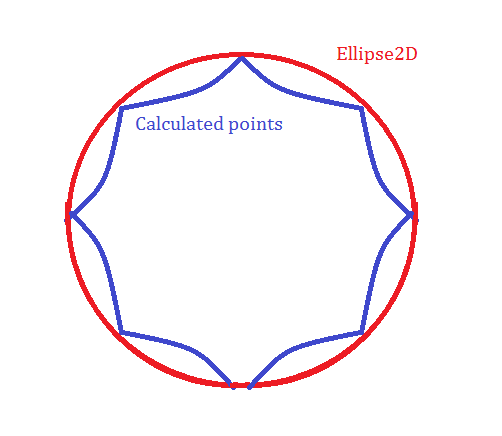
这让我相信计算是错误的。
所以这就是我的问题。我应该使用Ellipse2D以外的其他东西吗?也许Ellipse2D不够精确?我在代码示例中使用了BigDecimals,因为我认为它会给我更高的精度--这是错误的方法吗?我的最终目标是能够在特定的角度上计算椭圆上一个点的矩形位置。
提前谢谢。
回答 1
Stack Overflow用户
发布于 2015-10-12 01:04:26
您会看到这个错误,因为Ellipse2D是由四条三次曲线近似的。要确保只需查看其定义形状边框的路径迭代器:http://grepcode.com/file/repository.grepcode.com/java/root/jdk/openjdk/6-b14/java/awt/geom/EllipseIterator.java#187
为了提高质量,我们应该用更多的三次曲线来逼近椭圆。下面是标准java实现的扩展,其中有可变的段数:
class BetterEllipse extends Ellipse2D.Double {
    private int segments;

    public BetterEllipse(int segments, double x, double y, double w, double h) {
        super(x, y, w, h);
        this.segments = segments;
    }

    public int getSegments() {
        return segments;
    }

    @Override
    public PathIterator getPathIterator(final AffineTransform affine) {
        return new PathIterator() {
            private int index = 0;

            @Override
            public void next() {
                index++;
            }

            @Override
            public int getWindingRule() {
                return WIND_NON_ZERO;
            }

            @Override
            public boolean isDone() {
                return index > getSegments() + 1;
            }

            @Override
            public int currentSegment(double[] coords) {
                int count = getSegments();
                if (index > count)
                    return SEG_CLOSE;
                BetterEllipse ellipse = BetterEllipse.this;
                double x = ellipse.getCenterX() + Math.sin(2 * Math.PI * index / count) * ellipse.getWidth() / 2;
                double y = ellipse.getCenterY() + Math.cos(2 * Math.PI * index / count) * ellipse.getHeight() / 2;
                if (index == 0) {
                    coords[0] = x;
                    coords[1] = y;
                    if (affine != null)
                        affine.transform(coords, 0, coords, 0, 1);
                    return SEG_MOVETO;
                }
                double x0 = ellipse.getCenterX() + Math.sin(2 * Math.PI * (index - 2) / count) * ellipse.getWidth() / 2;
                double y0 = ellipse.getCenterY() + Math.cos(2 * Math.PI * (index - 2) / count) * ellipse.getHeight() / 2;
                double x1 = ellipse.getCenterX() + Math.sin(2 * Math.PI * (index - 1) / count) * ellipse.getWidth() / 2;
                double y1 = ellipse.getCenterY() + Math.cos(2 * Math.PI * (index - 1) / count) * ellipse.getHeight() / 2;
                double x2 = x;
                double y2 = y;
                double x3 = ellipse.getCenterX() + Math.sin(2 * Math.PI * (index + 1) / count) * ellipse.getWidth() / 2;
                double y3 = ellipse.getCenterY() + Math.cos(2 * Math.PI * (index + 1) / count) * ellipse.getHeight() / 2;
                double x1ctrl = x1 + (x2 - x0) / 6;
                double y1ctrl = y1 + (y2 - y0) / 6;
                double x2ctrl = x2 + (x1 - x3) / 6;
                double y2ctrl = y2 + (y1 - y3) / 6;
                coords[0] = x1ctrl;
                coords[1] = y1ctrl;
                coords[2] = x2ctrl;
                coords[3] = y2ctrl;
                coords[4] = x2;
                coords[5] = y2;
                if (affine != null)
                    affine.transform(coords, 0, coords, 0, 3);
                return SEG_CUBICTO;
            }

            @Override
            public int currentSegment(float[] coords) {
                double[] temp = new double[6];
                int ret = currentSegment(temp);
                for (int i = 0; i < coords.length; i++)
                    coords[i] = (float)temp[i];
                return ret;
            }
        };
    }
}
下面是如何在代码中使用它而不是标准代码(我在这里使用了100个段):
    g2d.draw(new BetterEllipse(100, circleCenter[0].subtract(circleRadius).doubleValue(),
            circleCenter[1].subtract(circleRadius).doubleValue(), circleRadius.multiply(new BigDecimal(2)).doubleValue(),
circleRadius.multiply(new BigDecimal(2)).doubleValue()));https://stackoverflow.com/questions/33071206
复制相似问题
腾讯云开发者

Copyright © 2013 - 2026 Tencent Cloud. All Rights Reserved. 腾讯云 版权所有
深圳市腾讯计算机系统有限公司 ICP备案/许可证号:粤B2-20090059  粤公网安备44030502008569号
腾讯云计算(北京)有限责任公司 京ICP证150476号 | 京ICP备11018762号