
R插入符号不一致导致模型调优
R插入符号不一致导致模型调优
提问于 2015-09-20 17:29:09
今天,使用插入符号包进行模型优化时,我遇到了这种奇怪的行为:给定调优参数T*的特定组合,如果单独计算T*或作为可能组合的网格的一部分,则与T*更改相关的度量(即Cohen's K)值。在下面的实例中,使用插入符号与gbm包进行接口。
# Load libraries and data
library (caret)
data<-read.csv("mydata.csv")
data$target<-as.factor(data$target)
# data are available at https://www.dropbox.com/s/1bglmqd14g840j1/mydata.csv?dl=0
Pocedure 1: T*单独评估
#Define 5-fold cv as validation settings
fitControl <- trainControl(method = "cv",number = 5)

# Define the combination of tuning parameter for this example T*
gbmGrid <- expand.grid(.interaction.depth = 1,
                   .n.trees = 1000,
                   .shrinkage = 0.1, .n.minobsinnode=1)

# Fit a gbm with T* as model parameters and K as scoring metric.
set.seed(825)
gbmFit1 <- train(target ~ ., data = data,
             method = "gbm",
             distribution="adaboost",
             trControl = fitControl,
             tuneGrid=gbmGrid,
             verbose=F,
             metric="Kappa")

# The results show that T* is associated with Kappa = 0.47. Remember this result and the confusion matrix.
testPred<-predict(gbmFit1, newdata = data)
confusionMatrix(testPred, data$target)
# output selection
Confusion Matrix and Statistics
           Reference
Prediction   0   1
         0 832  34
         1   0  16

Kappa : 0.4703
过程2: T*与其他调优配置文件一起评估
这里的所有内容都与过程1中的情况相同,除了考虑了几种调优参数{T}的组合之外:
# Notice that the original T* is included in {T}!!
gbmGrid2 <- expand.grid(.interaction.depth = 1,
                   .n.trees = seq(100,1000,by=100),
                   .shrinkage = 0.1, .n.minobsinnode=1)
# Fit the gbm
set.seed(825)
gbmFit2 <- train(target ~ ., data = data,
             method = "gbm",
             distribution="adaboost",
             trControl = fitControl,
             tuneGrid=gbmGrid2,
             verbose=F,
             metric="Kappa")

# Caret should pick the model with the highest Kappa.
# Since T* is in {T} I would expect the best model to have K >= 0.47
testPred<-predict(gbmFit2, newdata = data)
confusionMatrix(testPred, data$target)
# output selection
          Reference
Prediction   0   1
         0 831  47
         1   1   3

Kappa : 0.1036
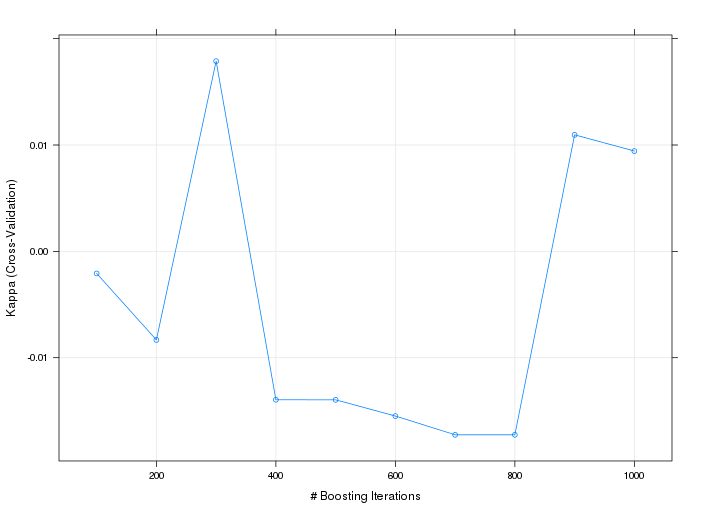
结果与我的预期不一致:{T}分数K=0.10中的最佳模型。如果T*有K= 0.47,并且它包含在{T}中,那怎么可能?另外,根据下面的图,步骤2中评估的T*的K值现在约为0.01。知道这是怎么回事吗?我是不是遗漏了什么?
回答 1
Stack Overflow用户
回答已采纳
发布于 2015-09-20 21:42:55
我正在从您的数据和代码中获得一致的重采样结果。
第一个模型有Kappa = 0.00943
gbmFit1$results
  interaction.depth n.trees shrinkage n.minobsinnode  Accuracy       Kappa  AccuracySD
1                 1    1000       0.1              1 0.9331022 0.009430576     0.004819004
    KappaSD
1 0.0589132第二个模型对于n.trees = 1000具有相同的结果。
gbmFit2$results
   shrinkage interaction.depth n.minobsinnode n.trees  Accuracy        Kappa  AccuracySD
1        0.1                 1              1     100 0.9421803 -0.002075765 0.002422952
2        0.1                 1              1     200 0.9387776 -0.008326896 0.002468351
3        0.1                 1              1     300 0.9365049 -0.012187900 0.002625886
4        0.1                 1              1     400 0.9353749 -0.013950906 0.003077431
5        0.1                 1              1     500 0.9353685 -0.013961221 0.003244201
6        0.1                 1              1     600 0.9342322 -0.015486214 0.005202656
7        0.1                 1              1     700 0.9319658 -0.018574633 0.007033402
8        0.1                 1              1     800 0.9319658 -0.018574633 0.007033402
9        0.1                 1              1     900 0.9342386  0.010955568 0.003144850
10       0.1                 1              1    1000 0.9331022  0.009430576 0.004819004
       KappaSD
1  0.004641553
2  0.004654972
3  0.003978702
4  0.004837097
5  0.004878259
6  0.007469843
7  0.009470466
8  0.009470466
9  0.057825336
10 0.058913202请注意,第二次运行中最好的模型是n.trees = 900。
gbmFit2$bestTune
     n.trees interaction.depth shrinkage n.minobsinnode
9 900 1 0.1 1由于train根据您的度量选择“最佳”模型,您的第二个预测是使用不同的模型(n.trees为900而不是1000)。
页面原文内容由Stack Overflow提供。腾讯云小微IT领域专用引擎提供翻译支持
原文链接:
https://stackoverflow.com/questions/32682259
复制相关文章
相似问题
腾讯云开发者

Copyright © 2013 - 2026 Tencent Cloud. All Rights Reserved. 腾讯云 版权所有
深圳市腾讯计算机系统有限公司 ICP备案/许可证号:粤B2-20090059  粤公网安备44030502008569号
腾讯云计算(北京)有限责任公司 京ICP证150476号 | 京ICP备11018762号