
用于解析金融数据的Python regex
我对regex相对来说是个新手(总是因为某种原因而挣扎).
我有这份表格的文本:
David Meredith, Financial Director sold post-exercise 15,000 shares in the company on YYYY-mm-dd at a price of 1044.00p. The Director now holds 6,290 shares representing 0.01% of the...

Mark Brookes, Non Executive Director bought 811 shares in the company on  YYYY-mm-dd at a price of 76.75p. The Director now holds 189,952 shares representing 0.38% of the shares in...

Albert Ellis, CEO bought 262 shares in the company on YYYY-mm-dd at a price of 52.00p. The Director now holds 465,085 shares. NOTE: Purchased through Co's SIP Story provided by...
对文本的分析显示了以下结构:
- 以句子开头的两个或多个单词,在第一个逗号之前,是参与交易的人的姓名。
- 在此之前的一个或多个单词(“出售”、“购买的”、“锻炼过的”、“出售后的锻炼”)是该人的标题。
- 这两种类型中的任何一种:(“出售”、“购买”、“已行使”、“出售后锻炼”)在标题之后,标识交易类型。
- 在事务类型之后的第一个数字字符串(‘sold’区)-已购买的‘\’\{e76f}表示事务的大小
- “价格”继承了一个数字字符串,该字符串指定了交易的价格。
我的问题是:
我如何使用这些知识(和regex)来编写一个解析类似文本的函数来返回感兴趣的变量(上面列出了1-5)?
我想要写的函数的伪代码..
def grok_directors_dealings_text(text_input):
    name, title, transaction_type, lot_size, price = (None, None, None, None, None)
    ....
    name = ...
    title = ...
    transaction_type = ...
    lot_size = ...
    price = ...

    pass
我将如何使用regex来实现函数,以便在传递符合上述结构的文本时返回感兴趣的变量?
[编辑]
出于某种原因,我似乎与regex斗争了一段时间,如果我要从S.O上的正确答案中学习,如果给出一个解释为什么这个神奇的表达(抱歉,regexpr)真的有效的话,情况会好得多。
我想真正学习这些东西而不是复制粘贴表达式..。
回答 4
Stack Overflow用户
发布于 2015-09-04 17:42:58
您可以使用以下正则表达式:
(.*?),\s(.*)\s(sold(?: post-exercise)?|bought|exercised)\s*([\d,]*).*price of\s*(\d*.\d+?p)Python:
import re

financialData = """
David Meredith, Financial Director sold post-exercise 15,000 shares in the company on YYYY-mm-dd at a price of 1044.00p. The Director now holds 6,290 shares representing 0.01% of the...

Mark Brookes, Non Executive Director bought 811 shares in the company on  YYYY-mm-dd at a price of 76.75p. The Director now holds 189,952 shares representing 0.38% of the shares in...

Albert Ellis, CEO bought 262 shares in the company on YYYY-mm-dd at a price of 52.00p. The Director now holds 465,085 shares. NOTE: Purchased through Co's SIP Story provided by...
"""

print(re.findall('(.*?),\s(.*)\s(sold(?: post-exercise)?|bought|exercised)\s*([\d,]*).*price of\s*(\d*.\d+?p)',financialData))
输出:
[('David Meredith', 'Financial Director', 'sold post-exercise', '15,000', '1044.00p'), ('Mark Brookes', 'Non Executive Director', 'bought', '811', '76.75p'), ('Albert Ellis', 'CEO', 'bought', '262', '52.00p')]编辑1
要理解它们的含义,请遵循演示链接,在右上角可以找到一个块来解释每个字符的含义如下:
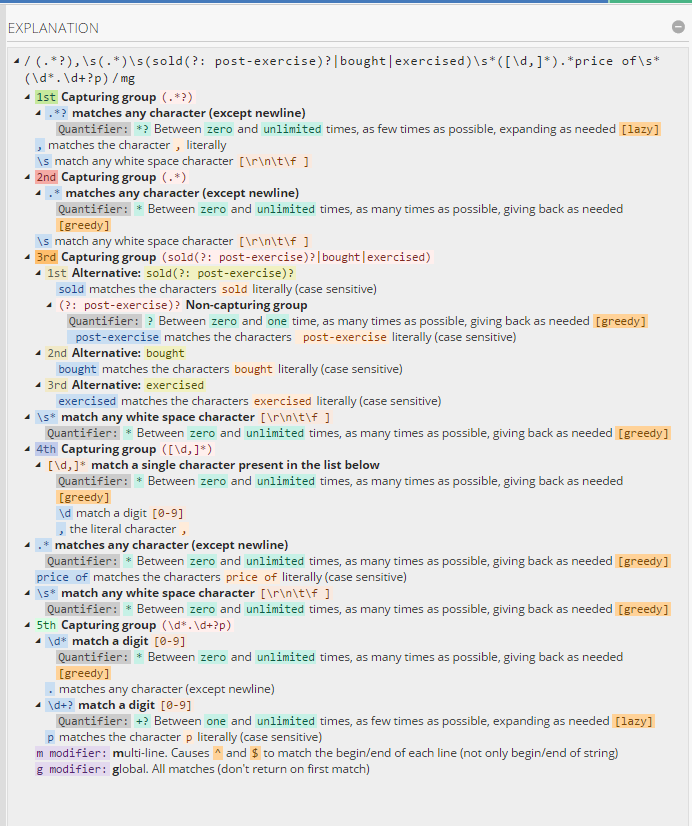
此外,德布盖克斯还通过显示哪个组匹配哪个字符来帮助您模拟字符串!
下面是一个针对特定情况的调试器演示:
(.*?),\s(.*)\s(sold(?: post-exercise)?|bought|exercised)\s*([\d,]*).*price of\s*(\d*.\d+?p)

Stack Overflow用户
发布于 2015-09-04 17:37:34
我想出了这个准则:
([\w ]+), ([\w ]+) (sold post-exercise|sold|bought|exercised) ([\d,\.]+).*price of ([\d\.,]+)p

基本上,我们使用括号来捕获您想要的重要信息,所以让我们检查一下每个信息:
([\w ]+):\w匹配任何单词字符a-zA-Z0-9_ 1次或多次,这将给我们一个人的名字;- 在一个空格和逗号之后的另一个
([\w ]+)得到标题; (sold post-exercise|sold|bought|exercised)然后我们搜索我们的事务类型。请注意,我将post-exercise放在post前面,以便它首先尝试匹配更大的单词;- 然后,我们试图找出数字,它是由数字(
\d),一个逗号和可能出现一个点也可能出现; ([\d\.,]+),然后,我们需要得到的价格,基本上是相同的交易规模。
连接每个组的正则表达式也是相当基本的。
如果您在regex101上尝试它,它提供了关于regex的一些解释,并在python中生成以下代码以供使用:
import re
p = re.compile(ur'([\w ]+), ([\w ]+) (sold post-exercise|sold|bought|exercised) ([\d,\.]+).*price of ([\d\.,]+)p')

test_str = u"David Meredith, Financial Director sold post-exercise 15,000 shares in the company on YYYY-mm-dd at a price of 1044.00p. The Director now holds 6,290 shares representing 0.01% of the...\n\nMark Brookes, Non Executive Director bought 811 shares in the company on  YYYY-mm-dd at a price of 76.75p. The Director now holds 189,952 shares representing 0.38% of the shares in...\n\nAlbert Ellis, CEO bought 262 shares in the company on YYYY-mm-dd at a price of 52.00p. The Director now holds 465,085 shares. NOTE: Purchased through Co's SIP Story provided by..."

re.findall(p, test_str)Stack Overflow用户
发布于 2015-09-04 17:26:44
这就是要做这件事的准则
(.*?),(.*?)(sold post-exercise|sold|bought|exercised).*?([\d|,]+).*?price of ([\d|\.]+)你就这样用它
import re
def get_data(line):
    pattern = r"(.*?),(.*?)(sold post-exercise|sold|bought|exercised).*?([\d|,]+).*?price of ([\d|\.]+)"
    m = re.match(pattern, line)
    return m.groups()
对于第一行,它将返回
(“大卫·梅雷迪斯”,“财务总监”,“演习后销售”,“15,000”,“1044.00”)编辑:增加解释
此正则表达式如下所示:第一个字符(.*?),将字符串取为下一次匹配(女巫为,)
。意味着每一个字符
*意味着它可以多次(许多字符,而不仅仅是1)
?意思是不要贪婪,这意味着它将使用第一个',‘和另一个(如果有很多',')
之后又出现了这样的情况(.*?)再取字符直到下一件事匹配(与常量字)。
在那之后,有(出售的,锻炼的,出售的,买的,买的,锻炼的)巫婆的意思-找到其中的一个单词(被\x)
在那之后有一个.*?女巫又一次意味着把所有的文本都拿到下一次比赛(这一次它不会被()覆盖,所以它不会被作为一个组来选择,也不会成为输出的一部分)。
(\d\\,+)意思是取数字(\d)或逗号。+代表一次或多次
又是.*?像以前一样
“价格”找到实际的字符串‘价格’
最后(\d|.+)的意思是再次取一个数字或一个点(因为字符转义)。由regex用于“任意字符”)一次或多次
https://stackoverflow.com/questions/32403338
复制相似问题
腾讯云开发者

Copyright © 2013 - 2026 Tencent Cloud. All Rights Reserved. 腾讯云 版权所有
深圳市腾讯计算机系统有限公司 ICP备案/许可证号:粤B2-20090059  粤公网安备44030502008569号
腾讯云计算(北京)有限责任公司 京ICP证150476号 | 京ICP备11018762号