
库达推力-计数匹配子阵
我试图找出是否有可能用CUDA有效地计算一组数字的条件熵。您可以通过将数组划分为窗口来计算条件熵,然后计算不同长度的匹配子数组/子字符串的数量。对于每个子数组长度,可以通过将匹配的子数组计数乘以这些计数的日志来计算熵。那么,无论你得到的最小熵是条件熵。
为了给出一个更清楚的例子来说明我的意思,下面是完整的计算:
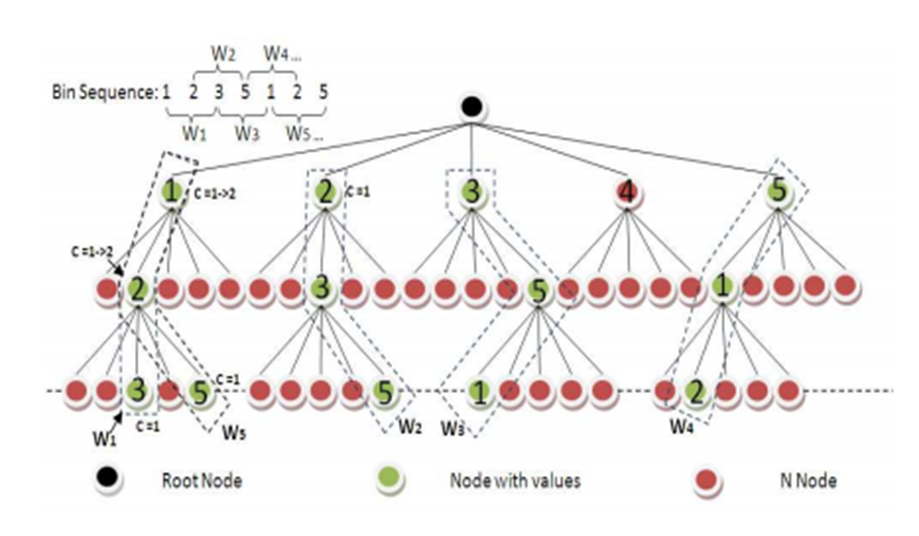
- 初始数组为1, 2, 3, 5,1,2,5,假设窗口大小为3,这必须分为5个窗口: 1,2,3,2,5,3,5,1,5,5,1,2和1,2,5。
- 接下来,查看每个窗口,我们希望找到每个长度的匹配子数组。
- 长度1的子阵列是1,2,3,5,1。有两个1s,一个是彼此的数。熵为log(2)2 + 4(log(1)*1) = 0.6。
- 长度为2的子阵列为1,2,2,3,3,5,5,1和1,2。熵与长度1相同,log(2)2 + 4(log(1)*1) = 0.6。
- 长度为3的子数组是完整的窗口: 1,2,3,2,3,3,3,5,1,5,5,1,2和1,2,5。所有五个窗口都是唯一的,因此熵为5*(log(1)*1) = 0。
- 最小熵为0,这意味着它是这个数组的条件熵。
这也可以表示为一棵树,其中每个节点的计数表示存在多少匹配。每个子阵列长度的熵等价于树的每个级别的熵。
如果可能的话,我想一次在许多数组上执行这个计算,并且并行地执行计算本身。有没有人对如何做到这一点有建议?推力有用吗?如果我需要提供更多信息,请告诉我。
回答 1
Stack Overflow用户
发布于 2015-09-04 17:05:39
我试过用推力解决你的问题。它可以工作,但它会导致大量的的推力调用。由于输入的大小相当小,所以应该并行处理多个数组。然而,这样做会导致大量的簿记工作,您将在下面的代码中看到这一点。
您的输入范围仅限于[1,5],这相当于[0,4]。一般的想法是(理论上)超出这个范围的任何元组(例如,{1,2,3}可以表示为基数4中的一个数字(例如1+2*4+3*16 = 57)。实际上,我们受到整数类型大小的限制。对于32位无符号整数,这将导致16的最大元组大小。这也是以下代码可以处理的最大窗口大小(更改为64位无符号整数将导致32的最大元组大小)。
假设输入数据的结构如下:我们要并行处理2数组,每个数组的大小为5,窗口大小为3。
{{0,0,3,4,4},{0,2,1,1,3}}我们现在可以生成所有窗口:
{{0,0,3},{0,3,4},{3,4,4}},{{0,2,1},{2,1,1},{1,1,3}}使用每元组前缀和,并将上述每个元组表示为单个基-4数,我们得到:
{{0,0,48},{0,12,76},{3,19,83}},{{0,8,24},{2,6,22},{1,5,53}}现在,我们重新排序这些值,这样我们就有了代表一个特定长度的子数组的数字:
{{0,0,3},{0,12,19},{48,76,83}},{0,2,1},{8,6,5},{24,22,53}}然后我们在每一组中进行排序:
{{0,0,3},{0,12,19},{48,76,83}},{0,1,2},{5,6,8},{22,24,53}}现在,我们可以计算每个组中数字发生的频率:
2,1,1,1,1,1,1,1,1,1,1,1,1,1,1,1,1将日志公式结果应用到
0.60206,0,0,0,0,0现在,我们获取每个数组的最小值:
0,0#include <thrust/device_vector.h>
#include <thrust/copy.h>
#include <thrust/transform.h>
#include <thrust/iterator/counting_iterator.h>
#include <thrust/iterator/zip_iterator.h>
#include <thrust/functional.h>
#include <thrust/random.h>
#include <iostream>
#include <thrust/tuple.h>
#include <thrust/reduce.h>
#include <thrust/scan.h>
#include <thrust/gather.h>
#include <thrust/sort.h>
#include <math.h>
#include <chrono>
#ifdef PRINT_ENABLED
#define PRINTER(name) print(#name, (name))
#else
#define PRINTER(name)
#endif
template <template <typename...> class V, typename T, typename ...Args>
void print(const char* name, const V<T,Args...> & v)
{
std::cout << name << ":\t";
thrust::copy(v.begin(), v.end(), std::ostream_iterator<T>(std::cout, "\t"));
std::cout << std::endl;
}
template <typename Integer, Integer Min, Integer Max>
struct random_filler
{
__device__
Integer operator()(std::size_t index) const
{
thrust::default_random_engine rng;
thrust::uniform_int_distribution<Integer> dist(Min, Max);
rng.discard(index);
return dist(rng);
}
};
template <std::size_t ArraySize,
std::size_t ArrayCount,
std::size_t WindowSize,
typename T,
std::size_t WindowCount = ArraySize - (WindowSize-1),
std::size_t PerArrayCount = WindowSize * WindowCount>
__device__ __inline__
thrust::tuple<T,T,T,T> calc_indices(const T& i0)
{
const T i1 = i0 / PerArrayCount;
const T i2 = i0 % PerArrayCount;
const T i3 = i2 / WindowSize;
const T i4 = i2 % WindowSize;
return thrust::make_tuple(i1,i2,i3,i4);
}
template <typename Iterator,
std::size_t ArraySize,
std::size_t ArrayCount,
std::size_t WindowSize,
std::size_t WindowCount = ArraySize - (WindowSize-1),
std::size_t PerArrayCount = WindowSize * WindowCount,
std::size_t TotalCount = PerArrayCount * ArrayCount
>
class sliding_window
{
public:
typedef typename thrust::iterator_difference<Iterator>::type difference_type;
struct window_functor : public thrust::unary_function<difference_type,difference_type>
{
__host__ __device__
difference_type operator()(const difference_type& i0) const
{
auto t = calc_indices<ArraySize, ArrayCount,WindowSize>(i0);
return thrust::get<0>(t) * ArraySize + thrust::get<2>(t) + thrust::get<3>(t);
}
};
typedef typename thrust::counting_iterator<difference_type> CountingIterator;
typedef typename thrust::transform_iterator<window_functor, CountingIterator> TransformIterator;
typedef typename thrust::permutation_iterator<Iterator,TransformIterator> PermutationIterator;
typedef PermutationIterator iterator;
sliding_window(Iterator first) : first(first){}
iterator begin(void) const
{
return PermutationIterator(first, TransformIterator(CountingIterator(0), window_functor()));
}
iterator end(void) const
{
return begin() + TotalCount;
}
protected:
Iterator first;
};
template <std::size_t ArraySize,
std::size_t ArrayCount,
std::size_t WindowSize,
typename Iterator>
sliding_window<Iterator, ArraySize, ArrayCount, WindowSize>
make_sliding_window(Iterator first)
{
return sliding_window<Iterator, ArraySize, ArrayCount, WindowSize>(first);
}
template <typename KeyType,
std::size_t ArraySize,
std::size_t ArrayCount,
std::size_t WindowSize>
struct key_generator : thrust::unary_function<KeyType, thrust::tuple<KeyType,KeyType> >
{
__device__
thrust::tuple<KeyType,KeyType> operator()(std::size_t i0) const
{
auto t = calc_indices<ArraySize, ArrayCount,WindowSize>(i0);
return thrust::make_tuple(thrust::get<0>(t),thrust::get<2>(t));
}
};
template <typename Integer,
std::size_t Base,
std::size_t ArraySize,
std::size_t ArrayCount,
std::size_t WindowSize>
struct base_n : thrust::unary_function<thrust::tuple<Integer, Integer>, Integer>
{
__host__ __device__
Integer operator()(const thrust::tuple<Integer, Integer> t) const
{
const auto i = calc_indices<ArraySize, ArrayCount, WindowSize>(thrust::get<0>(t));
// ipow could be optimized by precomputing a lookup table at compile time
const auto result = thrust::get<1>(t)*ipow(Base, thrust::get<3>(i));
return result;
}
// taken from http://stackoverflow.com/a/101613/678093
__host__ __device__ __inline__
Integer ipow(Integer base, Integer exp) const
{
Integer result = 1;
while (exp)
{
if (exp & 1)
result *= base;
exp >>= 1;
base *= base;
}
return result;
}
};
template <std::size_t ArraySize,
std::size_t ArrayCount,
std::size_t WindowSize,
typename T,
std::size_t WindowCount = ArraySize - (WindowSize-1),
std::size_t PerArrayCount = WindowSize * WindowCount>
__device__ __inline__
thrust::tuple<T,T,T,T> calc_sort_indices(const T& i0)
{
const T i1 = i0 % PerArrayCount;
const T i2 = i0 / PerArrayCount;
const T i3 = i1 % WindowCount;
const T i4 = i1 / WindowCount;
return thrust::make_tuple(i1,i2,i3,i4);
}
template <typename Integer,
std::size_t ArraySize,
std::size_t ArrayCount,
std::size_t WindowSize,
std::size_t WindowCount = ArraySize - (WindowSize-1),
std::size_t PerArrayCount = WindowSize * WindowCount>
struct pre_sort : thrust::unary_function<Integer, Integer>
{
__device__
Integer operator()(Integer i0) const
{
auto t = calc_sort_indices<ArraySize, ArrayCount,WindowSize>(i0);
const Integer i_result = ( thrust::get<2>(t) * WindowSize + thrust::get<3>(t) ) + thrust::get<1>(t) * PerArrayCount;
return i_result;
}
};
template <typename Integer,
std::size_t ArraySize,
std::size_t ArrayCount,
std::size_t WindowSize,
std::size_t WindowCount = ArraySize - (WindowSize-1),
std::size_t PerArrayCount = WindowSize * WindowCount>
struct generate_sort_keys : thrust::unary_function<Integer, Integer>
{
__device__
thrust::tuple<Integer,Integer> operator()(Integer i0) const
{
auto t = calc_sort_indices<ArraySize, ArrayCount,WindowSize>(i0);
return thrust::make_tuple( thrust::get<1>(t), thrust::get<3>(t));
}
};
template<typename... Iterators>
__host__ __device__
thrust::zip_iterator<thrust::tuple<Iterators...>> zip(Iterators... its)
{
return thrust::make_zip_iterator(thrust::make_tuple(its...));
}
struct calculate_log : thrust::unary_function<std::size_t, float>
{
__host__ __device__
float operator()(std::size_t i) const
{
return i*log10f(i);
}
};
int main()
{
typedef int Integer;
typedef float Real;
const std::size_t array_count = ARRAY_COUNT;
const std::size_t array_size = ARRAY_SIZE;
const std::size_t window_size = WINDOW_SIZE;
const std::size_t window_count = array_size - (window_size-1);
const std::size_t input_size = array_count * array_size;
const std::size_t base = 4;
thrust::device_vector<Integer> input_arrays(input_size);
thrust::counting_iterator<Integer> counting_it(0);
thrust::transform(counting_it,
counting_it + input_size,
input_arrays.begin(),
random_filler<Integer,0,base>());
PRINTER(input_arrays);
const int runs = 100;
auto start = std::chrono::high_resolution_clock::now();
for (int k = 0 ; k < runs; ++k)
{
auto sw = make_sliding_window<array_size, array_count, window_size>(input_arrays.begin());
const std::size_t total_count = window_size * window_count * array_count;
thrust::device_vector<Integer> result(total_count);
thrust::copy(sw.begin(), sw.end(), result.begin());
PRINTER(result);
auto ti_begin = thrust::make_transform_iterator(counting_it, key_generator<Integer, array_size, array_count, window_size>());
auto base_4_ti = thrust::make_transform_iterator(zip(counting_it, sw.begin()), base_n<Integer, base, array_size, array_count, window_size>());
thrust::inclusive_scan_by_key(ti_begin, ti_begin+total_count, base_4_ti, result.begin());
PRINTER(result);
thrust::device_vector<Integer> result_2(total_count);
auto ti_pre_sort = thrust::make_transform_iterator(counting_it, pre_sort<Integer, array_size, array_count, window_size>());
thrust::gather(ti_pre_sort,
ti_pre_sort+total_count,
result.begin(),
result_2.begin());
PRINTER(result_2);
thrust::device_vector<Integer> sort_keys_1(total_count);
thrust::device_vector<Integer> sort_keys_2(total_count);
auto zip_begin = zip(sort_keys_1.begin(),sort_keys_2.begin());
thrust::transform(counting_it,
counting_it+total_count,
zip_begin,
generate_sort_keys<Integer, array_size, array_count, window_size>());
thrust::stable_sort_by_key(result_2.begin(), result_2.end(), zip_begin);
thrust::stable_sort_by_key(zip_begin, zip_begin+total_count, result_2.begin());
PRINTER(result_2);
thrust::device_vector<Integer> key_counts(total_count);
thrust::device_vector<Integer> sort_keys_1_reduced(total_count);
thrust::device_vector<Integer> sort_keys_2_reduced(total_count);
// count how often each sub array occurs
auto zip_count_begin = zip(sort_keys_1.begin(), sort_keys_2.begin(), result_2.begin());
auto new_end = thrust::reduce_by_key(zip_count_begin,
zip_count_begin + total_count,
thrust::constant_iterator<Integer>(1),
zip(sort_keys_1_reduced.begin(), sort_keys_2_reduced.begin(), thrust::make_discard_iterator()),
key_counts.begin()
);
std::size_t new_size = new_end.second - key_counts.begin();
key_counts.resize(new_size);
sort_keys_1_reduced.resize(new_size);
sort_keys_2_reduced.resize(new_size);
PRINTER(key_counts);
PRINTER(sort_keys_1_reduced);
PRINTER(sort_keys_2_reduced);
auto log_ti = thrust::make_transform_iterator (key_counts.begin(), calculate_log());
thrust::device_vector<Real> log_result(new_size);
auto zip_keys_reduced_begin = zip(sort_keys_1_reduced.begin(), sort_keys_2_reduced.begin());
auto log_end = thrust::reduce_by_key(zip_keys_reduced_begin,
zip_keys_reduced_begin + new_size,
log_ti,
zip(sort_keys_1.begin(),thrust::make_discard_iterator()),
log_result.begin()
);
std::size_t final_size = log_end.second - log_result.begin();
log_result.resize(final_size);
sort_keys_1.resize(final_size);
PRINTER(log_result);
thrust::device_vector<Real> final_result(final_size);
auto final_end = thrust::reduce_by_key(sort_keys_1.begin(),
sort_keys_1.begin() + final_size,
log_result.begin(),
thrust::make_discard_iterator(),
final_result.begin(),
thrust::equal_to<Integer>(),
thrust::minimum<Real>()
);
final_result.resize(final_end.second-final_result.begin());
PRINTER(final_result);
}
auto duration = std::chrono::duration_cast<std::chrono::milliseconds>(std::chrono::high_resolution_clock::now() - start);
std::cout << "took " << duration.count()/runs << "milliseconds" << std::endl;
return 0;
}使用编译
nvcc -std=c++11 conditional_entropy.cu -o benchmark -DARRAY_SIZE=1000 -DARRAY_COUNT=1000 -DWINDOW_SIZE=10 && ./benchmark这个配置在我的GPU (GTX 680)上需要133毫秒,所以每个数组大约需要0.1毫秒。
实现肯定是可以优化的,例如,对基-4转换使用一个预先计算的查找表,也许可以避免一些推力调用。
https://stackoverflow.com/questions/32386014
复制相似问题
腾讯云开发者

Copyright © 2013 - 2026 Tencent Cloud. All Rights Reserved. 腾讯云 版权所有
深圳市腾讯计算机系统有限公司 ICP备案/许可证号:粤B2-20090059  粤公网安备44030502008569号
腾讯云计算(北京)有限责任公司 京ICP证150476号 | 京ICP备11018762号