
图分析:识别循环路径
我有一个无向图,如:
import igraph as ig
G = ig.Graph()
G.add_vertices(9)
G.add_edges([(0,1), (1,2),(2,3),(3,0),(0,4),(4,5),(5,6),(6,7),(6,8)])
从节点0到1,2,3返回到0有一个“循环路径”(抱歉,图中的节点标记以1而不是0开头)。
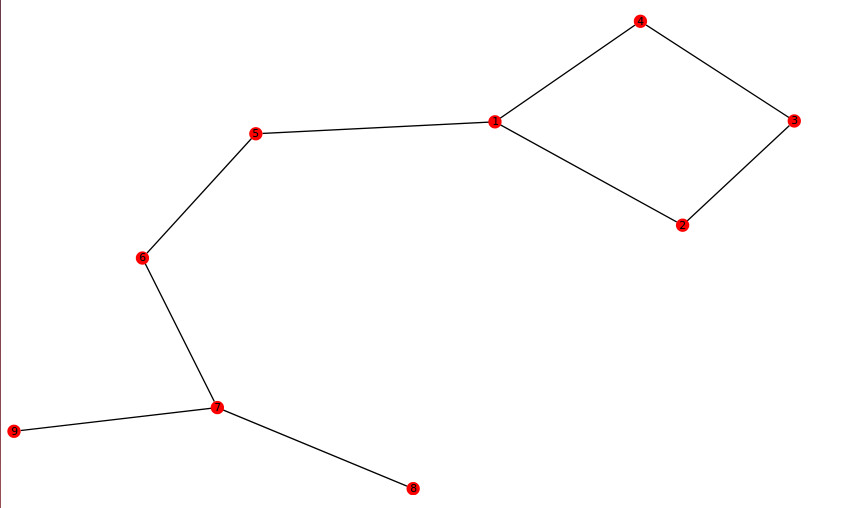
对于赋值,我需要标识“循环路径”连接到图的其余部分的节点,即0,最重要的是,“循环路径”本身,即[0,1,2,3,0]和/或[0,3,2,1,0]。
我正在努力,但真的毫无头绪。如果我像这里一样使用来自find_all_paths(G,0,0)的函数,我当然只能得到[0]
回答 4
Stack Overflow用户
发布于 2015-06-26 09:18:31
好的,这是我自己问题的答案之一:
多亏了马克斯李和深烯‘的帮助,我有了在python_igraph中重写基函数以便工作的想法:
import igraph as ig
G = ig.Graph()
G.add_vertices(9)
G.add_edges([(0,1), (1,2),(2,3),(3,0),(0,4),(4,5),(5,6),(6,7),(6,8)])

def cycle_basis_ig(G,root=None):
gnodes=set(n.index for n in G.vs())
cycles=[]
while gnodes:  # loop over connected components
    if root is None:
        root=gnodes.pop()
    stack=[root]
    pred={root:root}
    used={root:set()}
    while stack:  # walk the spanning tree finding cycles
        z=stack.pop() # use last-in so cycles easier to find
        zused=used[z]
        for nbr in G.neighbors(z,mode='ALL'):
            if nbr not in used:   # new node
                pred[nbr]=z
                stack.append(nbr)
                used[nbr]=set([z])
            elif nbr is z:        # self loops
                cycles.append([z])
            elif nbr not in zused:# found a cycle
                pn=used[nbr]
                cycle=[nbr,z]
                p=pred[z]
                while p not in pn:
                    cycle.append(p)
                    p=pred[p]
                cycle.append(p)
                cycles.append(cycle)
                used[nbr].add(z)
    gnodes-=set(pred)
    root=None
return cycles


cb = cycle_basis_ig(G)
print 'cycle_basis_ig: ', cbStack Overflow用户
发布于 2015-06-25 21:19:35
因为这个问题也是用networkx标记的,所以我用它来举例说明代码。
在图论中,“循环路径”通常称为循环。
我看到的最简单(可能不是最快的)想法是找到循环和交点集(或切割顶点,即增加连通部件数量的点),然后它们的交集就是解决方案。
在同样的基础上开始:
import networkx as nx
G.add_nodes_from([9])
G.add_edges_from([(0,1), (1,2),(2,3),(3,0),(0,4),(4,5),(5,6),(6,7),(6,8)])
现在问题的解决办法是:
cycles = nx.cycle_basis(G) # list of cycles
cuts = list(nx.articulation_points(G)) # list of cut verteces
nodes_needed = set() # the set of nodes we are looking for
for cycle in cycles:
    for node in cycle:
        if node in cuts:
nodes_needed.add(node)Stack Overflow用户
发布于 2015-06-25 22:36:47
下面是一个用宽度优先搜索寻找循环的例子。我想知道是否有更有效的方法。即使是中等大的图形,或者更长的最大循环长度,这也可能会持续很长时间。深度优先搜索也可以这样做。首先,我相信您使用R发布了这个问题,所以下面也可以找到R版本。由于同样的原因,python版本并不完全是pythonic的,因为我很快就从R翻译过来了。有关解释,请参见代码中的注释。
import igraph

# creating a toy graph
g = igraph.Graph.Erdos_Renyi(n = 100, p = 0.04)

# breadth first search of paths and unique loops
def get_loops(adj, paths, maxlen):
    # tracking the actual path length:
    maxlen -= 1
    nxt_paths = []
    # iterating over all paths:
    for path in paths['paths']:
        # iterating neighbors of the last vertex in the path:
        for nxt in adj[path[-1]]:
            # attaching the next vertex to the path:
            nxt_path = path + [nxt]
            if path[0] == nxt and min(path) == nxt:
                # the next vertex is the starting vertex, we found a loop
                # we keep the loop only if the starting vertex has the
                # lowest vertex id, to avoid having the same loops
                # more than once
                paths['loops'].append(nxt_path)
                # if you don't need the starting vertex
                # included at the end:
                # paths$loops <- c(paths$loops, list(path))
            elif nxt not in path:
                # keep the path only if we don't create
                # an internal loop in the path
                nxt_paths.append(nxt_path)
    # paths grown by one step:
    paths['paths'] = nxt_paths
    if maxlen == 0:
        # the final return when maximum search length reached
        return paths
    else:
        # recursive return, to grow paths further
        return get_loops(adj, paths, maxlen)

adj = []
loops = []
# the maximum length to limit computation time on large graphs
# maximum could be vcount(graph), but that might take for ages
maxlen = 4

# creating an adjacency list
# for directed graphs use the 'mode' argument of neighbors()
# according to your needs ('in', 'out' or 'all')
adj = [[n.index for n in v.neighbors()] for v in g.vs]

# recursive search of loops
# for each vertex as candidate starting point
for start in xrange(g.vcount()):
    loops += get_loops(adj,
{'paths': [[start]], 'loops': []}, maxlen)['loops']在R中相同
require(igraph)

# creating a toy graph
g <- erdos.renyi.game(n = 100, p.or.m = 0.04)

# breadth first search of paths and unique loops
get_loops <- function(adj, paths, maxlen){
    # tracking the actual path length:
    maxlen <- maxlen - 1
    nxt_paths <- list()
    # iterating over all paths:
    for(path in paths$paths){
        # iterating neighbors of the last vertex in the path:
        for(nxt in adj[[path[length(path)]]]){
            # attaching the next vertex to the path:
            nxt_path <- c(path, nxt)
            if(path[1] == nxt & min(path) == nxt){
                # the next vertex is the starting vertex, we found a loop
                # we keep the loop only if the starting vertex has the
                # lowest vertex id, to avoid having the same loops
                # more than once
                paths$loops <- c(paths$loops, list(nxt_path))
                # if you don't need the starting vertex included
                # at the end:
                # paths$loops <- c(paths$loops, list(path))
            }else if(!(nxt %in% path)){
                # keep the path only if we don't create
                # an internal loop in the path
                nxt_paths <- c(nxt_paths, list(nxt_path))
            }
        }
    }
    # paths grown by one step:
    paths$paths <- nxt_paths
    if(maxlen == 0){
        # the final return when maximum search length reached
        return(paths)
    }else{
        # recursive return, to grow paths further
        return(get_loops(adj, paths, maxlen))
    }
}

adj <- list()
loops <- list()
# the maximum length to limit computation time on large graphs
# maximum could be vcount(graph), but that might take for ages
maxlen <- 4

# creating an adjacency list
for(v in V(g)){
    # for directed graphs use the 'mode' argument of neighbors()
    # according to your needs ('in', 'out' or 'all')
    adj[[as.numeric(v)]] <- neighbors(g, v)
}

# recursive search of loops
# for each vertex as candidate starting point
for(start in seq(length(adj))){
    loops <- c(loops, get_loops(adj, list(paths = list(c(start)),
        loops = list()), maxlen)$loops)
}https://stackoverflow.com/questions/31034730
复制相似问题
腾讯云开发者

Copyright © 2013 - 2026 Tencent Cloud. All Rights Reserved. 腾讯云 版权所有
深圳市腾讯计算机系统有限公司 ICP备案/许可证号:粤B2-20090059  粤公网安备44030502008569号
腾讯云计算(北京)有限责任公司 京ICP证150476号 | 京ICP备11018762号