
零膨胀泊松模型不适合
以下是数据和设置:
library(fitdistrplus)
library(gamlss)

finalVector <- dput(finalVector)
c(0, 0, 0, 0, 0, 0, 0, 0, 0, 0, 0, 0, 0, 0, 0, 0, 0, 0, 0, 0,
0, 0, 0, 0, 0, 0, 0, 0, 0, 0, 0, 0, 0, 0, 0, 0, 0, 0, 0, 0, 0,
0, 0, 0, 0, 0, 0, 0, 0, 0, 0, 0, 0, 0, 0, 0, 0, 0, 0, 0, 0, 0,
0, 0, 0, 0, 0, 0, 0, 0, 0, 0, 0, 0, 0, 0, 0, 0, 0, 0, 0, 0, 0,
0, 0, 2, 1, 1, 1, 1, 1, 1, 1, 1, 2, 2, 2, 1, 2, 1, 1, 1, 1, 1,
1, 1, 2, 1, 1, 2, 1, 1, 1, 1, 2, 1, 3, 2, 1, 1, 1, 1, 1, 1, 2,
2, 1, 4, 2, 3, 1, 2, 3, 1, 1, 1, 1, 1, 1, 1, 1, 1, 1, 1, 1, 1,
2, 1, 2, 2, 1, 1, 4, 1, 2, 2, 1, 1, 1, 1, 1, 2, 1, 1, 2, 2, 1,
2, 1, 1, 4, 2, 2, 1, 1, 2, 1, 1, 1, 1, 1, 1)

countFitPoisson <- fitdist(finalVector,"pois",  method = "mle", lower = 0)
countFitZeroPoisson <- fitdist(finalVector, 'ZIP', start = list( ##mu  = mean of poisson, sigma = prob(x = 0))
                                                           mu = as.numeric(countFitPoisson$estimate),
                                                            sigma = as.numeric(as.numeric(countFitPoisson$estimate))
                                                          ), method = "mle", lower= 0)
第一次调用成功。决赛说没能估计,我不知道原因。谢谢!
编辑:
假设我正确地完成了代码(不确定),那么我唯一能想到的就是没有足够的零来适应模型?
回答 1
Stack Overflow用户
发布于 2015-06-25 07:30:04
你的数据并不是零膨胀的,因此拟合模型不会导致改进.我使用的不是fitdistr方法,而是下面的glm和扩展回归模型。所有回归(子)模型只是使用一个常量(或拦截),但没有任何真正的回归者。为了实现可视化,我通过package提供的countreg包(其中包含pscl计数数据回归的后续函数)使用rootograms。
首先,让我们看看Poisson fit:
(mp <- glm(finalVector ~ 1, family = poisson))
## Call:  glm(formula = finalVector ~ 1, family = poisson)
##
## Coefficients:
## (Intercept)
##      -0.284
##
## Degrees of Freedom: 181 Total (i.e. Null);  181 Residual
## Null Deviance:      200.2
## Residual Deviance: 200.2 AIC: 418.3这相当于exp(-0.284)的拟合平均值,即约0.753。如果您比较观察到的频率和拟合的频率,这非常符合数据:
library("countreg")
rootogram(mp)
这表明,对于计数0,1,2的拟合基本上是完美的,只有3,4,5的小偏差,但这些频率无论如何都是非常低的。因此,从这一点来看,似乎没有必要对模型进行扩展。
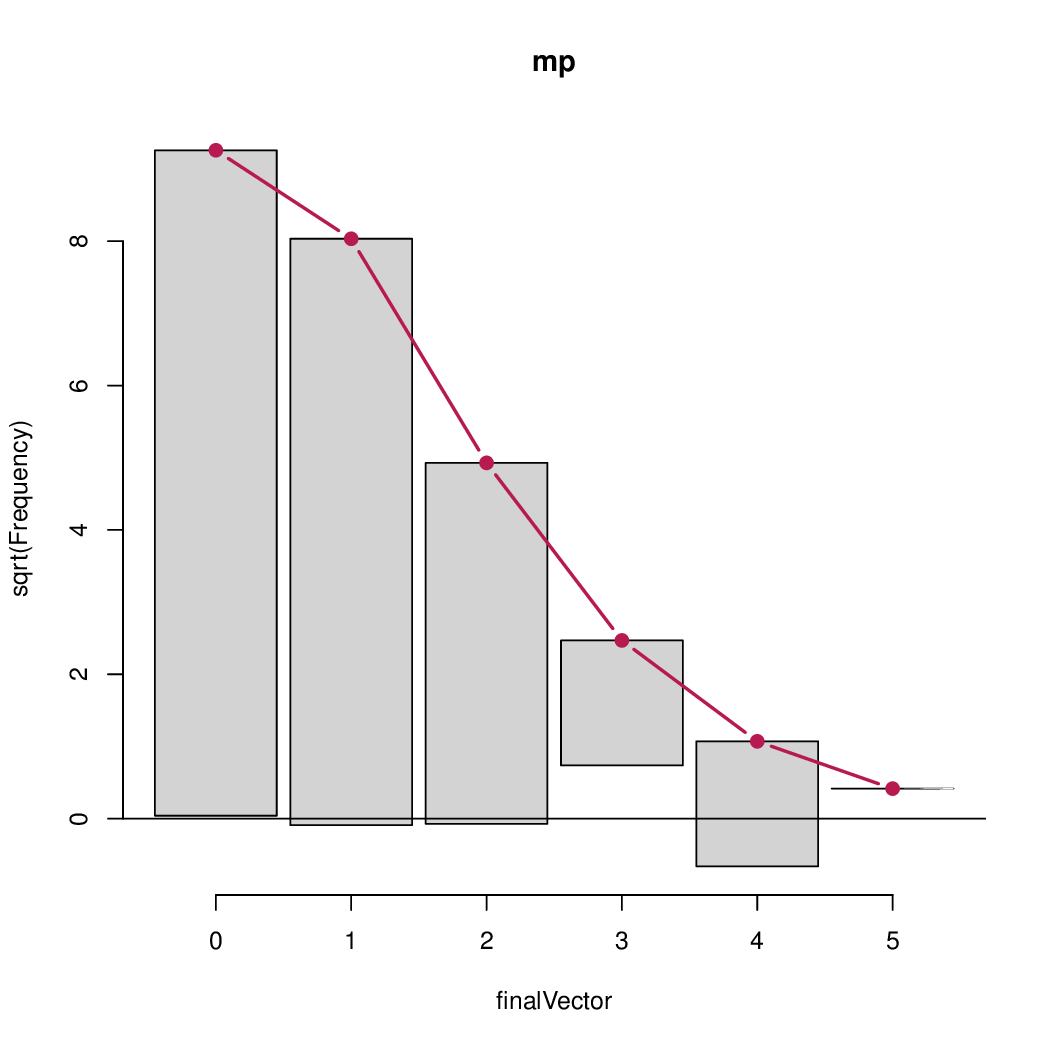
但要与其他模型进行正式比较,人们可以考虑零膨胀泊松(正如你尝试过的)一个障碍泊松或负二项式。零膨胀模型的结果是:
(mzip <- zeroinfl(finalVector ~ 1 | 1, dist = "poisson"))
## Call:
## zeroinfl(formula = finalVector ~ 1 | 1, dist = "poisson")
##
## Count model coefficients (poisson with log link):
## (Intercept)
##     -0.2839
##
## Zero-inflation model coefficients (binomial with logit link):
## (Intercept)
## -9.151 因此,计数平均数与以前基本相同,零通货膨胀的概率基本为零(plogis(-9.151)约为0.01%)。
该跨栏模型工作类似,但可以使用零删失泊松模型的0-vs-更大和截断泊松的正计数。然后,这也嵌套在Poisson模型中,因此Wald测试可以很容易地进行:
mhp <- hurdle(finalVector ~ 1 | 1, dist = "poisson", zero.dist = "poisson")
hurdletest(mhp)
## Wald test for hurdle models
##
## Restrictions:
## count_((Intercept) - zero_(Intercept) = 0
##
## Model 1: restricted model
## Model 2: finalVector ~ 1 | 1
##
##   Res.Df Df Chisq Pr(>Chisq)
## 1    181
## 2    180  1 0.036     0.8495
这也清楚地表明,没有多余的零和一个简单的泊松模型就足够了。
作为最后的检查,还可以考虑一个负二项分布模型:
(mnb <- glm.nb(finalVector ~ 1))
## Call:  glm.nb(formula = finalVector ~ 1, init.theta = 125.8922776, link = log)
##
## Coefficients:
## (Intercept)
##      -0.284
##
## Degrees of Freedom: 181 Total (i.e. Null);  181 Residual
## Null Deviance:      199.1
## Residual Deviance: 199.1        AIC: 420.3
这又是一个几乎相同的平均值和一个巨大的θ参数,足够接近无穷大(= Poisson)。因此,总的来说,Poisson模型是足够的,不需要任何考虑的扩展。可能性几乎没有变化,附加参数(零通胀、零门槛、θ-色散)也没有任何改善:
AIC(mp, mzip, mhp, mnb)
##      df      AIC
## mp    1 418.2993
## mzip  2 420.2996
## mhp   2 420.2631
## mnb 2 420.2959https://stackoverflow.com/questions/31034543
复制相似问题
腾讯云开发者

Copyright © 2013 - 2026 Tencent Cloud. All Rights Reserved. 腾讯云 版权所有
深圳市腾讯计算机系统有限公司 ICP备案/许可证号:粤B2-20090059  粤公网安备44030502008569号
腾讯云计算(北京)有限责任公司 京ICP证150476号 | 京ICP备11018762号