
XV6试图在xv6操作系统中实现三重间接方向时崩溃
最初的xv6-rev7操作系统包含:
12个定向块
1个间接blcok(指向128个区块)
也就是说我们有140个街区。
每个块的大小是512 in,==> 512* 140 = 71,680 ~= 70 in是xv6中文件大小的限制。
我希望在xv6中实现三重间接访问,以便支持大小为40 of的文件。
为了做到这一点,我需要在三重间接之前实现双间接。
所以我从我的12个街区中拿出了2个定向街区。
1为双间接,另1为三间接。
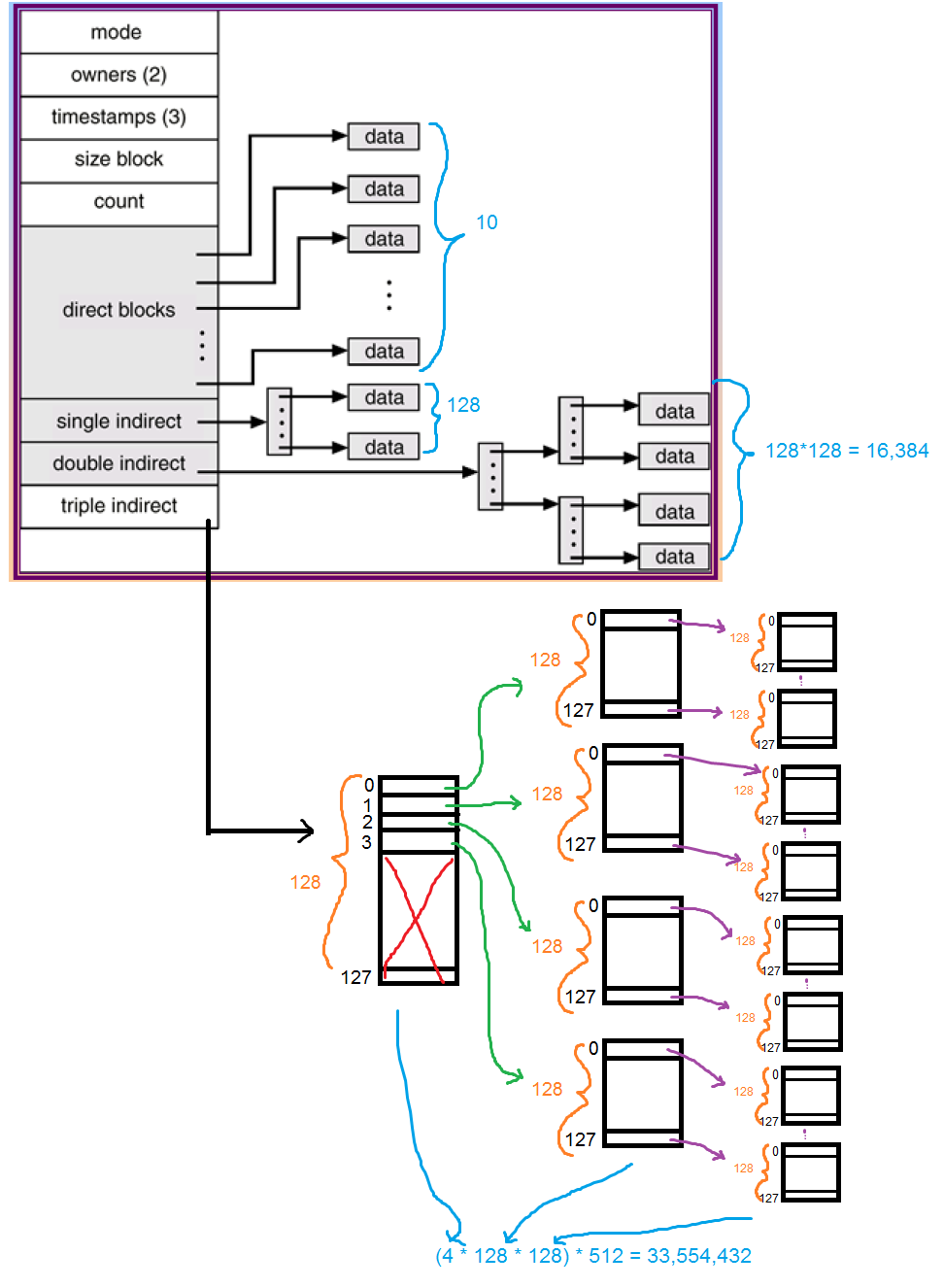
这就是我现在拥有的:
直接:10个街区
单一间接: 128
双重间接: 128*128
三重间接: 4* 128 *128 (我使用的是4而不是128,因为这足以容纳40 am )
这就是为什么#define NDIRECT 10和uint addrs[NDIRECT+3];
文件大小限制= (10 + 128 + 128*128 +4*128*128)*512 10= 42,013,696 ~= 42 10
所以我理解这个概念。三重间接的实现是在文件bmap中的fs.c函数中实现的.
这就是它的样子:
由于某些原因,当我试图创建大小为8.5MB的文件时,它会失败:

我正在使用bochs仿真器
我也不确定在mkfs.c中需要更改哪些值:
int nblocks = 20985;
int nlog = LOGSIZE;
int ninodes = 200;
int size = 21029;
fs.h:
// On-disk file system format.
// Both the kernel and user programs use this header file.

// Block 0 is unused.
// Block 1 is super block.
// Blocks 2 through sb.ninodes/IPB hold inodes.
// Then free bitmap blocks holding sb.size bits.
// Then sb.nblocks data blocks.
// Then sb.nlog log blocks.

#define ROOTINO 1  // root i-number
#define BSIZE 512  // block size

// File system super block
struct superblock {
  uint size;         // Size of file system image (blocks)
  uint nblocks;      // Number of data blocks
  uint ninodes;      // Number of inodes.
  uint nlog;         // Number of log blocks
};

#define NDIRECT 10
#define NINDIRECT (BSIZE / sizeof(uint))
#define MAXFILE (NDIRECT + NINDIRECT + NINDIRECT*NINDIRECT + 4*NINDIRECT*NINDIRECT)

// On-disk inode structure
struct dinode {
  short type;           // File type
  short major;          // Major device number (T_DEV only)
  short minor;          // Minor device number (T_DEV only)
  short nlink;          // Number of links to inode in file system
  uint size;            // Size of file (bytes)
  uint addrs[NDIRECT+3];   // Data block addresses
};

// Inodes per block.
#define IPB           (BSIZE / sizeof(struct dinode))

// Block containing inode i
#define IBLOCK(i)     ((i) / IPB + 2)

// Bitmap bits per block
#define BPB           (BSIZE*8)

// Block containing bit for block b
#define BBLOCK(b, ninodes) (b/BPB + (ninodes)/IPB + 3)

// Directory is a file containing a sequence of dirent structures.
#define DIRSIZ 14

struct dirent {
  ushort inum;
  char name[DIRSIZ];
};
fs.c:
// Return the disk block address of the nth block in inode ip.
// If there is no such block, bmap allocates one.
static uint
bmap(struct inode *ip, uint bn)
{
  uint addr, *a;
  struct buf *bp;

  if(bn < NDIRECT){
    if((addr = ip->addrs[bn]) == 0)
      ip->addrs[bn] = addr = balloc(ip->dev);
    return addr;
  }
  bn -= NDIRECT;

  if(bn < NINDIRECT){
    // Load indirect block, allocating if necessary.
    if((addr = ip->addrs[NDIRECT]) == 0)
      ip->addrs[NDIRECT] = addr = balloc(ip->dev);
    bp = bread(ip->dev, addr);
    a = (uint*)bp->data;
    if((addr = a[bn]) == 0){
      a[bn] = addr = balloc(ip->dev);
      log_write(bp);
    }
    brelse(bp);
    return addr;
  }

  /* Double indirect */
  bn -= NINDIRECT;
  if(bn < NINDIRECT*NINDIRECT){
        // Load 2nd indirect block, allocating if necessary.
        if((addr = ip->addrs[NDIRECT+1]) == 0) // 2d block. NDIRECT+1 is to get the index vector
          ip->addrs[NDIRECT+1] = addr = balloc(ip->dev);

        bp = bread(ip->dev, addr);
        a = (uint*)bp->data;
        if ((addr = a[bn/(NINDIRECT)]) == 0) { /* get index for 1st
                                                    indirection. (NINDIRECT is 128) */
              a[bn/(NINDIRECT)] = addr = balloc(ip->dev);
              log_write(bp);
          }
          brelse(bp);               /* release the double indirect table
                                       (main level) */

        bp = bread(ip->dev, addr);
        a = (uint*)bp->data;

         if ((addr = a[bn%(NINDIRECT)]) == 0) { /*  get the 2nd level table */
              a[bn%(NINDIRECT)] = addr = balloc(ip->dev);
              log_write(bp);
          }

        brelse(bp);
        return addr;
    }

   /* Triple indirect */

      bn -= NINDIRECT*NINDIRECT;
      if(bn < 4*NINDIRECT*NINDIRECT){
        // Load 3rd indirect block, allocating if necessary.
        if((addr = ip->addrs[NDIRECT+2]) == 0) // 3d block. NDIRECT+2 is to get the index vector
          ip->addrs[NDIRECT+2] = addr = balloc(ip->dev);

        bp = bread(ip->dev, addr);
        a = (uint*)bp->data;

        if ((addr = a[bn/(NINDIRECT*4)]) == 0) { /* get index for 2st
                                                    indirection. (NINDIRECT is 128) */
              a[bn/(NINDIRECT*4)] = addr = balloc(ip->dev);
              log_write(bp);
          }
          brelse(bp);

        bp = bread(ip->dev, addr);
        a = (uint*)bp->data;

        if ((addr = a[bn/(NINDIRECT*NINDIRECT*4)]) == 0) {

              a[bn/(NINDIRECT*NINDIRECT*4)] = addr = balloc(ip->dev);
              log_write(bp);
          }

          brelse(bp);


         if ((addr = a[bn%(NINDIRECT*NINDIRECT*4)]) == 0) {
              a[bn%(NINDIRECT*NINDIRECT*4)] = addr = balloc(ip->dev);
              log_write(bp);
          }

        brelse(bp);
        return addr;
    }

  panic("bmap: out of range");
}
mkfs.c:
#define stat xv6_stat  // avoid clash with host struct stat
#include "types.h"
#include "fs.h"
#include "stat.h"
#include "param.h"

int nblocks = 20985;
int nlog = LOGSIZE;
int ninodes = 200;
int size = 21029;
bigfile.c:
#include "types.h"
#include "stat.h"
#include "user.h"
#include "fcntl.h"
void
help()
{
  printf(1, "usage:\nfiles <name> <letter> <num>\n"
            "e.g. nfiles foo a 40\n creates a file foo, with 40 times the letter a\n");
}

void
num2str(int i, char str[3])
{
  str[2]=i%10+'0';
  i=i/10;
  str[1]=i%10+'0';
  i=i/10;
  str[0]=i%10+'0';
  i=i/10;
}
#define BUF_SZ 512

int
main(int argc, char *argv[])
{
    int i, count, fd, n;
    // char *name;
    // char c;
    char buf[BUF_SZ];
    if (argc !=4) {
        help();
        exit();
    }
    count = atoi(argv[3]);
    if((fd=open(argv[1], O_CREATE|O_RDWR))<0) {
        printf(2,"Failed to open file: %s\n", argv[1]);
        exit();
    }
    for (i=0; i<BUF_SZ;i++)
        buf[i]=argv[2][0];
    for (i=0; i<count/BUF_SZ;i++)
        if ((n=write(fd,buf,BUF_SZ)) != BUF_SZ)
        {
            printf(2,"Failed 1 to Write count=%d\n",i*BUF_SZ);
            exit();
        }

    for (i=0; i<count%BUF_SZ;i++)
        if ((n=write(fd,argv[2],1)) != 1)
        {
            printf(2,"Failed 2 to Write count=%d\n",count-i);
            exit();
        }

  exit();
}回答 1
Stack Overflow用户
发布于 2015-06-16 21:16:28
1.在mkfs.c中定义的n块数量不足。
int nblocks = 20985;
int nlog = LOGSIZE;
int ninodes = 200;
int size = 21029;
你的定义是:
#define MAXFILE (NDIRECT + NINDIRECT + NINDIRECT*NINDIRECT + 4*NINDIRECT*NINDIRECT它等于: 10+128+128^2+4*128^2 = 82058。
只需选择一些大于82058的nblocks,并相应地更新size。
2.在bmap()函数中,在三重间接代码中,您的第一级间接方向是一个四项数组(正如您在图表中提到的)。一旦您知道您应该访问这四个条目中的哪一个,您就返回了双重间接问题,您已经解决了这个问题。
因此,为了知道您应该访问的四个条目中的哪一个,可以使用以下命令:
if((addr = a[bn/(NINDIRECT*NINDIRECT)]) == 0){
  a[bn/(NINDIRECT*NINDIRECT)] = addr = balloc(ip->dev);
  log_write(bp);
}然后,您可以这样减少bn:
bn -= ((NINDIRECT*NINDIRECT)*(bn/(NINDIRECT*NINDIRECT)));再次解决双重间接问题。
https://stackoverflow.com/questions/30853617
复制相似问题
腾讯云开发者

Copyright © 2013 - 2026 Tencent Cloud. All Rights Reserved. 腾讯云 版权所有
深圳市腾讯计算机系统有限公司 ICP备案/许可证号:粤B2-20090059  粤公网安备44030502008569号
腾讯云计算(北京)有限责任公司 京ICP证150476号 | 京ICP备11018762号