
解耦可视化方法及其应用
这是我对此的第一个问题,所以请容忍我。
我们开发了一个收集数据的应用程序,我们有一些方法可以让我们以各种方式可视化数据。随着越来越多的方法,我们决定将应用程序和可视化方法分开。我想知道什么是实现这一目标的最佳方法。我想出了下面的代码,它试图将两者分开,但是.
有更好的方法吗?
// forward declaration
class App;

// Interface to all visualization methods
struct Methods {
    virtual void show(App * a) = 0;
};

// Some visualization method
struct Method0 : public Methods {
    void show(App * a) {
        a->getData();
    }
};

class App {
public:
    vector<Methods *> methods;

    void run() {
        // draw all registered methods
        for (auto m : methods)
            m->show(this);
    }

    int getData() {
        // parse and precompute data (time-consuming, thus do it only once)
        // return the required data (not just an int..)
        return 42;
    }
};

void main() {
    App a;

    // register some methods
    a.methods.push_back(new Method0());

    // run the application
    a.run();

    // clean up
    for (auto m : a.methods) delete(m);
}
编辑
我想亚历山大和彼特给我指明了正确的方向,谢谢。我将遵循Petr的建议,尝试将数据分离到另一个类中。
在谈到Spektre的评论时:
- 在Windows (MSVC)上开发,否则与平台无关。
- 可视化主要是静态的,基于用户输入的变化。我想每秒更新10次是刷新速率的上限。
- 数据传输时间是什么意思?
- 记忆不是问题。
数据是一组包含其他对象向量的对象向量,共5个维。
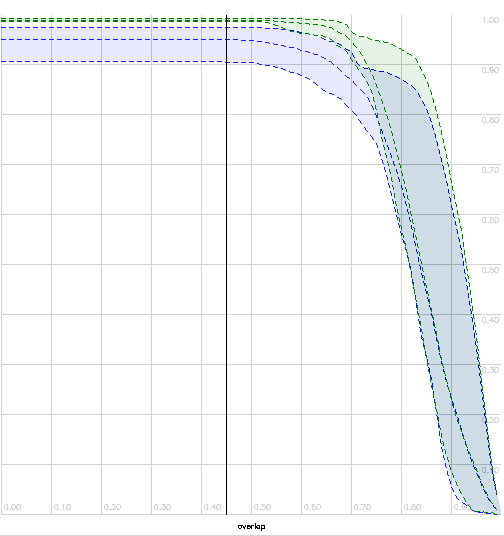
一个可视化类似于ROC曲线,包含几条曲线,因此我们需要遍历部分/所有维数并计算一些统计数据。结果如下图所示。
回答 2
Stack Overflow用户
发布于 2015-05-26 09:13:48
除了Alexander的回答之外,我要提到的是,实际上您并没有将数据和可视化完全分开。Application类仍然知道数据的内部结构和可视化方法的向量。您最好做的是有一个单独的类,比如Data,它将执行所需的所有计算,然后拥有主类(例如,App),它将处理方法的注册并将数据传递给它们。
有点像
class Data;

struct Methods {
    virtual void show(Data * a) = 0;
};

struct Method0 : public Methods {
    void show(Data * d) {
        d->getData();
    }
};

class Data {
    public:
    int getData() {
        // parse and precompute data (time-consuming, thus do it only once)
        // return the required data (not just an int..)
        return 42;
    }
}

class App {
public:
    vector<Methods *> methods;
    Data* data;

    void run() {
        // draw all registered methods
        for (auto m : methods)
            m->show(data);
    }

};Stack Overflow用户
发布于 2015-05-26 07:49:32
你那里的东西看上去已经很不错了。正如你可能已经假设的那样,你不是第一个有这种问题的人。将您的数据与可视化分离的标准解决方案称为模型视图控制器模式(MVC),它不仅将数据的表示与数据本身分离,而且还允许对数据进行简单的显示操作。
如果您只想显示您的数据,那么您可能需要查看一下观测器模式。再说一遍,你所拥有的已经非常接近这个模式了。
https://stackoverflow.com/questions/30452352
复制相似问题
腾讯云开发者

Copyright © 2013 - 2026 Tencent Cloud. All Rights Reserved. 腾讯云 版权所有
深圳市腾讯计算机系统有限公司 ICP备案/许可证号:粤B2-20090059  粤公网安备44030502008569号
腾讯云计算(北京)有限责任公司 京ICP证150476号 | 京ICP备11018762号