
请求与请求期货-响应时间不准确?
请求与请求期货-响应时间不准确?
提问于 2015-04-23 16:01:29
我有Python代码,它运行10个GET请求并测量响应时间:
from datetime import datetime
from requests_futures.sessions import FuturesSession
import requests

class CustomSession(FuturesSession):

    def __init__(self, *args, **kwargs):
        super(CustomSession, self).__init__(*args, **kwargs)
        self.timing = {}
        self.timing = {}

    def request(self, method, url, *args, **kwargs):
        background_callback = kwargs.pop('background_callback', None)
        test_id = kwargs.pop('test_id', None)

        # start counting
        self.timing[test_id] = {}
        self.timing[test_id]['cS'] = datetime.now()

        def time_it(sess, resp):
            # here if you want to time the server stuff only
            self.timing[test_id]['cE'] = datetime.now()
            if background_callback:
                background_callback(sess, resp)
            # here if you want to include any time in the callback

        return super(CustomSession, self).request(method, url, *args,
                                                  background_callback=time_it,
                                                  **kwargs)

# using requests-futures

print('requests-futures:')

session = CustomSession()

futures = []
for i in range(10):

    futures.append(session.get('http://google.com/', test_id=i))
for future in futures:
    try:
        r = future.result()
        #print((session.timing[i]['cE'] - session.timing[i]['cS']))
    except Exception as e:
        print(e)
for i in range(10):
    print((session.timing[i]['cE'] - session.timing[i]['cS']).total_seconds() * 1000)


# using requests

print('requests:')

for i in range(10):

    check_start_timestamp = datetime.utcnow()
    r = requests.get('http://google.com')
    check_end_timestamp = datetime.utcnow()
    cE = int((check_end_timestamp - check_start_timestamp).total_seconds() * 1000)
    print(cE)
请求-期货:
112.959
118.627
160.139
174.32
214.399
224.295
267.557
276.582
316.824
327.00800000000004
请求:
99
104
92
110
100
126
140
112
102
107
看来:
requests-futures的响应时间看起来是相加的(时间越来越长)- 使用普通的
requests运行速度快得多。
这是正常的吗?我是不是遗漏了什么会导致这种差异的东西?
回答 1
Stack Overflow用户
回答已采纳
发布于 2015-04-23 20:53:07
问题1
请求的响应时间-期货看起来是加性的(时间越来越大)
原因是requests_futures在幕后使用线程池。您可以看到这一点,因为计时发生在块中(为清楚起见添加的分隔符,线程数可以由max_workers参数更改):
- 默认池大小为2: 161.226 172.41600000000003 - 250.141 253.18600000000004 - 329.32800000000003 342.71000000000004 - 408.21200000000005 420.614 - 487.356 499.311
- 泳池大小为4: 149.781 154.761 151.971 155.385 -- 225.458 230.596 239.784 240.386 -- 313.801 314.056
- 图(蓝色为2,红色为4):
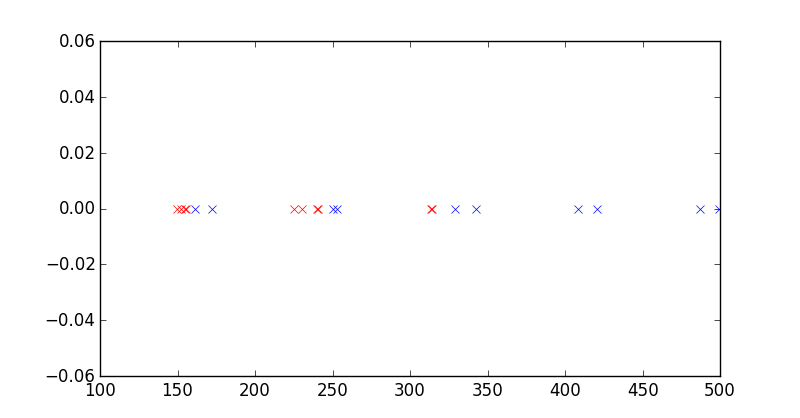
如您所见,组的间隔大致相同,这应该是一个请求的响应时间。
理论上,将池大小设置为10为您的测试提供了最佳结果,给出的结果如下:
252.977
168.379
161.689
165.44
169.238
157.929
171.77
154.089
168.283
159.23999999999998
然而,下面的效果会产生更多的效果。
问题2
使用普通请求运行得更快。
我不确定,但看看第一批请求的时间,它只有15个单位(微秒?)关了。这可能是由于:
- 线程切换由于正常的请求请求发生在与请求者相同的线程中,所以作业立即开始。对于线程池,只有当OS切换到正确的线程时才启动请求。这将导致一段时间的开销。
- 投票。期货可能使用某种形式的投票来检查结果,因此也可能会出现延迟。
未来的优势是,10次请求的总时间更短,而不是单个的时间,因此这种细微的差异并不是真正值得关注的。
页面原文内容由Stack Overflow提供。腾讯云小微IT领域专用引擎提供翻译支持
原文链接:
https://stackoverflow.com/questions/29828734
复制相关文章
相似问题
腾讯云开发者

Copyright © 2013 - 2026 Tencent Cloud. All Rights Reserved. 腾讯云 版权所有
深圳市腾讯计算机系统有限公司 ICP备案/许可证号:粤B2-20090059  粤公网安备44030502008569号
腾讯云计算(北京)有限责任公司 京ICP证150476号 | 京ICP备11018762号