
R中残差的自动基本计算
R中残差的自动基本计算
提问于 2015-03-30 09:45:57
我有一些基本的计算,我想应用在一个plm模型的剩余,但我被困在如何自动化的步骤,为大量的数据。
让我们假设输入是一个具有以下数据的data.frame (df):
Id          Year    Population  Y       X1          X2          X3
country A   2009    977612  212451.009  19482.7995  0.346657979 0.001023221
country A   2010    985332  221431.632  18989.3     0.345142551 0.001015205
country A   2011    998211  219939.296  18277.79286 0.344020453 0.001002106
country A   2012    1010001 218487.503  17916.2765  0.342434314 0.000990409
country B   2009    150291  177665.268  18444.04522 0.330864789 0.001940218
country B   2010    150841  183819.407  18042       0.327563461 0.001933143
country B   2011    152210  183761.566  17817.3515  0.32539255  0.001915756
country B   2012    153105  182825.112  17626.62261 0.321315437 0.001904557
country c   2009    83129   132328.034  17113.64268 0.359525557 0.005862866
country c   2010    83752   137413.878  16872.5     0.357854141 0.005819254
country c   2011    84493   136002.537  16576.17856 0.356479235 0.005768219
country c   2012    84958   133064.911  16443.3057  0.355246122 0.005736648
应用了一个模型,并存储了残差:
    fixed <- plm(Y ~ Y1 + X2 + X3,
           data=df, drop.unused.levels = TRUE, index=c("Id", "Year"), model="within")
residuals <- resid(fixed)
在接下来的步骤中,我想用以下方法计算残差的“加权平均值”:
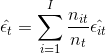
以nit代表国家I的人口,t和nt是t的总人口。
到目前为止,我的做法是:
首先,我计算了每年的新台币总人口:
year_range <- seq(from=2009,to=2012,by=1)
tot_pop = NULL
for (n in year_range)
{
  tot_pop[n] = with(df, sum(Population[Year == n]))
}
在取“加权”残差之和之前,我的下一步将是自动计算“新”残差:
res1 <- df$Population[1]/tot_pop[2009] * residuals[1]
res2 <- df$Population[2]/tot_pop[2010] * residuals[2]
res3 <- df$Population[3]/tot_pop[2011] * residuals[3]
...
res12 <- df$Population[12]/tot_pop[2011] * residuals[12]
编辑:将JTT的解决方案应用于我的问题,最后一步是:
year_range1 <- rep(year_range, 3)
df_res <- data.frame(year = year_range1, res=as.vector(res))
aggr_res <- aggregate(df_res$res, list(df_res$year), sum)
colnames(aggr_res) <- c("Year", "Aggregated residual")
对吗?
我试过了lapply函数和双“换循环”,但没有成功。我不知道该怎么做。你的帮助将不胜感激。如果我的问题不清楚,请评论,我将努力改进它。
回答 1
Stack Overflow用户
回答已采纳
发布于 2015-03-30 10:12:43
首先,您可能需要使用聚合函数来计算总人口,而不是for-循环,例如:
a<-aggregate(df$Population, list(df$Year), sum)注意(Group.1和x)的列名。
然后,您可以使用a -function将df中的结果匹配到df中的数据。它给出了匹配的行号,在与残差相乘之前,行号可以用于从df到除法的数据子集。例如:
res<-df$Population/a$x[match(df$Year, a$Group.1)]*residuals现在,您应该在对象res中有一个“新”残差的向量。
页面原文内容由Stack Overflow提供。腾讯云小微IT领域专用引擎提供翻译支持
原文链接:
https://stackoverflow.com/questions/29342993
复制相关文章
相似问题
腾讯云开发者

Copyright © 2013 - 2026 Tencent Cloud. All Rights Reserved. 腾讯云 版权所有
深圳市腾讯计算机系统有限公司 ICP备案/许可证号:粤B2-20090059  粤公网安备44030502008569号
腾讯云计算(北京)有限责任公司 京ICP证150476号 | 京ICP备11018762号