
将带有自联接的SQL转换为SPARQL
我正在尝试将SQL查询转换为SPARQL,而且我正在接近它,但我似乎无法通过SQL查询所做的自连接。
下面是SQL (Q:计算堆栈溢出用户接受的答案百分比):
SELECT
    ( Count(a.Id) / (SELECT Count(*) FROM posts WHERE OwnerUserId = 45 AND PostTypeId = 2) * 100) AS AcceptedPercentage
FROM
    posts q
  INNER JOIN
    posts a ON q.AcceptedAnswerId = a.Id
WHERE
    a.OwnerUserId = 45
  AND
    a.PostTypeId = 2;
到目前为止,我在斯派克的情况如下:
SELECT
    (count(?answers) AS ?totalAnswers)
    (count(?acceptedAnswers) AS ?totalAcceptedAnswers)
    ((count(?acceptedAnswers)/count(?answers))*100 AS ?acceptedPercentage)
WHERE {
    {
        #all answers
        ?answers a vocab:posts .

        #user 45
        ?answers vocab:posts_OwnerUserId 45 .

        #accepted answers
        ?answers vocab:posts_PostTypeId 2 .

        #set the answers id variable
        ?answers vocab:posts_Id ?answerId .

    } UNION {

        #all answers
        ?acceptedAnswers a vocab:posts .

        #user 45
        ?acceptedAnswers vocab:posts_OwnerUserId 45 .

        #is type answer
        ?acceptedAnswers vocab:posts_PostTypeId 2 .

        #accepted answer ID matches the overal ID of the question
        ?acceptedAnswers vocab:posts_AcceptedAnswerId ?acceptedAnswerId
        FILTER( ?answerId = ?acceptedAnswerId )

    }
}
以下是典型帖子中包含的数据( vocab:posts_PostTypeId=2的意思是“答案”):
vocab:posts_AcceptedAnswerId    104 -
vocab:posts_AnswerCount         11  -
vocab:posts_Body                "here's the body of the question"   -
vocab:posts_CommentCount        0   -
vocab:posts_CreationDate        "2009-04-30T07:48:06"^^xsd:dateTime -
vocab:posts_FavoriteCount       11  -
vocab:posts_Id                  3   -
vocab:posts_LastActivityDate    "2009-06-05T04:01:09"^^xsd:dateTime -
vocab:posts_LastEditDate        "2009-04-30T08:05:02"^^xsd:dateTime -
vocab:posts_LastEditorUserId    22  -
vocab:posts_OwnerUserId         22  -
vocab:posts_PostTypeId          1   -
vocab:posts_Score               21  -
vocab:posts_Tags                "<unix><package-management><server-management>" -
vocab:posts_Title               "Best practices for keeping UNIX packages up to date?"  -
vocab:posts_ViewCount           548 -
rdf:type                        vocab:posts -
rdfs:label                      "posts #3"
在SPARQL将如何执行?
回答 1
Stack Overflow用户
发布于 2015-01-23 11:46:48
一些数据
如果我们有一些要处理的样本数据,就更容易了。根据您正在使用的属性(尽管我为了可读性而稍微更改了名称),下面的一些示例数据描述了10个答案,其中6个被接受:
@prefix : <http://stackoverflow.com/q/28101179/1281433/> .

:answer0 a :Post ; :hasId 0 ; :hasOwnerUserId 45 ; :hasPostTypeId 2 . :question0 a :Post ; :hasAcceptedAnswer 0.
:answer1 a :Post ; :hasId 1 ; :hasOwnerUserId 45 ; :hasPostTypeId 2 . :question1 a :Post ; :hasAcceptedAnswer 1.
:answer2 a :Post ; :hasId 2 ; :hasOwnerUserId 45 ; :hasPostTypeId 2 . :question2 a :Post ; :hasAcceptedAnswer 2.
:answer3 a :Post ; :hasId 3 ; :hasOwnerUserId 45 ; :hasPostTypeId 2 . :question3 a :Post ; :hasAcceptedAnswer 3.
:answer4 a :Post ; :hasId 4 ; :hasOwnerUserId 45 ; :hasPostTypeId 2 . :question4 a :Post ; :hasAcceptedAnswer 4.
:answer5 a :Post ; :hasId 5 ; :hasOwnerUserId 45 ; :hasPostTypeId 2 . :question5 a :Post ; :hasAcceptedAnswer 5.
:answer6 a :Post ; :hasId 6 ; :hasOwnerUserId 45 ; :hasPostTypeId 2 . :question6 a :Post ; :hasAcceptedAnswer 96.
:answer7 a :Post ; :hasId 7 ; :hasOwnerUserId 45 ; :hasPostTypeId 2 . :question7 a :Post ; :hasAcceptedAnswer 97.
:answer8 a :Post ; :hasId 8 ; :hasOwnerUserId 45 ; :hasPostTypeId 2 . :question8 a :Post ; :hasAcceptedAnswer 98.
:answer9 a :Post ; :hasId 9 ; :hasOwnerUserId 45 ; :hasPostTypeId 2 . :question9 a :Post ; :hasAcceptedAnswer 99.
这有点精简,但是每一行都有这样的数据,一个问题和一个答案:
:answer9  a              :Post ;
        :hasId           9 ;
        :hasOwnerUserId  45 ;
        :hasPostTypeId   2 .

:question9  a               :Post ;
        :hasAcceptedAnswer  99 .
一些斯巴克尔
现在,我们可以使用这样的查询来获得我们正在寻找的结果:
prefix : <http://stackoverflow.com/q/28101179/1281433/>

select (count(?answer) as ?nanswers)
       (count(?question) as ?naccepted)
       (100*?naccepted/?nanswers as ?percentAccepted)
where {
  ?answer a :Post ;
          :hasId ?id ;
          :hasOwnerUserId 45 ;
          :hasPostTypeId 2 .
  optional {
    ?question a :Post ;
              :hasAcceptedAnswer ?id .
  }
}------------------------------------------
| nanswers | naccepted | percentAccepted |
==========================================
| 10 | 6 | 60.0 |
------------------------------------------关于SQL
值得注意的是,在SPARQL查询中,我使用了可选的选项,这样我就得到了“行”,比如:
-------------------------
| answer   | question   |
=========================
| :answer0 | :question0 |
| :answer1 | :question1 |
| :answer2 | :question2 |
| :answer3 | :question3 |
| :answer4 | :question4 |
| :answer5 | :question5 |
| :answer6 |            |
| :answer7 |            |
| :answer8 |            |
| :answer9 |            |
-------------------------实际上,这在SQL版本中也是可以做到的,只是不能使用内部联接。我发现杰夫·阿特伍德在这里很有用。你实际上是在寻找一个左加入
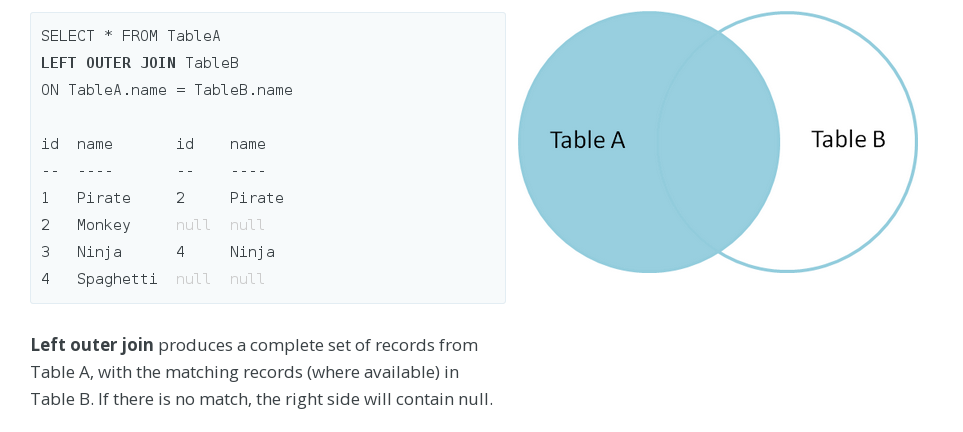
例如,在堆栈交换数据资源管理器上的此查询计算已被接受的答案的百分比(但UserId是一个参数,因此您可以很容易地更改它):
select count(a.id) as nAnswers,
       count(q.id) as nAccepted,
       100.0*count(q.id)/count(a.id) as rate
from Posts a
left outer join Posts q
     on q.AcceptedAnswerId = a.id
where a.OwnerUserId = ##UserId##
and a.PostTypeId = 2因此,我们可以逐行比较。该可选选项负责左侧的外部联接,它隐含了它所基于的变量;它是它们共有的任何变量。在这种情况下,这只是?id。
select (count(?answer) as ?nanswers)
       (count(?question) as ?naccepted)
       (100*?naccepted/?nanswers as ?percentAccepted)
where {
  ?answer a :Post ;                     #-- from Posts a
          :hasId ?id ;
          :hasOwnerUserId 45 ;          #-- where a.OwnerUserId = 45
          :hasPostTypeId 2 .            #--       and a.PostTypeId = 2
  optional {                            #-- left outer join on a.id
    ?question a :Post ;                 #-- from Posts q
              :hasAcceptedAnswer ?id .
  }
}
但是,实际上也可以翻译使用子查询的原始SQL查询。看起来会更像这样:
prefix : <http://stackoverflow.com/q/28101179/1281433/>

select ?nAnswers ?nAccepted (100*?nAccepted/?nAnswers as ?percentAccepted)
where {
  {
    select (count(?answer) as ?nAnswers) where {
      ?answer a :Post ;
             :hasId ?id ;
             :hasOwnerUserId 45 ;
             :hasPostTypeId 2 .
    }
  }
  {
    select (count(?answer) as ?nAccepted) where {
      ?answer a :Post ;
              :hasId ?id ;
              :hasOwnerUserId 45 ;
              :hasPostTypeId 2 .
      ?question a :Post ;
               :hasAcceptedAnswer ?id .
    }
  }
}------------------------------------------
| nAnswers | nAccepted | percentAccepted |
==========================================
| 10 | 6 | 60.0 |
------------------------------------------https://stackoverflow.com/questions/28101179
复制相似问题
腾讯云开发者

Copyright © 2013 - 2026 Tencent Cloud. All Rights Reserved. 腾讯云 版权所有
深圳市腾讯计算机系统有限公司 ICP备案/许可证号:粤B2-20090059  粤公网安备44030502008569号
腾讯云计算(北京)有限责任公司 京ICP证150476号 | 京ICP备11018762号