
PHP语句过滤记录
我使用PDO通过JSON将对象检索到iOS应用程序。有一个带有事件对象的数据库表。它有三个字段来存储日、月和年。数据库的所有者不希望将日期存储在日期字段中,这意味着我必须处理它。
该应用程序发送一个带有params的URL,如下所示:
http://..hidden domain./myfile.php?dia_inicio=16&dia_final=15&mes_inicio=11&mes_final=12&ano_inicio=2014&ano_final=2015这意味着我期待从2014年11月16日到2015年12月15日的活动。
这是我的PHP代码:
 $sql = 'SELECT * FROM tbagenda  WHERE  (dia_evento => :di AND mes_evento = :mi AND ano_evento = :ai) OR (dia_evento <= :df AND mes_evento = :mf AND ano_evento = :af) ';

    // use prepared statements, even if not strictly required is good practice
    $stmt = $dbh->prepare( $sql );
    $stmt->bindParam(':di', $dia_inicio, PDO::PARAM_INT);
    $stmt->bindParam(':df', $dia_final, PDO::PARAM_INT);
    $stmt->bindParam(':mi', $mes_inicio, PDO::PARAM_INT);
    $stmt->bindParam(':mf', $mes_final, PDO::PARAM_INT);
    $stmt->bindParam(':ai', $ano_inicio, PDO::PARAM_INT);
    $stmt->bindParam(':af', $ano_final, PDO::PARAM_INT);
    // execute the query
    $stmt->execute();

    // fetch the results into an array
    $result = $stmt->fetchAll( PDO::FETCH_ASSOC );

    // convert to json
    $json = json_encode( $result );

    // echo the json string
    echo $json
我应该如何改变我的声明,使之适用于这样的日期:2014年11月16日至2014年11月28日(同月)、2014年11月16日至2014年12月5日(不同月份、同年)和2014年11月16日至2015年5月2日(不同年份)?
后加:
iOS日志以显示发送到的URL:
recuperar_eventos_dia.php?dia_inicio=11&dia_final=26&mes_inicio=11&mes_final=11&ano_inicio=2014&ano_final=2014PHP部件:
$start = "$ano_inicio-$mes_inicio-$dia_inicio";
$end = "$ano_final-$mes_final-$dia_final";

// In the SQL, concatenate the columns to make a YYYY-MM-DD date string
// and cast it to a MySQL DATE type.
// That makes it possible to use BETWEEN
$sql = 'SELECT
  *
FROM tbagenda
WHERE STR_TO_DATE(CONCAT_WS('-', ano_evento, mes_evento, dia_evento), "%Y-%m-%d")
     BETWEEN :start AND :end';

// Bind and execute the statement with 2 parameters:
$stmt = $dbh->prepare( $sql );
$stmt->bindParam(':start', $start, PDO::PARAM_STR);
$stmt->bindParam(':end', $end, PDO::PARAM_STR);
$stmt->execute();

// fetch, etc...
$result = $stmt->fetchAll( PDO::FETCH_ASSOC );

        // convert to json
        $json = json_encode( $result );

        // echo the json string
        echo $json;
现在有张桌上的截图:
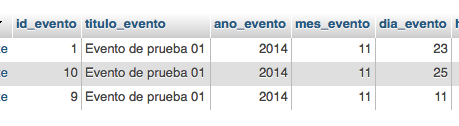
回答 1
Stack Overflow用户
发布于 2014-11-22 03:07:48
很抱歉你被这个糟糕的桌子结构困住了。
我建议将表的列连接起来,形成可用的日期字符串,并通过MySQL内置的函数STR_TO_DATE()将它们转换为日期值。对查询字符串输入值进行同样的操作,以便与BETWEEN运算符进行适当的日期比较。
// Begin by concatenating the input values into single date strings YYYY-MM-DD
$start = "$ano_inicio-$mes_inicio-$dia_inicio";
$end = "$ano_final-$mes_final-$dia_final";

// In the SQL, concatenate the columns to make a YYYY-MM-DD date string
// and cast it to a MySQL DATE type.
// That makes it possible to use BETWEEN
$sql = "SELECT *
        FROM tbagenda
        WHERE STR_TO_DATE(CONCAT_WS('-', ano_evento, mes_evento, dia_evento), '%Y-%m-%d')
          BETWEEN :start AND :end";

// Bind and execute the statement with 2 parameters:
$stmt = $dbh->prepare( $sql );
$stmt->bindParam(':start', $start, PDO::PARAM_STR);
$stmt->bindParam(':end', $end, PDO::PARAM_STR);
$stmt->execute();

// fetch, etc...
$result = $stmt->fetchAll( PDO::FETCH_ASSOC );字符串操作将影响此查询的性能。如您所知,如果将日期存储为适当的DATE,这样MySQL就不需要将它们转换为比较,这会更好。然后,它们也可以被编入索引。
还请注意,我没有包括日期字符串的验证。您可以考虑检查它们,以确保它们在执行查询之前确定了有效日期。
// strtotime() would return false for invalid date strings...
if (strtotime($start) && strtotime($end)) {
  // The dates are valid, and so you can proceed with the query
  $sql = 'SELECT.....';
}https://stackoverflow.com/questions/27073542
复制相似问题
腾讯云开发者

Copyright © 2013 - 2026 Tencent Cloud. All Rights Reserved. 腾讯云 版权所有
深圳市腾讯计算机系统有限公司 ICP备案/许可证号:粤B2-20090059  粤公网安备44030502008569号
腾讯云计算(北京)有限责任公司 京ICP证150476号 | 京ICP备11018762号