
脚手架ApplicationUser
脚手架ApplicationUser
提问于 2014-10-14 02:40:29
我使用的是带有EF 6的ASP.NET MVC 5的默认模板。
public class ApplicationUser : IdentityUser
{
    public async Task<ClaimsIdentity> GenerateUserIdentityAsync(UserManager<ApplicationUser> manager)
    {
        // Note the authenticationType must match the one defined in CookieAuthenticationOptions.AuthenticationType
        var userIdentity = await manager.CreateIdentityAsync(this, DefaultAuthenticationTypes.ApplicationCookie);
        // Add custom user claims here
        return userIdentity;
    }
}

public class ApplicationDbContext : IdentityDbContext<ApplicationUser>
{
    public ApplicationDbContext()
        : base("DefaultConnection", throwIfV1Schema: false)
    {
    }

    public static ApplicationDbContext Create()
    {
        return new ApplicationDbContext();
    }
}
我希望能够管理和编辑用户列表,因此我构建了身份模型,并在ApplicationDbContext类中添加了下面一行。
public System.Data.Entity.DbSet<QProj.Models.ApplicationUser> ApplicationUsers { get; set; }我知道这是错误的,但我不知道如何解决这个问题。
回答 2
Stack Overflow用户
发布于 2020-06-07 10:45:13
下面是我的步骤,如果您想管理AspNetUsers表,当您启用带有所有默认设置的迁移时,将为您生成该表。
- 首先使用MVC 5 controller和视图创建控制器,使用EFL
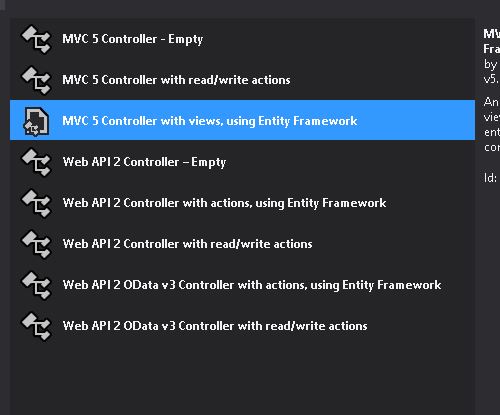
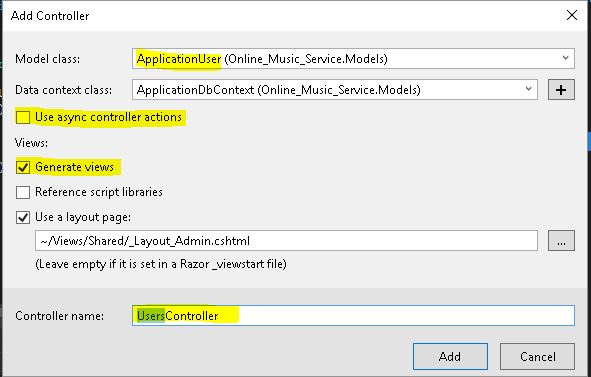
- 使用以下设置添加控制器。这里不应该选择/检查
Use async controller actions,因为UsersDbSet不支持异步,除非我们使用UserManager。这将是一个不同的话题。
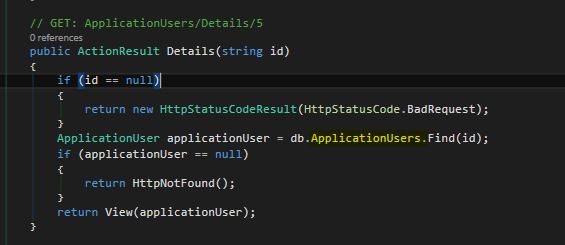
- 转到生成的控制器,将
ApplicationUsers的所有实例重命名为Users
- 最后,您现在可以安全地在
IdentityModel上删除IdentityModel(就我的情况而言,它是第37行)
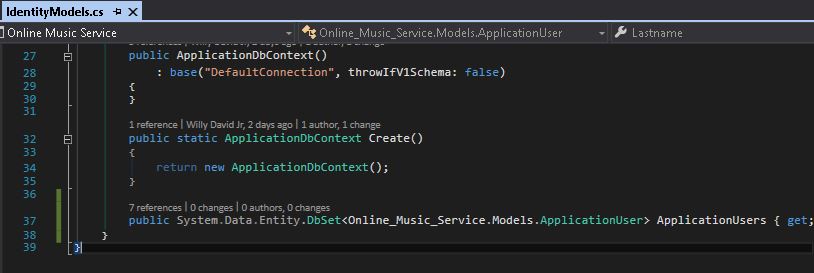
我们需要删除第37行,就像我在最后一张图片中显示的那样,因为当您运行enable-migrations时,它将无法构建。因为IdentityDbContext<T>本身已经包含了Users属性。因此,不需要在ApplicationDbContext类或您为此声明的任何类下添加额外的ApplicationDbContext。顺便说一句,这个属性是在Scaffold ApplicationUser时自动添加的。
Stack Overflow用户
发布于 2015-01-31 06:31:06
这些步骤使我成功地搭建了ApplicationUser:
- 将ApplicationUser名称重构为其他东西,比如MyAppUser,
- 使用EntityFramework添加控制器,使用MyAppUser模型,这将成功地搭建MyappUser,
- 脚手架将为
DbSet<MyAppUser> MyAppUsers创建属性ApplicationDbContext,删除它 - 在新创建的控制器中,将所有出现的
db.MyAppUsers更改为db.Users
那你就可以走了,希望这能帮上忙
页面原文内容由Stack Overflow提供。腾讯云小微IT领域专用引擎提供翻译支持
原文链接:
https://stackoverflow.com/questions/26351822
复制相关文章
相似问题
腾讯云开发者

Copyright © 2013 - 2026 Tencent Cloud. All Rights Reserved. 腾讯云 版权所有
深圳市腾讯计算机系统有限公司 ICP备案/许可证号:粤B2-20090059  粤公网安备44030502008569号
腾讯云计算(北京)有限责任公司 京ICP证150476号 | 京ICP备11018762号