
R函数用于根据更近的词的频率对单词进行校正
R函数用于根据更近的词的频率对单词进行校正
提问于 2014-09-09 19:36:33
我有一张有拼错字的桌子。我需要纠正那些使用的词更类似于那个,一个有更多的频率。
例如,在我跑完之后
aggregate(CustomerID ~ Province, ventas2, length)我得到了
1
2                     AMBA         29
    3                   BAIRES          1
    4              BENOS AIRES          1

    12            BUENAS AIRES          1

    17           BUENOS  AIRES          4
    18            buenos aires          7
    19            Buenos Aires          3
    20            BUENOS AIRES      11337
    35                 CORDOBA       2297
    36                cordoba           1
    38               CORDOBESA          1
    39              CORRIENTES        424
所以我需要用布宜诺斯艾利斯取代布宜诺斯艾利斯,布宜诺斯艾利斯,贝尔斯,布宜诺斯艾利斯,但是AMBA不应该被取代。同样,CORDOBESA和CORDOBA应该被cordoba取代,而不是CORRIENTES。
我怎样才能在R中做到这一点?
谢谢!
回答 2
Stack Overflow用户
回答已采纳
发布于 2014-09-09 21:56:40
这是一个可能的解决方案。
免责声明:
这段代码在当前示例中似乎运行得很好。我不能保证现有的参数(如切割高度、聚类聚集法、距离法等)。将对您的真实(完整)数据有效。
# recreating your data
data <-
read.csv(text=
'City,Occurr
AMBA,29
BAIRES,1
BENOS AIRES,1
BUENAS AIRES,1
BUENOS  AIRES,4
buenos aires,7
Buenos Aires,3
BUENOS AIRES,11337
CORDOBA,2297
cordoba,1
CORDOBESA,1
CORRIENTES,424',stringsAsFactors=F)


# simple pre-processing to city strings:
# - removing spaces
# - turning strings to uppercase
cities <- gsub('\\s+','',toupper(data$City))

# string distance computation
# N.B. here you can play with single components of distance costs
d <- adist(cities, costs=list(insertions=1, deletions=1, substitutions=1))
# assign original cities names to distance matrix
rownames(d) <- data$City
# clustering cities
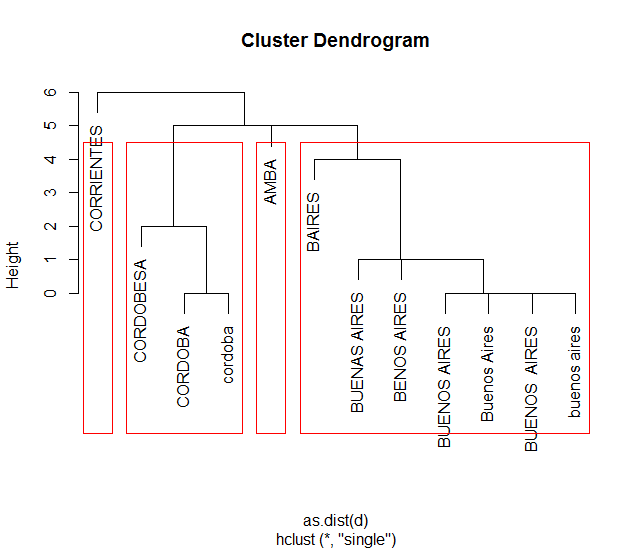
hc <- hclust(as.dist(d),method='single')

# plot the cluster dendrogram
plot(hc)
# add the cluster rectangles (just to see the clusters)
# N.B. I decided to cut at distance height < 5
#      (read it as: "I consider equal 2 strings needing
#       less than 5 modifications to pass from one to the other")
#      Obviously you can use another value.
rect.hclust(hc,h=4.9)

# get the clusters ids
clusters <- cutree(hc,h=4.9)
# turn into data.frame
clusters <- data.frame(City=names(clusters),ClusterId=clusters)

# merge with frequencies
merged <- merge(data,clusters,all.x=T,by='City')

# add CityCorrected column to the merged data.frame
ret <- by(merged,
          merged$ClusterId,
          FUN=function(grp){
                idx <- which.max(grp$Occur)
                grp$CityCorrected <- grp[idx,'City']
                return(grp)
              })

fixed <- do.call(rbind,ret)
结果:
> fixed
              City Occurr ClusterId CityCorrected
1             AMBA     29         1          AMBA
2.2         BAIRES      1         2  BUENOS AIRES
2.3    BENOS AIRES      1         2  BUENOS AIRES
2.4   BUENAS AIRES      1         2  BUENOS AIRES
2.5  BUENOS  AIRES      4         2  BUENOS AIRES
2.6   buenos aires      7         2  BUENOS AIRES
2.7   Buenos Aires      3         2  BUENOS AIRES
2.8   BUENOS AIRES  11337         2  BUENOS AIRES
3.9        cordoba      1         3       CORDOBA
3.10       CORDOBA   2297         3       CORDOBA
3.11     CORDOBESA      1         3       CORDOBA
4       CORRIENTES    424         4    CORRIENTES
集群图:
Stack Overflow用户
发布于 2014-09-09 20:04:49
下面是我对聚合结果的小复制,您将需要更改对数据帧的所有调用,以适应数据的任何结构。
df
#output
#       word freq
#1         a    1
#2         b    2
#3         c    3

#find the max frequency
mostFrequent<-max(df[,2])  #doesn't handle ties

#find the word we will be replacing with
replaceString<-df[df[,2]==mostFrequent,1]
#[1] "c"

#find all the other words to be replaced
tobereplaced<-df[df[,2]!=mostFrequent,1]
#[1] "a" "b"
现在假设您有下面的dataframe,它包含您的整个数据集,我将只复制一个带有单词的列。
totalData
 #    [,1]
 #[1,] "a"
 #[2,] "c"
 #[3,] "b"
 #[4,] "d"
 #[5,] "f"
 #[6,] "a"
 #[7,] "d"
 #[8,] "b"
 #[9,] "c"
我们可以通过以下调用,用我们想用的字符串替换所有想要替换的单词
totaldata[totaldata%in%tobereplaced]<-replaceString
 #    [,1]
 #[1,] "c"
 #[2,] "c"
 #[3,] "c"
 #[4,] "d"
 #[5,] "f"
 #[6,] "c"
 #[7,] "d"
 #[8,] "c"
 #[9,] "c"
正如你所看到的,所有的a和b都用c代替,其中其他的单词是相同的。
页面原文内容由Stack Overflow提供。腾讯云小微IT领域专用引擎提供翻译支持
原文链接:
https://stackoverflow.com/questions/25752306
复制相关文章
相似问题
腾讯云开发者

Copyright © 2013 - 2026 Tencent Cloud. All Rights Reserved. 腾讯云 版权所有
深圳市腾讯计算机系统有限公司 ICP备案/许可证号:粤B2-20090059  粤公网安备44030502008569号
腾讯云计算(北京)有限责任公司 京ICP证150476号 | 京ICP备11018762号