
MPI将多个内部通信系统合并为一个内部模型
我试着把一堆产生的过程设置成一个内模。我需要将不同的进程生成到唯一的工作目录中,因为这些子进程会写出一堆文件。在产生所有进程之后,希望将它们合并到一个内部通信器中。为了尝试这一点,我设置了一个简单的测试程序。
int main(int argc, const char * argv[]) {
    int rank, size;

    const int num_children = 5;
    int error_codes;

    MPI_Init(&argc, (char ***)&argv);

    MPI_Comm parentcomm;
    MPI_Comm childcomm;
    MPI_Comm intracomm;
    MPI_Comm_get_parent(&parentcomm);

    if (parentcomm == MPI_COMM_NULL) {
        printf("Current Command %s\n", argv[0]);

        for (size_t i = 0; i < num_children; i++) {
            MPI_Comm_spawn(argv[0], MPI_ARGV_NULL, 1, MPI_INFO_NULL, 0, MPI_COMM_WORLD, &childcomm, &error_codes);
            MPI_Intercomm_merge(childcomm, 0, &intracomm);
            MPI_Barrier(childcomm);
        }
    } else {
        MPI_Intercomm_merge(parentcomm, 1, &intracomm);
        MPI_Barrier(parentcomm);
    }

    printf("Test\n");

    MPI_Barrier(intracomm);

    printf("Test2\n");

    MPI_Comm_rank(intracomm, &rank);
    MPI_Comm_size(intracomm, &size);

    printf("Rank %d of %d\n", rank + 1, size);

    MPI_Barrier(intracomm);
    MPI_Finalize();
    return 0;
}
当我运行这个程序时,我得到了所有的6个进程,但是我的内部处理只是在父进程和最后一个子进程之间进行的。结果的输出是
Test
Test
Test
Test
Test
Test
Test2
Rank 1 of 2
Test2
Rank 2 of 2
有办法将多个通信器合并成一个通信器吗?还要注意的是,我每次都要执行这些子进程,因为我需要在一个唯一的工作目录中执行每个子进程。
回答 2
Stack Overflow用户
发布于 2014-07-17 15:55:46
如果要通过多次调用MPI_COMM_SPAWN来完成此操作,则必须更加小心。在您第一次调用SPAWN之后,生成的进程还需要参与下一次对SPAWN的调用,否则它将被排除在您要合并的通信器之外。最后看起来是这样的:
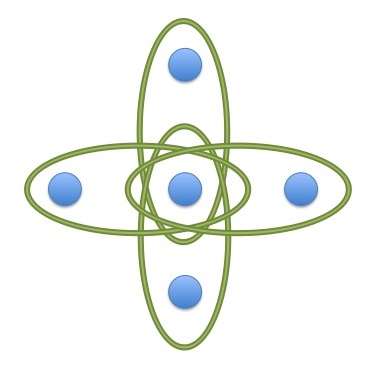
问题是,每个MPI_INTERCOMM_MERGE中只有两个进程参与,您不能合并三个通信器,因此永远不会有一个大的通信器。
如果您让每个进程按其进行的方式参与合并,那么最终您将得到一个大型的通信器:
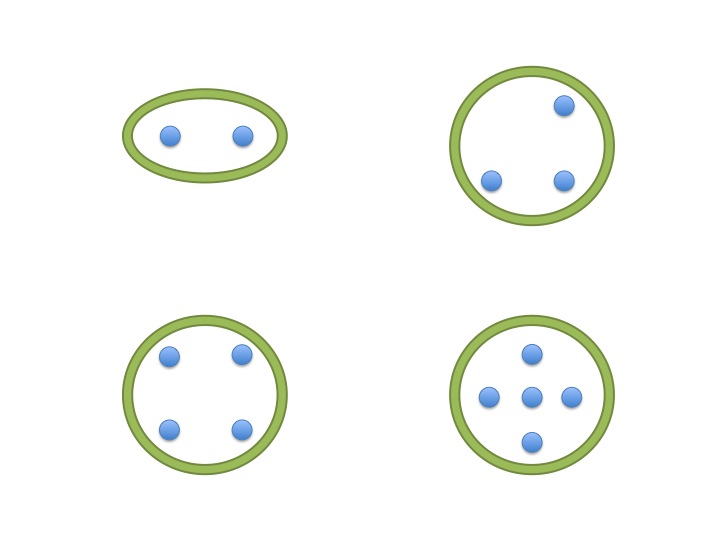
当然,您可以一次性生成所有额外的进程,但听起来您可能有其他原因不这样做。
Stack Overflow用户
发布于 2015-06-30 21:25:59
我意识到我对这个问题的回答已经过时了一年,但我想也许其他人会希望看到这个答案的实现。正如最初的被访者所说,没有办法合并三个(或更多)通信者。你得一次建立一个新的内部通讯系统。这是我使用的代码。此版本删除原始的内部通信;您可能希望或不希望这样做,具体取决于您的特定应用程序:
#include <mpi.h>


// The Borg routine: given
//   (1) a (quiesced) intra-communicator with one or more members, and
//   (2) a (quiesced) inter-communicator with exactly two members, one
//       of which is rank zero of the intra-communicator, and
//       the other of which is an unrelated spawned rank,
// return a new intra-communicator which is the union of both inputs.
//
// This is a collective operation.  All ranks of the intra-
// communicator, and the remote rank of the inter-communicator, must
// call this routine.  Ranks that are members of the intra-comm must
// supply the proper value for the "intra" argument, and MPI_COMM_NULL
// for the "inter" argument.  The remote inter-comm rank must
// supply MPI_COMM_NULL for the "intra" argument, and the proper value
// for the "inter" argument.  Rank zero (only) of the intra-comm must
// supply proper values for both arguments.
//
// N.B. It would make a certain amount of sense to split this into
// separate routines for the intra-communicator processes and the
// remote inter-communicator process.  The reason we don't do that is
// that, despite the relatively few lines of code,  what's going on here
// is really pretty complicated, and requires close coordination of the
// participating processes.  Putting all the code for all the processes
// into this one routine makes it easier to be sure everything "lines up"
// properly.
MPI_Comm
assimilateComm(MPI_Comm intra, MPI_Comm inter)
{
    MPI_Comm peer = MPI_COMM_NULL;
    MPI_Comm newInterComm = MPI_COMM_NULL;
    MPI_Comm newIntraComm = MPI_COMM_NULL;

    // The spawned rank will be the "high" rank in the new intra-comm
    int high = (MPI_COMM_NULL == intra) ? 1 : 0;

    // If this is one of the (two) ranks in the inter-comm,
    // create a new intra-comm from the inter-comm
    if (MPI_COMM_NULL != inter) {
        MPI_Intercomm_merge(inter, high, &peer);
    } else {
        peer = MPI_COMM_NULL;
    }

    // Create a new inter-comm between the pre-existing intra-comm
    // (all of it, not only rank zero), and the remote (spawned) rank,
    // using the just-created intra-comm as the peer communicator.
    int tag = 12345;
    if (MPI_COMM_NULL != intra) {
        // This task is a member of the pre-existing intra-comm
        MPI_Intercomm_create(intra, 0, peer, 1, tag, &newInterComm);
    }
    else {
        // This is the remote (spawned) task
        MPI_Intercomm_create(MPI_COMM_SELF, 0, peer, 0, tag, &newInterComm);
    }

    // Now convert this inter-comm into an intra-comm
    MPI_Intercomm_merge(newInterComm, high, &newIntraComm);


    // Clean up the intermediaries
    if (MPI_COMM_NULL != peer) MPI_Comm_free(&peer);
    MPI_Comm_free(&newInterComm);

    // Delete the original intra-comm
    if (MPI_COMM_NULL != intra) MPI_Comm_free(&intra);

    // Return the new intra-comm
    return newIntraComm;
}https://stackoverflow.com/questions/24806782
复制相似问题
腾讯云开发者

Copyright © 2013 - 2026 Tencent Cloud. All Rights Reserved. 腾讯云 版权所有
深圳市腾讯计算机系统有限公司 ICP备案/许可证号:粤B2-20090059  粤公网安备44030502008569号
腾讯云计算(北京)有限责任公司 京ICP证150476号 | 京ICP备11018762号