
如何设置延迟队列的延迟
如何设置延迟队列的延迟
提问于 2014-04-22 12:36:47
我刚开始用java编写代码,我正在努力设置一个DelayQueue,
我想这么做,
DelayQueue queue = new DelayQueue();

If (counter > 0){
queue.offer(Integer, *A custom delay*)
} Else {
queue.offer(Integer, *A different custom delay*)
}
我只是试着学习所有的基础知识,我已经阅读了API,似乎无法理解它。
提前感谢
回答 3
Stack Overflow用户
发布于 2016-12-29 13:41:12
Delayed的这种实现是很好的,因为:
compareTo()的实现不执行任何类的转换,消除了抛出ClassCastException的可能性。compareTo()的实现在转换为int之前使用Math.min和Math.max函数,以适当防止溢出错误getDelay()的实现正确地转换单元并实际返回剩余时间
TestDelay类实现Delayed
import org.jetbrains.annotations.NotNull;

import java.util.concurrent.Delayed;
import java.util.concurrent.TimeUnit;

public class TestDelay implements Delayed
{
    public final Long delayMillis;
    public final Long expireTimeMillis;

    public TestDelay(Long delayMillis)
    {
        this.delayMillis = delayMillis;
        this.expireTimeMillis = System.currentTimeMillis()+delayMillis;
    }

    @Override
    public final int compareTo(@NotNull Delayed o)
    {
        long diffMillis = getDelay(TimeUnit.MILLISECONDS)-o.getDelay(TimeUnit.MILLISECONDS);
        diffMillis = Math.min(diffMillis,1);
        diffMillis = Math.max(diffMillis,-1);
        return (int) diffMillis;
    }

    @Override
    public final long getDelay(@NotNull TimeUnit unit)
    {
        long delayMillis = expireTimeMillis-System.currentTimeMillis();
        return unit.convert(delayMillis,TimeUnit.MILLISECONDS);
    }
}JUnit单元测试展示了使用TestDelay类的示例:
import org.junit.Test;

import java.util.concurrent.DelayQueue;

public class DelayQueueTest
{
    @Test
    public final void generalTest() throws InterruptedException
    {
        DelayQueue<TestDelay> q = new DelayQueue<>();
        q.put(new TestDelay(500L));
        q.put(new TestDelay(2000L));
        q.put(new TestDelay(1000L));
        q.put(new TestDelay(10L));
        q.put(new TestDelay(3000L));
        while (!q.isEmpty())
        {
            System.out.println(q.take().delayMillis);
        }
    }
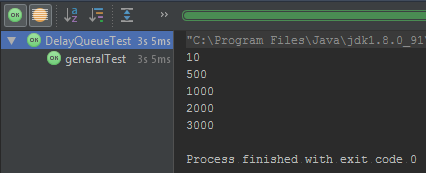
}DelayQueueTest输出
Stack Overflow用户
发布于 2015-08-03 10:33:30
import java.util.concurrent.BlockingQueue;
import java.util.concurrent.DelayQueue;
import java.util.concurrent.Delayed;
import java.util.concurrent.TimeUnit;

public class DelayQueueExample {

    public static void main(String[] args) {

        BlockingQueue<DelayedElement> blockingQueue = new DelayQueue<DelayedElement>();

        try {
            blockingQueue
                    .put(new DelayedElement(4000, "Message with delay 4s"));
            blockingQueue
                    .put(new DelayedElement(2000, "Message with delay 2s"));
            blockingQueue
                    .put(new DelayedElement(9000, "Message with delay 9s"));
        } catch (InterruptedException ie) {
        }

        while (!blockingQueue.isEmpty()) {
            try {
                System.out.println(">>" + blockingQueue.take());
            } catch (InterruptedException ie) {
            }

        }

    }
}

class DelayedElement implements Delayed {

    private long duration = 0;
    private String message;

    public DelayedElement(long duration, String name) {
        this.duration = System.currentTimeMillis() + duration;
        this.message = name;
    }

    @Override
    public int compareTo(Delayed o) {
        return (int) (this.duration - ((DelayedElement) o).getDuration());
    }

    @Override
    /*
     * Expiration occurs when an element's getDelay(TimeUnit unit) method
     * returns a value less than or equal to zero.
     */
    public long getDelay(TimeUnit unit) {
        long diff = duration - System.currentTimeMillis();
        return unit.convert(diff, TimeUnit.MILLISECONDS);
    }

    public long getDuration() {
        return duration;
    }

    public void setDuration(long duration) {
        this.duration = duration;
    }

    public String getMessage() {
        return message;
    }

    public void setMessage(String message) {
        this.message = message;
    }

    @Override
    public String toString() {
        return "DelayedElement [duration=" + duration + ", message=" + message
                + "]";
    }

}Stack Overflow用户
发布于 2014-04-22 12:44:37
您的“自定义延迟”类必须从getDelay(TimeUnit timeUnit)接口中指定的Delayed方法返回延迟。例如。
public class MyClass implements Delayed {
    public long getDelay(TimeUnit timeUnit) {
        long delay = calculateDelaySomehow();
        return delay;
    }
}注意,您还需要为compareTo()提供一个实现。
页面原文内容由Stack Overflow提供。腾讯云小微IT领域专用引擎提供翻译支持
原文链接:
https://stackoverflow.com/questions/23219801
复制相关文章
相似问题
腾讯云开发者

Copyright © 2013 - 2026 Tencent Cloud. All Rights Reserved. 腾讯云 版权所有
深圳市腾讯计算机系统有限公司 ICP备案/许可证号:粤B2-20090059  粤公网安备44030502008569号
腾讯云计算(北京)有限责任公司 京ICP证150476号 | 京ICP备11018762号