
Rails-4,对于存在的用户模型属性,CanCan返回nil:NilClass的未定义方法。
在我的应用程序中,我使用的是设计和cancan。我的seller:boolean.产品模型有一个belong_to :user,用户表有一个列belong_to所以,在我的能力类中,我有这一行product.try(:user).seller,如粘贴在问题中的create类中所示,这一行在ProductsController#create中抛出了NoMethodError,当我试图创建新产品时,未定义的方法‘So :NilClass’。但是在控制器创建动作中,用户对象是而不是nil,因为当我在错误后检查日志时,我看到从“用户”选择“user”.*。“id”= 11。
另外,在rails控制台中,如果我这样做的话:
   a = Product.find(4)
   a.user.seller  will return  => true
我的能力课
 class Ability
   include CanCan::Ability

   def initialize(user)
     user ||= User.new

     can :manage, Product do | product |
      product.try(:user_id) == user.id
      product.try(:user).seller == true
     end
   end
 end
产品总监:
class ProductsController < ApplicationController
  before_filter :authenticate_user!, except: [:index, :show]
  load_and_authorize_resource only: [:create, :edit, :destroy]
  respond_to :html, :json

  def index
    @products = Product.all
    respond_with @products
  end

  def new
    @product = Product.new
  end

  def create
    @user = User.find_by(id: current_user.id)
    @product = @user.products.build(product_params)
    @product.save
  end

end
为了使CanCan与rails 4一起工作,我的应用程序控制器
class ApplicationController < ActionController::Base
  #temprary work-around for cancan gem to work with rails-4
  #source https://github.com/ryanb/cancan/issues/835#issuecomment-18663815
  before_filter do
    resource = controller_path.singularize.gsub('/', '_').to_sym
    method = "#{resource}_params"
    params[resource] &&= send(method) if respond_to?(method, true)
  end
end
为了清晰地显示下面的截图,下面是products/index.html.erb的缩短版本。
<% @products.each do |product| %>
  <% if user_signed_in? %>
    <% if can? :update, product %>
      <span class="bottomcentre"><%= link_to 'edit', edit_product_path(product), class: "btn btn-primary"  %></span>
    <% end %>

    <% if can? :destroy, product %>
      <span class="bottomright"><%= link_to "Delete", product, data: {confirm: 'Are u sure?'}, method: :delete, class: "btn btn-danger" %></span>
    <% end %>

   <% end %><!-- closes user_signed_in -->

  <% end %>

  <br/>
  <% if user_signed_in? %>
    <% if can? :create, Product %>
      <%= link_to 'Create a new Product', new_product_path %>
    <% end %>
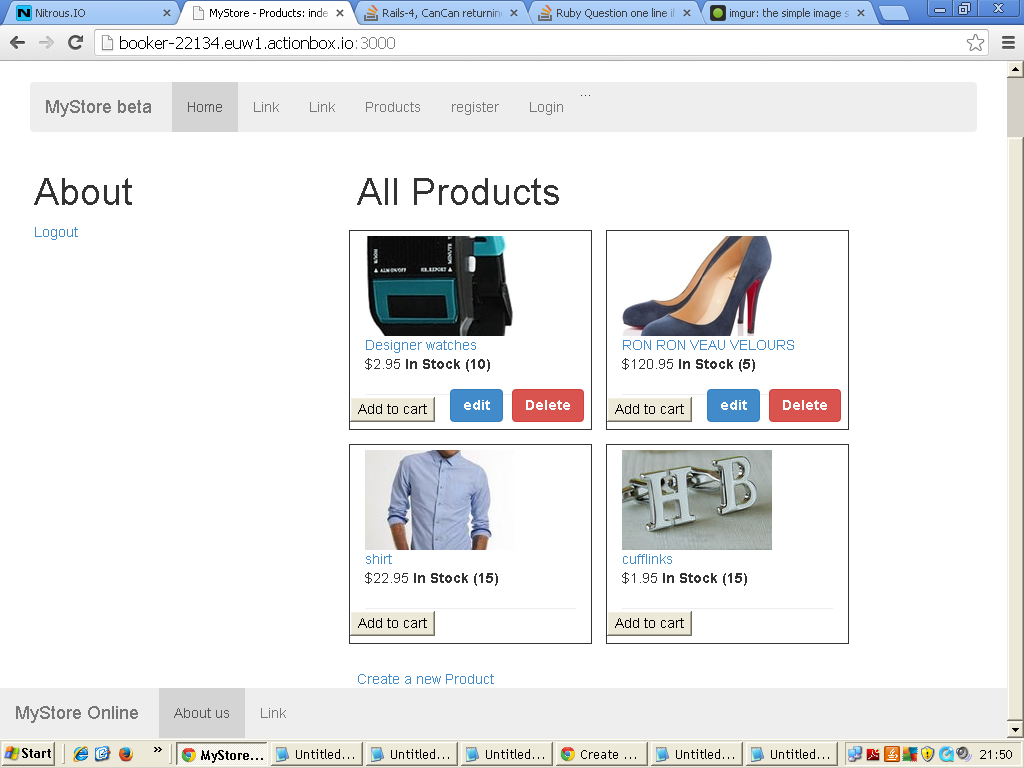
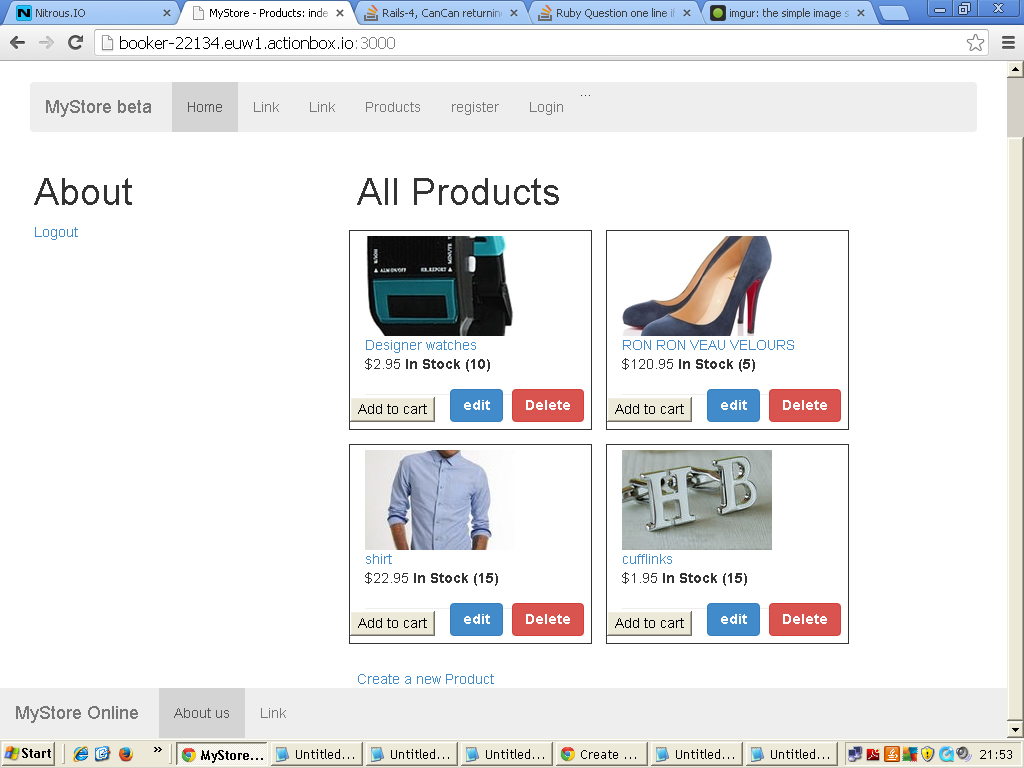
<% end %>另一个效果是,编辑和破坏链接将显示给销售者,以获取不属于他们的产品,除非我注释掉了引起错误的行,即CanCan的能力类中的product.try(:user).seller == true。所以当注释掉的时候,我得到了这个屏幕截图1,里面隐藏着隐藏在产品上的链接,而当没有注释的时候,你会得到屏幕截图2,所有的产品编辑链接都会显示给销售者,即使产品不是他们的。
屏幕截图1与product.try(:user).seller ==真正的在CanCan能力类中注释掉,它只显示了属于signed_in卖家的前两个产品的编辑链接
截图2与product.try(:user).seller ==真正的在CanCan能力类中完好无损。参见编辑链接正在显示的较低的产品,即,恤,和袖口链接,他们不属于signed_in卖家。
回答 1
Stack Overflow用户
发布于 2013-09-10 21:10:21
您的can :manage块定义稍有错误。是块的返回值决定了用户是否具有这种能力。在您的块中,您有两个语句,其中只有第二个语句对用户是否有能力有任何影响。您需要使用&&连接您的语句。
此外,您的错误似乎是当一个产品没有用户时,而不是当当前用户为零时。您也需要在返回try时使用product.try(:user),因为如果没有产品,则为零。
所以,我觉得你的街区需要:
can :manage, Product do | product |
  product.try(:user_id) == user.id &&
  product.try(:user).try(:seller) == true
endhttps://stackoverflow.com/questions/18728517
复制相似问题
腾讯云开发者

Copyright © 2013 - 2026 Tencent Cloud. All Rights Reserved. 腾讯云 版权所有
深圳市腾讯计算机系统有限公司 ICP备案/许可证号:粤B2-20090059  粤公网安备44030502008569号
腾讯云计算(北京)有限责任公司 京ICP证150476号 | 京ICP备11018762号