
大O表示法和θ表示法的区别在于,为什么(θ)Ө-表示法适合插入排序来描述其最坏的运行时间?
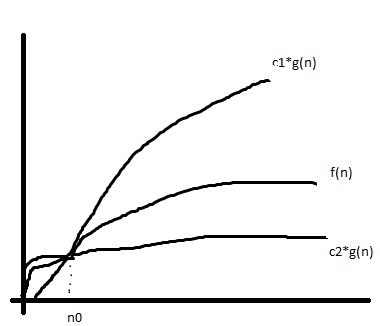
We use Ө-notation to write worst case running time of insertion sort. But I’m not able to relate properties of Ө-notation with insertion sort, why Ө-notation is suitable to insertion sort. How does the insertion sort function f(n), lies between the c1*n^2 and c2*n^2 for all n>=n0.
作为Ө(n^2)的插入排序的运行时间意味着它具有上界O(n^2)和下界Ω(n^2)。我很困惑插入排序下界是Ω(n^2)还是Ω(n)。
回答 3
Stack Overflow用户
发布于 2013-04-29 15:54:34
Ө的使用-表示法:
如果任何函数具有相同的上界和下界,我们可以用Ө-表示法来描述它的时间,它的上界和下界可以用单个表示法来指定。它简单地告诉了更多关于该函数的特性。
示例,
suppose we have a function ,
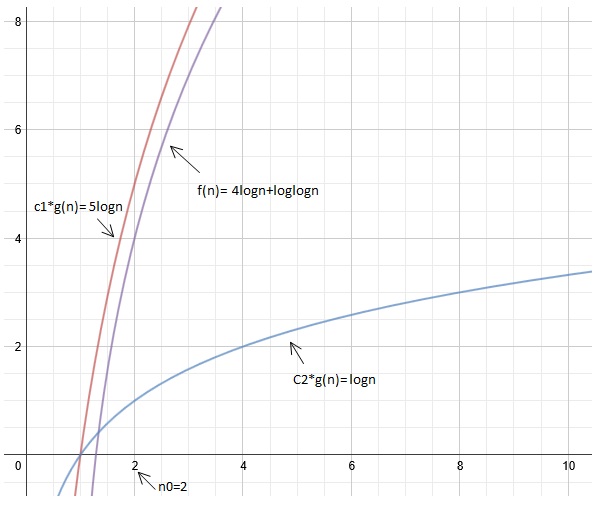
                  f(n) = 4logn + loglogn
             we can write this function as
                  f(n) = Ө(logn)
             Because its upper bound and lower bound
are O(logn) and  Ω(logn) repectively, which are same
so it is legal to write this function as ,
                  f(n)=  Ө(logn)
证明:
     **Finding upper bound :**

 f(n) = 4logn+loglogn


    For all sufficience value of n>=2

        4logn <= 4 logn
        loglogn <= logn

    Thus ,

     f(n) = 4logn+loglogn <= 4logn+logn
                          <= 5logn
                           = O(logn)       // where c1 can be 5 and n0 =2
**Finding lower bound :**

   f(n) = 4logn+loglogn

   For all sufficience value of n>=2

      f(n) = 4logn+loglogn >= logn
    Thus,              f(n) =  Ω(logn)   // where c2 can be 1 and n0=2


  so ,
                        f(n) = Ɵ(logn)
类似地,在插入排序的情况下:
If running time of insertion sort is described by simple function f(n).
In particular , if f(n) = 2n^2+n+1 then

Finding upper bound:
      for all sufficient large value of n>=1
                         2n^2<=2n^2   ------------------- (1)
                           n <=n^2    --------------------(2)
                           1 <=n^2    --------------------(3)
        adding eq 1,2 and 3, we get.
                     2n^2+n+1<= 2n^2+n^2+n^2
        that is
                         f(n)<= 4n^2
                         f(n) = O(n^2)  where c=4 and n0=1

Finding lower bound:
       for all sufficient large value of n>=1
                           2n^2+n^2+1 >= 2n^2
         that is ,
                                f(n) >= 2n^2
                                f(n) = Ω(n^2) where c=2 and n0=1
      because upper bound and lower bound are same,
                                f(n) = Ө(n^2)


   if f(n)= 2n^2+n+1 then, c1*g(n) and c2*g(n) are presented by diagram:
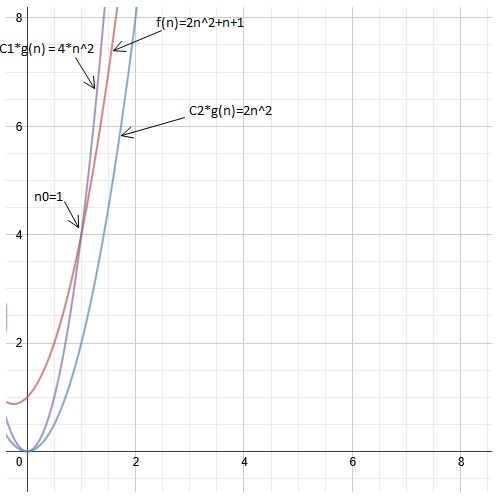
在最坏的情况下,插入排序上界和下界分别是O(n^2)和Ω(n^2),因此在最坏的情况下,将插入排序写入Ө(n^2)是合法的。
在最好的情况下是Ө(n).
Stack Overflow用户
发布于 2013-03-25 06:14:00
准确地说,插入时间的最佳运行时间是Ө(n),最坏的情况是Ө(n^2)。因此,插入排序的运行时间是O(n^2)而不是Ө(n^2)。O( n^2 )是指算法的运行时间应该小于或等于n^2,其中Ө(n^2)表示它应该完全等于n^2。
最坏的情况下运行时间永远不会少于Ө(n^2)。我们使用Ө(n^2),因为它更精确。
Stack Overflow用户
发布于 2013-03-25 06:50:46
插入排序时间“计算”复杂性: O(n^2),Ω(n)
O(SUM{1..n}) = O(1/2 n(n+1)) = O(1/2 n^2 + 1/2 n)) ~ O(n^2)

Ө(SUM{1..(n/2)}) = Ө(1/8 n(n+2)) = Ө(1/8 n^2 + 1/4 n) ~ Ө(n^2)
这里有一篇论文,说明间隙插入排序是O(n log ),这是插入排序的最佳版本:间隙插入排序。
但是如果你在寻找更快的排序算法,就会有计数排序,在最坏的情况下它有时间: O(3n),当k=n (所有符号都是唯一的),空格: O(n)
https://stackoverflow.com/questions/15608655
复制相似问题
腾讯云开发者

Copyright © 2013 - 2026 Tencent Cloud. All Rights Reserved. 腾讯云 版权所有
深圳市腾讯计算机系统有限公司 ICP备案/许可证号:粤B2-20090059  粤公网安备44030502008569号
腾讯云计算(北京)有限责任公司 京ICP证150476号 | 京ICP备11018762号