
Emgu CV -各向异性扩散
Emgu CV -各向异性扩散
提问于 2013-02-05 19:54:41
有谁能给我介绍一些现有的各向异性扩散的实现,最好是perona-malik扩散?
回答 2
Stack Overflow用户
回答已采纳
发布于 2013-02-05 21:28:44
翻译以下MATLAB代码:
% pm2.m - Anisotropic Diffusion routines


function ZN = pm2(ZN,K,iterate);

[m,n] = size(ZN);

% lambda = 0.250;
lambda = .025;
%K=16;

rowC = [1:m]; rowN = [1 1:m-1]; rowS = [2:m m];
colC = [1:n]; colE = [2:n n]; colW = [1 1:n-1];
result_save=0;
for i = 1:iterate,
   %i;
%    result=PSNR(Z,ZN);
%    if result>result_save
%     result_save=result;
% else
%     break;
% end
  deltaN = ZN(rowN,colC) - ZN(rowC,colC);
  deltaS = ZN(rowS,colC) - ZN(rowC,colC);
  deltaE = ZN(rowC,colE) - ZN(rowC,colC);
  deltaW = ZN(rowC,colW) - ZN(rowC,colC);
%   deltaN = deltaN .*abs(deltaN<K);
%   deltaS = deltaS .*abs(deltaS<K);
%   deltaE = deltaE .*abs(deltaE<K);
%   deltaW = deltaW .*abs(deltaW<K);

     fluxN = deltaN .* exp(-((abs(deltaN) ./ K).^2)  );
     fluxS = deltaS .* exp(-((abs(deltaS) ./ K).^2)  );
     fluxE = deltaE .* exp(-((abs(deltaE) ./ K).^2)  );
     fluxW = deltaW .* exp(-((abs(deltaW) ./ K).^2)  );


   ZN = ZN + lambda*(fluxN +fluxS + fluxE + fluxW);
   %ZN=max(0,ZN);ZN=min(255,ZN);
end代码不是我的,而是从:http://www.csee.wvu.edu/~xinl/code/pm2.m中提取的。
Stack Overflow用户
发布于 2020-08-15 01:40:39
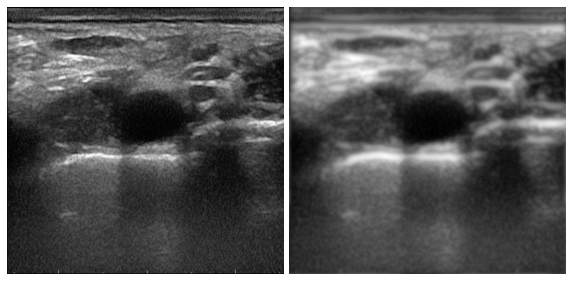
OpenCV Implementation (它需要3通道映像):
from cv2.ximgproc import anisotropicDiffusion
ultrasound_ad_cv2 = anisotropicDiffusion(im,0.075 ,80, 100)
并列比较
:(仅适用于灰度图像)
import scipy.ndimage.filters as flt
import numpy as np
import warnings

def anisodiff(img,niter=1,kappa=50,gamma=0.1,step=(1.,1.),sigma=0, option=1,ploton=False):
    """
    Anisotropic diffusion.

    Usage:
    imgout = anisodiff(im, niter, kappa, gamma, option)

    Arguments:
            img    - input image
            niter  - number of iterations
            kappa  - conduction coefficient 20-100 ?
            gamma  - max value of .25 for stability
            step   - tuple, the distance between adjacent pixels in (y,x)
            option - 1 Perona Malik diffusion equation No 1
                     2 Perona Malik diffusion equation No 2
            ploton - if True, the image will be plotted on every iteration

    Returns:
            imgout   - diffused image.

    kappa controls conduction as a function of gradient.  If kappa is low
    small intensity gradients are able to block conduction and hence diffusion
    across step edges.  A large value reduces the influence of intensity
    gradients on conduction.

    gamma controls speed of diffusion (you usually want it at a maximum of
    0.25)

    step is used to scale the gradients in case the spacing between adjacent
    pixels differs in the x and y axes

    Diffusion equation 1 favours high contrast edges over low contrast ones.
    Diffusion equation 2 favours wide regions over smaller ones.
  """

    # ...you could always diffuse each color channel independently if you
    # really want
    if img.ndim == 3:
        warnings.warn("Only grayscale images allowed, converting to 2D matrix")
        img = img.mean(2)

    # initialize output array
    img = img.astype('float32')
    imgout = img.copy()

    # initialize some internal variables
    deltaS = np.zeros_like(imgout)
    deltaE = deltaS.copy()
    NS = deltaS.copy()
    EW = deltaS.copy()
    gS = np.ones_like(imgout)
    gE = gS.copy()

    # create the plot figure, if requested
    if ploton:
        import pylab as pl
        from time import sleep

        fig = pl.figure(figsize=(20,5.5),num="Anisotropic diffusion")
        ax1,ax2 = fig.add_subplot(1,2,1),fig.add_subplot(1,2,2)

        ax1.imshow(img,interpolation='nearest')
        ih = ax2.imshow(imgout,interpolation='nearest',animated=True)
        ax1.set_title("Original image")
        ax2.set_title("Iteration 0")

        fig.canvas.draw()

    for ii in np.arange(1,niter):

        # calculate the diffs
        deltaS[:-1,: ] = np.diff(imgout,axis=0)
        deltaE[: ,:-1] = np.diff(imgout,axis=1)

        if 0<sigma:
            deltaSf=flt.gaussian_filter(deltaS,sigma);
            deltaEf=flt.gaussian_filter(deltaE,sigma);
        else:
            deltaSf=deltaS;
            deltaEf=deltaE;

        # conduction gradients (only need to compute one per dim!)
        if option == 1:
            gS = np.exp(-(deltaSf/kappa)**2.)/step[0]
            gE = np.exp(-(deltaEf/kappa)**2.)/step[1]
        elif option == 2:
            gS = 1./(1.+(deltaSf/kappa)**2.)/step[0]
            gE = 1./(1.+(deltaEf/kappa)**2.)/step[1]

        # update matrices
        E = gE*deltaE
        S = gS*deltaS

        # subtract a copy that has been shifted 'North/West' by one
        # pixel. don't as questions. just do it. trust me.
        NS[:] = S
        EW[:] = E
        NS[1:,:] -= S[:-1,:]
        EW[:,1:] -= E[:,:-1]

        # update the image
        imgout += gamma*(NS+EW)

        if ploton:
            iterstring = "Iteration %i" %(ii+1)
            ih.set_data(imgout)
            ax2.set_title(iterstring)
            fig.canvas.draw()
            # sleep(0.01)

return imgout- 用法
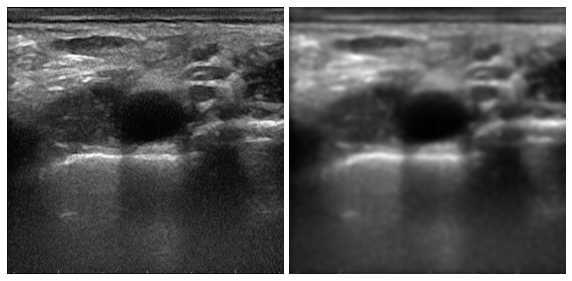
#茴香( niter=1,kappa=50,gamma=0.1,step=(1,1.),sigma=0,option=1,ploton=False)
us_im_ad = anisodiff(ultrasound,100,80,0.075,(1,1),2.5,1)并列比较
页面原文内容由Stack Overflow提供。腾讯云小微IT领域专用引擎提供翻译支持
原文链接:
https://stackoverflow.com/questions/14715817
复制相关文章
相似问题
腾讯云开发者

Copyright © 2013 - 2026 Tencent Cloud. All Rights Reserved. 腾讯云 版权所有
深圳市腾讯计算机系统有限公司 ICP备案/许可证号:粤B2-20090059  粤公网安备44030502008569号
腾讯云计算(北京)有限责任公司 京ICP证150476号 | 京ICP备11018762号