
next 2->next包含什么?
这是一个试图建立链接列表的程序。
#include <iostream>
using namespace std;

struct node {
char name[20];
int age;
int height;
node* next; // Pointer to the next node
 };
 node* startPTR = NULL; // Start Pointer (root)
                   // This pointer permanantly points to the start of the list
                   // Initially there are no nodes

void addNode_AT_END(); // prototype for the function that 'adds nodes at the end'

int main() {
   do {
 addNode_AT_END();
     cout << "Add more ?";
     char ch;
     cin >> ch;
   } while( ch == 'y');
}

void addNode_AT_END() {
node *temp1;
node *temp2;
temp1 = new node;  // We declare space for a pointer item and assign a temporary pointer to it
                   //*temp1 is the node that it points to
cout << "Enter the name : ";
cin >> temp1->name;
cout << endl << "Enter the age : ";
cin >> temp1->age;
cout << endl << "Enter height : ";
cin >> temp1->height;
temp1->next = NULL; // indicates that this node when inserted in the list will be the last node
  if( startPTR == NULL) {
    startPTR = temp1;  // In the empty list last node will be the first node
  }  else {
        temp2 = startPTR;
        while( temp2->next != NULL )
            temp2 = temp2->next;
        temp2->next = temp1;
     }
}
从这个尚未完成的项目中,我了解到:
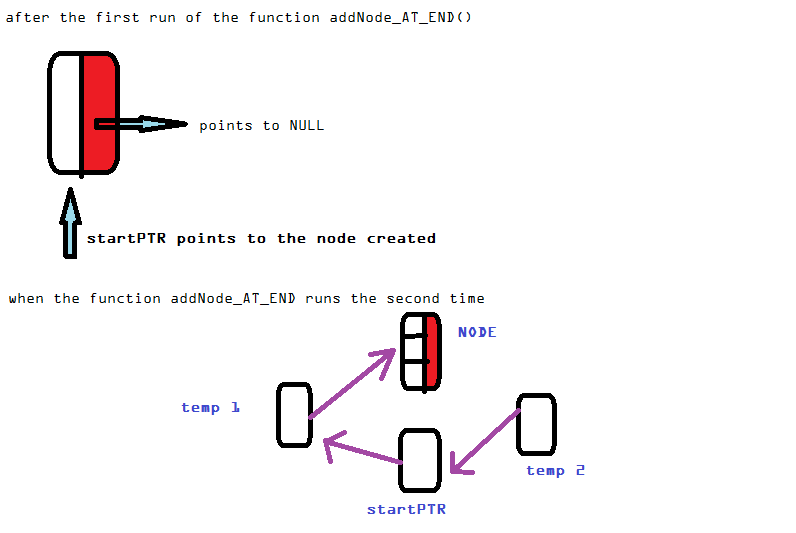
如果第二次调用函数addNode_AT_END后的图为真,那么temp2->next在while( temp2->next != NULL )语句中包含什么?
回答 2
Stack Overflow用户
发布于 2011-08-31 16:47:51
你的图表不正确。start = temp2确实意味着start和temp2指针都指向同一个节点。您的图表显示了temp2指针的下一个字段保存着开始的地址。而且,在执行start->next = temp1之后,并不意味着如果您在temp1中获得了一些新的节点值(在下一个函数调用中),start->next仍然会继续指向刚刚在temp1中分配的新值。它将保存旧值,在您用新的值覆盖它之前。start->next = temp1只是在temp1 ie中复制值。指向变量(指针变量)的地址,该变量是由start指向的节点的下一个组件,即start->next。之后,start和temp1之间就没有任何联系了。
在链接列表上下文中,"temp1 -> temp2“是指存储在temp1中的节点的next字段,该节点的地址由temp2持有或持有。现在,在更改指针变量的值之后,temp2不会更改存储在temp1中的地址处节点的next字段。temp1->next仍然包含它以前存储的值。
下一个链接不指向某个变量名称,即,start->next = temp start 将不会使start节点的下一个节点始终指向节点 temp1 包含的任何节点,但是 start->next 将包含在分配时存储的E 236 temp1 <代码>E 140的地址。
请注意,通过说"start is指向temp1“意味着地址
while (temp2->next != NULL)
temp2 = temp2->next;当temp2->next = NULL中断时,这意味着temp2指向列表的最后一个节点。此时,temp2->next = temp1将新分配的节点链接到temp2当前指向的节点之后。这就是简单地在末尾添加新节点。
  At the end of the above while loop

                                                              temp2
                                                                |
                                                                V

(start) ----> (n1) ----> (n2) ----> (n3) . . . (n(n-1)) ----> (nn) ----> NULL


   temp2->next = temp1    makes


                                                              temp2
                                                                |
                                                                V

(start) ----> (n1) ----> (n2) ----> (n3) . . . (n(n-1)) ----> (nn) ----> (temp1)--->NULL


 because temp2 holds the address of (nn) therefore linking the new node to the next node of the last node.
更新
第一次:
start = NULL
a new address is allocated and the address stored into temp1 pointer. Also temp->next = NULL
if condition becomes true and temp1 is assigned to start
start = temp1

List state


start = addr1;
 |
 V
(addr1) ----> (NULL)
第二次:
a new node is allocated and the address of the new node is stored into `temp1`. Let this address be `addr2`. Now `temp1` contains the value `addr2`

start is NOT NULL, as start has addr1 in it from the last call.So the else part is true and we get the address of the start node `addr1` into temp2.

temp2 = start;

which means temp2 now points to `addr1`

while loop is encountered. The first iteration the condition `temp2->next != NULL` is FALSE. This is because `temp2` points to `addr1` and the next pointer field of `addr1` has NULL from the last time the function is called. Therefore the while loop terminates.

The next statement does `temp2->next = temp1` . `temp2` points to `addr1` address, and the address of the newly allocated node `addr2` contained in `temp1` is assigned into the next field of the node whose address is stored into `temp2`. Which actually assigns the address `addr2` to the next field of the node identified by the address `addr1`.


temp1 = addr2     after allocation

start = addr1;
 |
 V
(addr1) ----> (NULL)      at begining
 ^
 |
 temp2


after temp2->next = temp1

start = addr1;
 |
 V
(addr1) ----> (addr2) ----> (NULL)      at end
 ^
 |
 temp2
第三次:
temp1 = addr3      new node address allocated

start = addr1;
 |
 V
(addr1) ----> (addr2) ----> (NULL)      at start
 ^
 |
 temp2


start = addr1;
 |
 V
(addr1) ----> (addr2) ----> (NULL)      next iteration after temp2=temp2->next
                 ^
                 |
               temp2


we can see temp2->next = NULL and while condition is false. Note that temp2 contains itself the address addr2, and thus temp2->next is NOT addr2, it is NULL.

start = addr1;
 |
 V
(addr1) ----> (addr2) ----> (NULL)      next iteration after temp2=temp2->next
                 ^
                 |
               temp2


After linking: temp2->next = temp1;

start = addr1;               temp1         the address addr3 (new node)
 |                             |          is stored in temp1. this address is assigned
 V                             V         to the next node of temp2, replacing NULL
(addr1) ----> (addr2) ----> (addr3) ----> (NULL)
                 ^
                 |
temp2指针是在列表中穿行的手段。列表的起始地址保存在指针start中。当每个节点的下一个字段指向下一个节点时,如果我们得到start节点,那么通过依次跟踪下一个字段,我们可以访问每个节点。temp1和temp2是执行遍历的指针,它们充当临时指针,temp1用于保存新分配的节点,而temp2用于通过跟踪next链接遍历列表,直到最后一个链接(在下一个字段中由空指针检测到)时,最后一个节点的空链接被temp1持有的新分配节点替换。由于现在temp1保存的节点被链接/添加到列表的末尾,所以temp1被重用来容纳另一个新节点。
Stack Overflow用户
发布于 2011-08-31 16:47:49
它包含NULL,这是因为这行:
temp1->next = NULL; 每个新节点都有next指针,通过执行上面的步骤使之成为NULL,并且新节点被追加到列表的末尾,结果,列表的末尾总是NULL。while循环遍历到列表的末尾,while(temp2->next != NULL)设置条件,直到next of temp2变成NULL,do temp2 = temp2->next。
https://stackoverflow.com/questions/7260452
复制相似问题
腾讯云开发者

Copyright © 2013 - 2026 Tencent Cloud. All Rights Reserved. 腾讯云 版权所有
深圳市腾讯计算机系统有限公司 ICP备案/许可证号:粤B2-20090059  粤公网安备44030502008569号
腾讯云计算(北京)有限责任公司 京ICP证150476号 | 京ICP备11018762号