
数据模型草案/报价/订单/发票
我目前正在做一个小项目,在这个项目中,我需要对以下场景建模:
场景
- 客户来电,他想要一辆新车的报价。
- 销售代表。注册客户information.
- Sales代表。在系统中创建一个报价,并将一个项目添加到报价(汽车)中。
- 销售代表。将报价发送给email.
- Customer上的客户,接受报价,现在报价不再是报价,而是订单。
- 销售代表。检查订单,一切正常,他开发票。现在订单不再是订单,而是发票。
Thoughts
我需要一些帮助,找到理想的方式建模,但我有一些想法。
我在想,两个草稿/报价/发票基本上都是一个order.
- Draft/quote/invoice,需要单独的唯一数字(Id),所以在这里,我想为所有这些单独的表。
模型
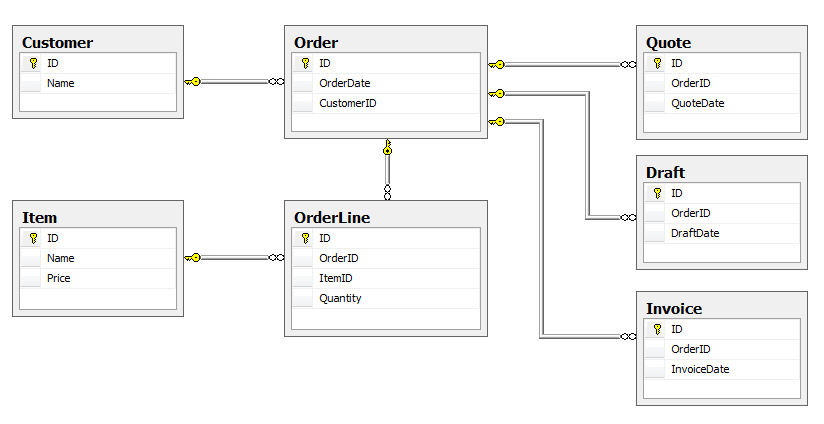
这是我的数据模型v.1.0,请让我知道你的想法。
关注
然而,我对这一模式感到关切:
- Draft/quote/invoice在定单线上可能有不同的商品和价格。在这种模式中,所有的汇票/报价/发票都与同一订单和订单线相连接,因此不可能有单独的报价行/草稿线/发票线。也许我会为此做新的表,但基本上相同的信息将存储在多个表中,这不是很好的either.
- Sometimes两个或多个报价成为发票,这个模型将如何处理这个问题?
如果你对如何更好地塑造这个模型有任何建议,请告诉我!
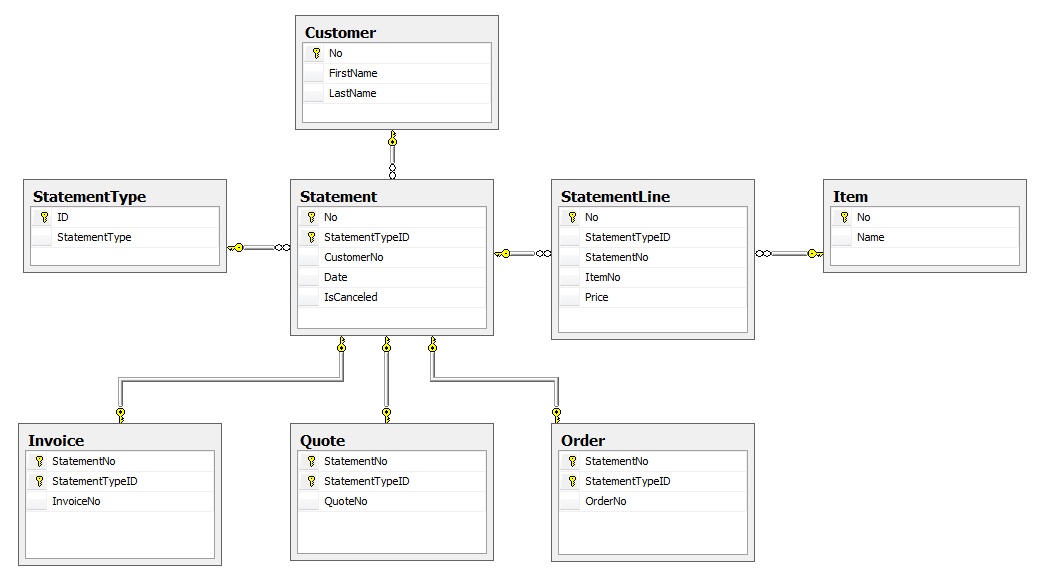
编辑:数据模型v.1.4
回答 3
Stack Overflow用户
发布于 2011-04-17 11:34:59
看起来你已经把这些东西中的每一件--报价,订单,汇票,发票--都建模成了与所有其他东西结构相同的模型。如果是这样的话,那么您可以将所有类似的属性“推”到一个表中。
create table statement (
    stmt_id integer primary key,
    stmt_type char(1) not null check (stmt_type in ('d', 'q', 'o', 'i')),
    stmt_date date not null default current_date,
    customer_id integer not null  -- references customer (customer_id)
);

create table statement_line_items (
    stmt_id integer not null references statement (stmt_id),
    line_item_number integer not null,
    -- other columns for line items
    primary key (stmt_id, line_item_number)
);
我认为这将适用于您所描述的模型,但我认为从长远来看,将这些模型建模为一个超级/子类型会更好。所有子类型共有的列都被“向上”推到超级类型中;每个子类型都有一个单独的表,用于该子类型特有的属性。
This SO question及其公认的答案(和注释)说明了博客评论的超级类型/子类型设计。Another question与个人和组织有关。Yet another与人员配置和电话号码有关。
稍后是。。。
这还没完成,但我没时间了。我知道它不包括行项。可能漏掉了别的东西。
-- "Supertype". Comments appear above the column they apply to.
create table statement (
  -- Autoincrement or serial is ok here.
  stmt_id integer primary key,
  stmt_type char(1) unique check (stmt_type in ('d','q','o','i')),
  -- Guarantees that only the order_st table can reference rows having
  -- stmt_type = 'o', only the invoice_st table can reference rows having
  -- stmt_type = 'i', etc.
  unique (stmt_id, stmt_type),
  stmt_date date not null default current_date,
  cust_id integer not null -- references customers (cust_id)
);

-- order "subtype"
create table order_st (
  stmt_id integer primary key,
  stmt_type char(1) not null default 'o' check (stmt_type = 'o'),
  -- Guarantees that this row references a row having stmt_type = 'o'
  -- in the table "statement".
  unique (stmt_id, stmt_type),
  -- Don't cascade deletes. Don't even allow deletes. Every order given
  -- an order number must be maintained for accountability, if not for
  -- accounting.
  foreign key (stmt_id, stmt_type) references statement (stmt_id, stmt_type)
    on delete restrict,
  -- Autoincrement or serial is *not* ok here, because they can have gaps.
  -- Database must account for each order number.
  order_num integer not null,
  is_canceled boolean not null
    default FALSE
);

-- Write triggers, rules, whatever to make this view updatable.
-- You build one view per subtype, joining the supertype and the subtype.
-- Application code uses the updatable views, not the base tables.
create view orders as
select t1.stmt_id, t1.stmt_type, t1.stmt_date, t1.cust_id,
       t2.order_num, t2.is_canceled
from statement t1
inner join order_st t2 on (t1.stmt_id = t2.stmt_id);Stack Overflow用户
发布于 2011-04-17 10:36:17
应该有一个表“商”,类似于“命令行”。类似地,您应该有一个‘发票线’表。所有这些表都应该有一个“价格”字段(名义上将是该部分的默认价格)和一个“折扣”字段。您还可以在“报价”、“订单”和“发票”表中添加“折扣”字段,以处理现金折扣或特殊优惠等问题。尽管您写了什么,但是有单独的表是的,因为报价中的数量和价格可能与客户的实际订单不匹配,而且也可能与您实际提供的数量不同。
我不确定“草稿”表是什么--您可能会将“草稿”和“发票”表合并,因为它们包含相同的信息,其中一个字段包含发票的状态--草稿或最后一个。将您的发票数据与订单数据分离是很重要的,因为您可能会根据您的收入(发票)纳税。
“引号”、“订单”和“发票”都应该有一个字段(外键),该字段保存销售代表的值;该字段指向不存在的“SalesRep”表。您还可以在“customers”表中添加“salesrep”字段,该字段指向客户的默认代表。这个值将被复制到“引号”表中,尽管如果默认的另一个代表给出了引号,它可能会被更改。类似地,当从报价发出订单和从订单发出发票时,应复制此字段。
我可能会添加更多,但这取决于您想要创建的系统有多复杂和详细。你可能需要添加某种形式的“材料清单”,如果汽车是根据他们的选择配置,并相应定价。
Stack Overflow用户
发布于 2020-01-29 14:41:41
向line_items添加一个新列(例如:状态为smallint)
当一个quote_line变成order_line,然后从0到3到1之间选择set位。
但是,当qty发生变化时,添加一个新的qte行,并保持最后一行不变。
卡德。
https://stackoverflow.com/questions/5692924
复制相似问题
腾讯云开发者

Copyright © 2013 - 2026 Tencent Cloud. All Rights Reserved. 腾讯云 版权所有
深圳市腾讯计算机系统有限公司 ICP备案/许可证号:粤B2-20090059  粤公网安备44030502008569号
腾讯云计算(北京)有限责任公司 京ICP证150476号 | 京ICP备11018762号