
Scala eq问题
Scala eq问题
提问于 2011-02-28 09:08:11
我对Scala中的以下代码有问题
import org.junit.Test
import org.junit.Assert._

class BoxingTest {

    val holder: Holder[Integer] = new Holder[Integer]();

    @Test
    def Holder_Eq_Primitive(){
        assertEquals(holder, holder eq 1);
    }

    @Test
    def Holder_Eq_Boxed(){
        assertEquals(holder, holder eq 1.asInstanceOf[Integer]);
    }

}

class Holder[T] {

    def eq(other: T): Holder[_] = this;
}
我在编译过程中出现以下错误
/BoxingTest.scala:12: error: type mismatch;
[INFO]  found   : Int
[INFO]  required: AnyRef
[INFO] Note: primitive types are not implicitly converted to AnyRef.
[INFO] You can safely force boxing by casting x.asInstanceOf[AnyRef].
[INFO]         assertEquals(holder, holder eq 1);
[INFO]                                     ^
[ERROR] one error found
[INFO] -------------------------
为什么从Int到Integer的隐式转换不能处理这个问题?
我可以很容易地通过不使用eq来修正代码,但这似乎不太正确。IMHO可用的隐式转换应该在这里应用。
更新
我用这样的签名解决了问题
import org.junit.Test
import org.junit.Assert._

class BoxingTest {

    @Test
    def Holder_Eq_Primitive(){
        val holder: Holder[Int] = new Holder[Int]();
        assertEquals(holder, holder eq 1);
    }

    @Test
    def Holder_Eq_Boxed(){
        val holder: Holder[Integer] = new Holder[Integer]();
        assertEquals(holder, holder eq 1.asInstanceOf[Integer]);
    }

}

class Holder[T] {

    def eq(other: T): Holder[_] = ...;
}
不过,最好还是使用包装器类型。
回答 2
Stack Overflow用户
回答已采纳
发布于 2011-03-20 17:19:53
我尝试将Int值与整数文本进行比较,并从编译器那里得到了一些有趣的注释。这可能说明了这种行为的原因。
scala> val a = 1
scala> a eq 1
<console>:6: error: type mismatch;
 found   : Int
 required: ?{val eq: ?}
Note that implicit conversions are not applicable because they are ambiguous:
 both method int2Integer in object Predef of type (Int)java.lang.Integer
 and method intWrapper in object Predef of type (Int)scala.runtime.RichInt
 are possible conversion functions from Int to ?{val eq: ?}
       a eq 1
^Stack Overflow用户
发布于 2011-11-27 13:00:54
我认为这是关于Java 的。当您编译类时
class Holder[T] {

    def eq(other: T): Holder[_] = this;
}类型T将被删除。你可以做一个测试:
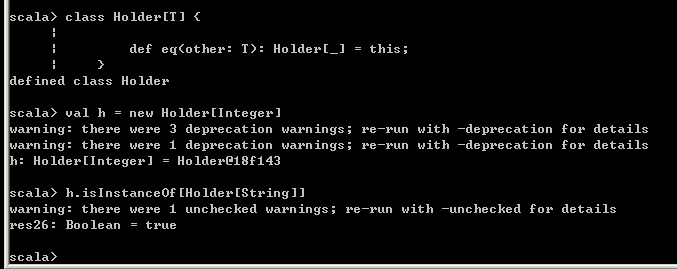
另一方面,Int类是AnyVal的子类型,而不是AnyRef。因此,如果尝试使用带有参数1 (类型为Int)的方法Int,则会发出运行时错误。
PS:虽然Int可以隐式地转换为java.lang.Integer,但正如Vilius所指出的,它也可以隐式地转换为RichInt。
页面原文内容由Stack Overflow提供。腾讯云小微IT领域专用引擎提供翻译支持
原文链接:
https://stackoverflow.com/questions/5139962
复制相关文章
相似问题
腾讯云开发者

Copyright © 2013 - 2026 Tencent Cloud. All Rights Reserved. 腾讯云 版权所有
深圳市腾讯计算机系统有限公司 ICP备案/许可证号:粤B2-20090059  粤公网安备44030502008569号
腾讯云计算(北京)有限责任公司 京ICP证150476号 | 京ICP备11018762号