
移动摄像机以适应三维场景
我正在寻找一个算法,以适应一个边界框内的一个视口(在我的例子中,一个DirectX场景)。我知道在正射相机中对包围球进行中心化的算法,但是对于一个边框和一个透视相机,我需要同样的算法。我不能仅仅更改FOV,因为这个应用程序有FOV作为用户可编辑的变量,所以它必须移动相机。
我有大部分数据:
- 我有相机的上矢量
- 我有包围盒的中心点
- 我有从摄像机指向盒中心的看向矢量(方向和距离)。
- 我在垂直于摄像机的平面上投影了点,并检索了描述最大/分、X和Y弦在观察平面内或外部的系数。
问题:
- 包围框的中心不一定位于视口的中心(也就是说,它是投影后的边框)。
- 由于视场“偏斜”投影(见http://en.wikipedia.org/wiki/File:Perspective-foreshortening.svg),我不能简单地使用系数作为缩放因子来移动摄像机,因为它会超调/低于所需的摄像机位置。
我如何找到相机的位置,以使它尽可能完美地填充视口(但如果纵横比离1.0很远,它只需要填充一个屏幕轴)?
我尝试过其他一些东西:
- 使用一个边界球和切线来找到一个比例因子来移动相机。这不是很好,因为它没有考虑透视投影,其次,对于我的使用来说,球体是不好的边界体积,因为我有很多平面和长的几何图形。
- 迭代函数的调用,以得到一个越来越小的错误在相机的位置。这在某种程度上起了作用,但我有时会遇到一些奇怪的边缘情况,相机的位置过高,错误因素增加。而且,在这样做的时候,我没有根据包围矩形的位置重新输入模型。我找不到可靠可靠的可靠方法。
救命啊!
回答 7
Stack Overflow用户
发布于 2010-05-19 14:34:11
有许多可能的相机位置+方向,其中包围框将适合在视野中的圆顶。但是任何程序都会选择一个特定的摄像机位置和方向。
如果你考虑包围球,一种解决办法是
- 第一次改变方向来观察包围球的中心
- 然后充分地向后移动(负看方向),以使圆圈适合于圆锥花序内。
有了包围盒,您可以考虑一个较早的步骤,首先定位相机垂直于中心的最大(或最小,无论你喜欢)的立方体面。
我没有DirectX的经验,但移动和改变相机的寻找方向,以一个特定的点中心应该是容易的。最困难的部分是做决定移动多远来查看物体的数学运算。
数学
如果您知道物体在世界坐标中的边界大小s (我们对像素或相机坐标不感兴趣,因为它们取决于您的距离),那么如果您知道透视投影的x和y视场角a,则可以计算相机到边界形状所需的距离d。
     frustum      ------
            ------    *****          -
       -----          *   *          |
   -===     ) FOV a   *bounding box  | BB size s
camera -----          *   *          |
            ------    *****          -
                  ------

  |-------------------|
distance d因此,数学是tan(a/2) = (s/2) / d => d = (s/2) / tan(a/2),它将给出相机应该从最近的边界面放置的距离。
Stack Overflow用户
发布于 2015-09-29 05:54:20
我知道上面有一些很好的答案,但我想加入一个简单的解决方案,以适应相机内的包围球。它假设要保持相机目标和前向矢量相同,并简单地调整相机距离以达到目标。
注意到, --这不会给你最好的拟合,但是它会给你一个近似的拟合,显示所有的几何图形,并且只在几行代码中显示,并且没有屏幕到世界的转换
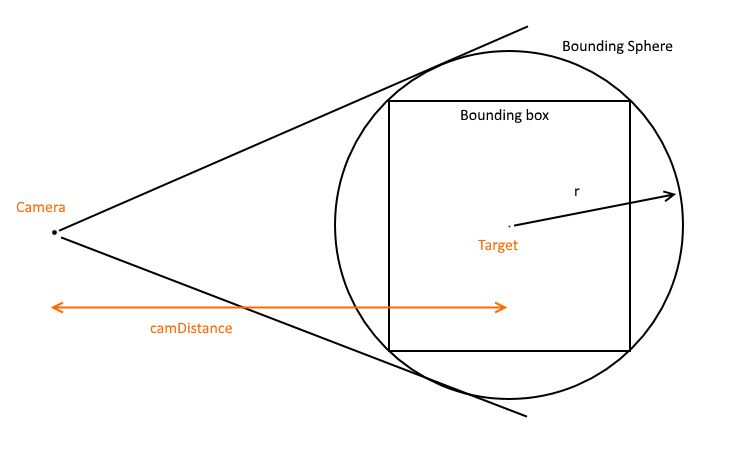
// Compute camera radius to fit bounding sphere
// Implementation in C#
//

// Given a bounding box around your scene
BoundingBox bounds = new BoundingBox();

// Compute the centre point of the bounding box
// NOTE: The implementation for this is to take the mid-way point between
// two opposing corners of the bounding box
Vector3 center = bounds.Center;

// Find the corner of the bounding box which is maximum distance from the
// centre of the bounding box. Vector3.Distance computes the distance between
// two vectors. Select is just nice syntactic sugar to loop
// over Corners and find the max distance.
double boundSphereRadius = bounds.Corners.Select(x => Vector3.Distance(x, bounds.Center)).Max();

// Given the camera Field of View in radians
double fov = Math3D.DegToRad(FieldOfView);

// Compute the distance the camera should be to fit the entire bounding sphere
double camDistance = (boundSphereRadius * 2.0) / Math.Tan(fov / 2.0);

// Now, set camera.Target to bounds.Center
// set camera.Radius to camDistance
// Keep current forward vector the same
BoundingBox在C#中的实现如下所示。重要的一点是中心和角落的财产。Vector3是一个非常标准的3分量(X,Y,Z)向量的实现
public struct BoundingBox
{
    public Vector3 Vec0;
    public Vector3 Vec1;

    public BoundingBox(Vector3 vec0, Vector3 vec1)
    {
        Vec0 = vec0;
        Vec1 = vec1;
    }

    public Vector3 Center
    {
        get { return (Vec0 + Vec1)*0.5; }
    }

    public IList<Vector3> Corners
    {
        get
        {
            Vector3[] corners = new[]
            {
                new Vector3( Vec0.X, Vec0.Y, Vec0.Z ),
                new Vector3( Vec1.X, Vec0.Y, Vec0.Z ),
                new Vector3( Vec0.X, Vec1.Y, Vec0.Z ),
                new Vector3( Vec0.X, Vec0.Y, Vec1.Z ),
                new Vector3( Vec1.X, Vec1.Y, Vec0.Z ),
                new Vector3( Vec1.X, Vec0.Y, Vec1.Z ),
                new Vector3( Vec0.X, Vec1.Y, Vec1.Z ),
                new Vector3( Vec1.X, Vec1.Y, Vec1.Z ),
            };

            return corners;
        }
    }
}Stack Overflow用户
发布于 2010-05-19 14:45:14
因为你有一个包围框,你应该有一个描述它的方向的基础。似乎您想要将相机定位在与描述盒最小尺寸的基向量一致的线上,然后滚动相机,使最大尺寸是水平的(假设您有OBB而不是AABB)。这假设高宽比大于1.0;如果不是,则需要使用垂直维度。
我要做的是:
- 找到最小的方框尺寸。
- 找到相关的基向量。
- 缩小基本矢量的距离,从中心的盒,相机应该是。这个距离就是
boxWidth / (2 * tan(horizontalFov / 2))。请注意,boxWidth是框的最大维度的宽度。 - 把相机放在
boxCenter + scaledBasis,看着boxCenter。 - 如有必要,可将相机的向上矢量与适当的方框基矢量对齐。
编辑:
所以我认为,你得到的是,你有相机在一个任意的位置,看看某处,你有一个AABB在另一个位置。如果不将摄像机移到盒的一侧,则需要:
- 看盒子的中心
- 将相机沿其外观向量转换,使该框占用最大的屏幕空间
如果是这样的话,您还需要做更多的工作;下面是我的建议:
- 旋转相机,以查看包围框的中心。
- 将框中的所有点投影到屏幕空间中,并在屏幕空间中找到min/max边界框(您已经有了这个)。
- 现在
Unproject的两个相对的角屏幕空间包围框进入世界空间。对于Z值,使用您的AABB最近的世界空间点到相机。 - 这将使您的世界空间飞机面对相机定位在AABB上的一点,是最接近的相机。
- 现在,使用我们现有的面向侧面的方法,把相机移到合适的位置,把这架飞机当作你盒子的侧面。
https://stackoverflow.com/questions/2866350
复制相似问题
腾讯云开发者

Copyright © 2013 - 2026 Tencent Cloud. All Rights Reserved. 腾讯云 版权所有
深圳市腾讯计算机系统有限公司 ICP备案/许可证号:粤B2-20090059  粤公网安备44030502008569号
腾讯云计算(北京)有限责任公司 京ICP证150476号 | 京ICP备11018762号