
NodeJS快递API -票务/排队系统
在结尾处重新措辞,
NodeJS通过GRPC与其他API通信。
每个外部API都有自己的与Node的专用GRPC连接,每个专用的GRPC连接都有一个可以同时服务的并发客户端的上限(例如,外部API 1的上限为30个用户)。
每个对速成API的请求,都可能需要与外部API 1、External 2或External 3 (从现在起,EAP1、EAP2等)进行通信,而且该快速API还具有一个可供EAP2使用的并发客户端(例如100个客户端)的上限。
所以,我是如何考虑解决这个问题的:
- 客户端向Express API提出新的请求。
- 中间件queueManager为客户端创建一张票证(把它看作是一张批准对系统访问的票据--它拥有客户端的基本数据(例如名称))
- 客户端获取票证,创建一个事件侦听器,该侦听器以其票证ID作为事件名称(当系统准备接受票证时,它将产生票证ID为事件),并输入"Lobby“,其中客户端只等待他们的票证ID被接受/宣布(事件)。
我的问题是,我无法真正考虑如何实现系统跟踪票证的方式,以及如何根据系统的并发客户端拥有队列。
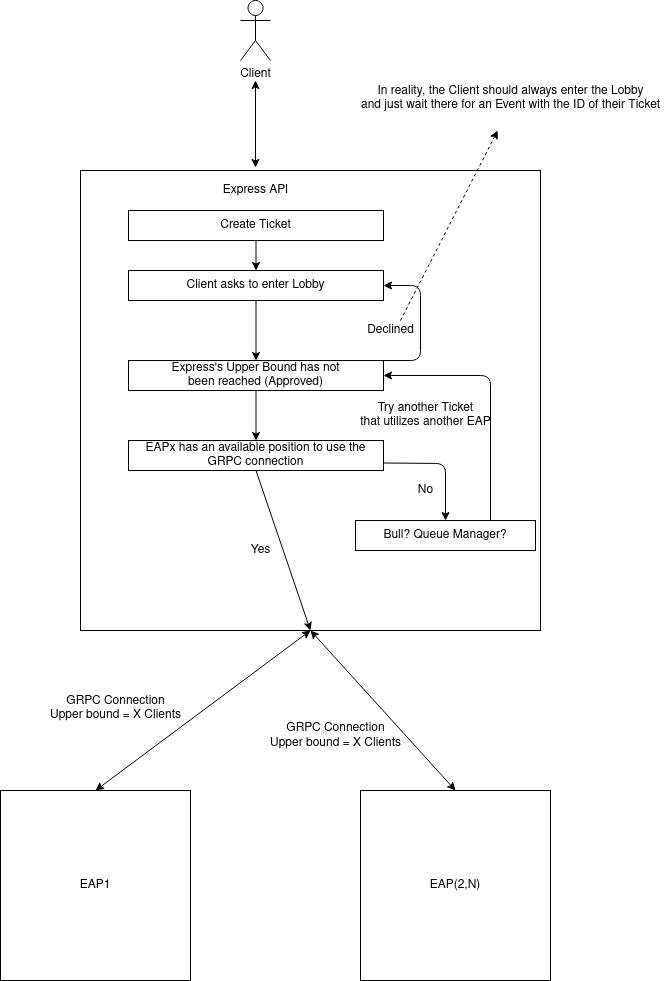
在允许客户端访问系统之前,系统本身应该:
- 检查Express API是否达到了并发客户端->的上限(如果是这样的话),应该等到新的票务位置可用时再进行检查。
- 如果有一个新的职位可用,它应该检查票证,并找出它需要联系哪个API。例如,如果它需要联系EAP1,它应该检查有多少当前客户端使用GRPC连接。这已经实现了(每个外部API都在一个拥有所需所有信息的类下)。如果EAP1已经达到了上限,那么NodeJS应该稍后再试(但是,多久之后呢?)我是否应该在系统完成对EAP1的另一个请求之后发出一个系统事件?)
我知道公牛,但我不确定它是否符合我的要求。我真正需要做的是让客户端排队,并且:
- 检查Express API是否已达到并发用户的上限。
- 如果某个位置是空的,则从票证的数组中弹出一张票证
- 检查EAPx是否已达到并发用户的上限。
- 如果为真,请尝试另一张需要与其他EAP通信的票证(如果可用)。
- 如果为假,则授予访问权
编辑:另一个想法可能是有两个公牛队列。一个用于Express API (其中选项“并发”可以设置为Express API的上限)和一个用于EAP。每个EAP队列将有一个不同的工作人员(以设置上限)。
改称为
为了更好地描述这一问题,我将尝试重新表述需求。
对该系统的一个简单看法可以是:
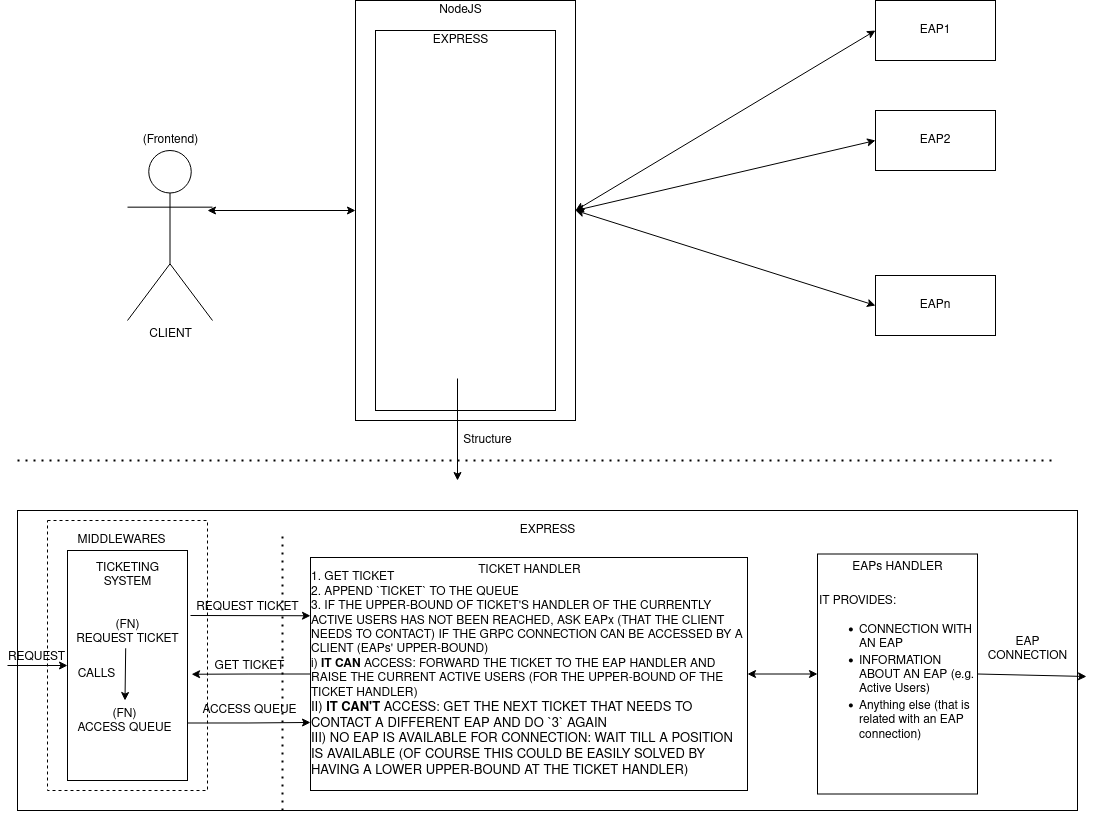
我已经使用了Clem的建议(RabbitMQ),但同样,我不能实现与限制(上限)的并发。
所以,
- 客户向
TicketHandler索取一张票。为了让TicketHandler构建一个新的票据,客户端和其他信息一起提供了一个callback
TicketHandler.getTicket(variousInfo, function () {
    next();
  })
系统将使用回调来允许客户端与EAP连接。
- TickerHandler得到了票: )将其添加到队列中。 当可以访问票证(没有到达上限)时,它会询问适当的EAP处理程序,客户端是否可以使用GRPC连接。如果是,那么请TicketHandler锁定一个位置,然后调用票证的可用回调(从步骤1) (如果不是),TicketHandler将检查下一个需要与其他EAP联系的可用票证。这种情况应该一直持续到TicketHandler首先通知TicketHandler“没有可用的位置”,然后向TicketHandler发送一条消息,以便通知TicketHandler“现在有X个可用职位”(或“1个可用位置”)。然后TicketHandler,应该检查之前无法访问EAPx的票证,并再次询问EAPx是否可以访问GRPC连接。
回答 1
Stack Overflow用户
发布于 2021-09-20 17:16:32
从你的描述中,我明白了以下几点:
- 你有一个Node.js前端层.每个Node.js框需要被限制为最多100个客户端。
- 您有一个未定义的后台层,它与前面层中的框具有GRPC连接(让我们称它们为EAP)。每个EAP <-> Node.js GRPS链接仅限于N个并发连接。
我在这里看到的只是服务器级别和连接级别的限制,因此我认为没有理由让任何分布式系统(比如Bull)来管理队列(如果Node.js框死了,就没有人能够恢复HTTP上下文来提供对特定请求的响应--因此,当一个Node.js框死亡时,对其请求的响应就不会更有用)。
考虑到这一点,我只需创建一个本地队列(就像数组一样简单)来管理您的队列。
免责声明:这必须被视为伪代码,以下内容是简化和未经测试的。
这可能是一个队列实现:
interface SimpleQueueObject<Req, Res> {
  req: Req;
  then: (Res) => void;
  catch: (any) => void;
}


class SimpleQueue<Req = any, Res = any> {

  constructor(
    protected size: number = 100,
    /** async function to be executed when a request is de-queued */
    protected execute: (req: Req) => Promise<Res>,
    /** an optional function that may ba used to indicate a request is
     not yet ready to be de-queued. In such case nex request will be attempted */
    protected ready?: (req: Req) => boolean,
  ) { }

  _queue: SimpleQueueObject<Req, Res>[] = [];
  _running: number = 0;

  private _dispatch() {
    // Queues all available
    while (this._running < this.size && this._queue.length > 0) {
      // Accept
      let obj;
      if (this.ready) {
        const ix = this._queue.findIndex(o => this.ready(o.req));
        // todo : this may cause queue to stall (for now we throw error)
        if (ix === -1) return;
        obj = this._queue.splice(ix, 1)[0];
      } else {
        obj = this._queue.pop();
      }
      // Execute
      this.execute(obj.req)
        // Resolves the main request
        .then(obj.then)
        .catch(obj.catch)
        // Attempts to queue something else after an outcome from EAP
        .finally(() => {
          this._running --;
          this._dispatch();
        });
      obj.running = true;
      this._running ++;
    }
  }

  /** Queue a request, fail if queue is busy */
  queue(req: Req): Promise<Res> {
    if (this._running >= this.size) {
      throw "Queue is busy";
    }

    // Queue up
    return new Promise<Res>((resolve, reject) => {
      this._queue.push({ req, then: resolve, catch: reject });
      this._dispatch();
    });
  }

  /** Queue a request (even if busy), but wait a maximum time
   * for the request to be de-queued */
  queueTimeout(req: Req, maxWait: number): Promise<Res> {
    return new Promise<Res>((resolve, reject) => {
      const obj: SimpleQueueObject<Req, Res> = { req, then: resolve, catch: reject };
      // Expire if not started after maxWait
      const _t = setTimeout(() => {
        const ix = this._queue.indexOf(obj);
        if (ix !== -1) {
          this._queue.splice(ix, 1);
          reject("Request expired");
        }
      }, maxWait);
      // todo : clear timeout
      // Queue up
      this._queue.push(obj);
      this._dispatch();
    })
  }

  isBusy(): boolean {
    return this._running >= this.size;
  }

}
然后,您的Node.js业务逻辑可能会执行如下操作:
const EAP1: SimpleQueue = /* ... */;
const EAP2: SimpleQueue = /* ... */;

const INGRESS: SimpleQueue = new SimpleQueue<any, any>(
  100,
  // Forward request to EAP
  async req => {
    if (req.forEap1) {
      // Example 1: this will fail if EAP1 is busy
      return EAP1.queue(req);
    } else if (req.forEap2) {
      // Example 2: this will fail if EAP2 is busy and the request can not
      // be queued within 200ms
      return EAP2.queueTimeout(req, 200);
    }
  }
)

app.get('/', function (req, res) {
  // Forward request to ingress queue
  INGRESS.queue(req)
    .then(r => res.status(200).send(r))
    .catch(e => res.status(400).send(e));
})
或者,此解决方案将允许您(根据请求)也接受繁忙的EAP请求(最多可达100个),并在它们准备就绪时发送:
const INGRESS: SimpleQueue = new SimpleQueue<any, any>(
  100,
  // Forward request to EAP
  async req => {
    if (req.forEap1) {
      return EAP1.queue(req);
    } else if (req.forEap2) {
      return EAP2.queue(req);
    }
  },
  // Delay queue for busy consumers
  req => {
    if (req.forEap1) {
      return !EAP1.isBusy();
    } else if (req.forEap2) {
      return !EAP2.isBusy();
    } else {
      return true;
    }
  }
)
请注意:
- 在本例中,当接收到100多个并发请求时,Node.js将开始抛出(在节流时抛出503并不少见)
- 当您有更多的节流限制(在您的情况下是Node.js和GRPC )时,要小心,因为第一个限制可能会导致秒数减少(考虑接收100个EAP1请求,然后接收10个EAP2请求,Node.js将满是EAP1请求,并拒绝EAP2请求--所有EAP2都不做任何事情)
https://stackoverflow.com/questions/69256398
复制相似问题
腾讯云开发者

Copyright © 2013 - 2026 Tencent Cloud. All Rights Reserved. 腾讯云 版权所有
深圳市腾讯计算机系统有限公司 ICP备案/许可证号:粤B2-20090059  粤公网安备44030502008569号
腾讯云计算(北京)有限责任公司 京ICP证150476号 | 京ICP备11018762号