
如何在全连接层之后应用组规范化?
如何在全连接层之后应用组规范化?
提问于 2021-07-07 12:23:58
如何在全连接层之后应用组规范化?假设全连接层的输出为1024.分组归一化层使用16组。
self.gn1 = nn.GroupNorm(16, hidden_size)
h1 = F.relu(self.gn1(self.fc1(x))))
我说的对吗?如果将组规范化应用于全连接层的输出,我们应该如何理解它?
回答 1
Stack Overflow用户
回答已采纳
发布于 2021-07-12 15:46:05
您的代码是正确的,但是让我们看看在一个小示例中发生了什么。
完全连接层的输出通常是二维张量,形状为(batch_size, hidden_size),所以我将重点讨论这类输入,但请记住,GroupNorm支持任意维数的张量。事实上,GroupNorm总是在张量的最后一个维上工作。
GroupNorm将批处理中的所有样本视为独立的,它从张量的最后一个维度创建n_groups,从图像中可以看到这一点。
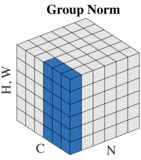
当输入张量为2D时,图像中的立方体由于没有三维垂直维数而变成正方形,因此在实际应用中,归一化是在输入矩阵的连续行的固定大小的连续段上进行的。
让我们看一个有一些代码的例子。
import torch
import torch.nn as nn

batch_size = 2
hidden_size = 32
n_groups = 8
group_size = hidden_size // n_groups # = 4

# Input tensor that can be the result of a fully-connected layer
x = torch.rand(batch_size, hidden_size)

# GroupNorm with affine disabled to simplify the inspection of results
gn1 = nn.GroupNorm(n_groups, hidden_size, affine=False)
r = gn1(x)

# The rows are split into n_groups (8) groups of size group_size (4)
# and the normalization is applied to these pieces of rows.
# We can check it for the first group x[0, :group_size] with the following code
first_group = x[0, :group_size]
normalized_first_group = (first_group - first_group.mean())/torch.sqrt(first_group.var(unbiased=False) + gn1.eps)
print(r[0, :4])
print(normalized_first_group)
if(torch.allclose(r[0, :4], normalized_first_group)):
print('The result on the first group is the expected one')页面原文内容由Stack Overflow提供。腾讯云小微IT领域专用引擎提供翻译支持
原文链接:
https://stackoverflow.com/questions/68286001
复制相关文章
相似问题
腾讯云开发者

Copyright © 2013 - 2026 Tencent Cloud. All Rights Reserved. 腾讯云 版权所有
深圳市腾讯计算机系统有限公司 ICP备案/许可证号:粤B2-20090059  粤公网安备44030502008569号
腾讯云计算(北京)有限责任公司 京ICP证150476号 | 京ICP备11018762号