
如何检查直线多边形是否相交
如何检查直线多边形是否相交
提问于 2021-04-18 20:33:53
我试图在C中创建一个程序来检查直线多边形的直线在任何一点上是否相交。
我只需要简单的直线多边形,在任何一点都不相交。它可以是逆时针,也可以是顺时针.
方向值将小于10。NS方向必须与我们的方向交替,反之亦然。
正在传递的输入以来自输入文件(例如;)的方向的形式传递,并且还显示在图片中:
S_2 E_4 S_2 E_4 N_2 W_4 N_2 W_4
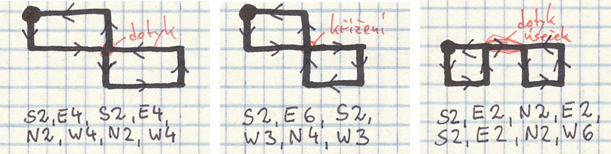
我试图将点存储在二维数组中,每个点都被检查为真,但我无法弄清楚如何在逆时针方向移动,因为这些点可能是N4 E6或S4 W6。在这种情况下,如果我将值加为N-4 (x,y) = (0,4),而当S-4 (x,y) = (0,-4)时减去,则当将其用作数组中的索引时,将失败。
int arr[10][10];
int xPrime = 0, yPrime = 0;

bool checkContinuity(int y, const char * dir ){

    if(strcmp(dir, "S")==0){
        y = -y;
        cols = y;
        int j;
        for(j = cols; j >= 0; j--){
            if(arr[xPrime][j] == 1 && j != yPrime){
                return false;
            }
            arr[xPrime][j] = 1;
            printf(" %d ", j);
        }
        yPrime -= y;
        if(yPrime < 0)
            yPrime = -yPrime;
    }
    else if(strcmp(dir, "W")==0){
        y = -y;
        cols = y;
        int j;
        for(j = cols; j >= 0; j--){
            if(arr[j][yPrime] == 1 && j != xPrime && (j != 0 && yPrime != 0)){
                return false;
            }
            arr[j][yPrime] = 1;
            printf(" %d ", j);
        }
        xPrime -= y;
        if(xPrime < 0)
            xPrime = -xPrime;
    }
    else if(strcmp(dir, "N")==0){
        cols = y;
        int j;
        for(j = 0; j <= cols; j++){
            if(arr[xPrime][j] == 1)
                return false;
            arr[xPrime][j] = 1;
            printf(" %d ", j);
        }
        yPrime += y;
    }
    else if(strcmp(dir, "E")==0){
        cols = y;
        int j;
        for(j = 0; j <= cols; j++){
            if(arr[j][yPrime] == 1 && j != xPrime)
                return false;
            arr[j][yPrime] = 1;
            printf(" %d ", j);
        }
        xPrime += y;
    }
    else
        return false;

    return true;
}回答 1
Stack Overflow用户
回答已采纳
发布于 2021-04-20 18:22:35
它可能更容易存储实际多边形,而不是所有可能的点的平面。然后,我们将不受点数组的选择(代码中的arr)的限制。参见此工作示例:
多边形存储在int数组P= {0,0,x1,y1,x2,y2,.}中。
- 片段是两点多边形.函数“交集”检查两个这样的段Q和P是否相交;如果是,则返回交集坐标.
- --它使用助手函数“中间”来模仿一个数字是否介于另外两个数字之间。
函数“next”计算多边形的下一个点,假设输入以char-string形式提供(例如:"S2E4S2E4N2W4N2W4") )。
函数main中的
- 现在循环遍历所有段,并检查它们是否与前面的段相交。
当然,应该在某个时候检查输入是否正常,等等,。
#include <stdio.h>
#include <string.h>
#include <stdlib.h>


void
next(           const char *s,
                int *v          )
{
        v[2] = v[0];
        v[3] = v[1];
        int step = s[1] - '0';
        switch(s[0]) {
        case 'S': v[3] -= step; break;
        case 'N': v[3] += step; break;
        case 'W': v[2] -= step; break;
        case 'E': v[2] += step; break;
        }
}


int
between(        int x,
                int a,
                int b           )
{
        return a < b ? x >= a && x <= b : x >= b && x <= a;
}

int
intersection(   int *P,
                int *Q,
                int *R          )
{
        if(P[0] == P[2] && Q[1] == Q[3]){  // P vertical, Q horizontal (w.l.o.g.)
                if(between(P[0], Q[0], Q[2]) && between(Q[1], P[1], P[3])){
                        R[0] = P[0];
                        R[1] = Q[1];
                        return 1;
                } else
                        return 0;
        }else if(Q[0] == Q[2] && P[1] == P[3])
                return intersection(Q, P, R);
        else return 0;
}

int
main() {
        char *s = "S2E4S2E4N2W4N2W4";

        int n = strlen(s) / 2,                                  // number of steps
                *P = calloc((n + 1) * 2, sizeof(int)),          // polygon
                R[2];                                           // intersection
        if(!P) exit(137);

        for(int k = 0; k < n; k++){
                next(s + 2 * k, P + 2 * k);
                for(int j = 0; j < k - 1; j++) {
                        if(intersection(P + k * 2, P + j * 2, R)) {
                                printf("Intersection at: %d, %d\n", R[0], R[1]);
                                exit(0);
                        }
                }
        }
        printf("No intersection\n");
}页面原文内容由Stack Overflow提供。腾讯云小微IT领域专用引擎提供翻译支持
原文链接:
https://stackoverflow.com/questions/67153126
复制相关文章
相似问题
腾讯云开发者

Copyright © 2013 - 2026 Tencent Cloud. All Rights Reserved. 腾讯云 版权所有
深圳市腾讯计算机系统有限公司 ICP备案/许可证号:粤B2-20090059  粤公网安备44030502008569号
腾讯云计算(北京)有限责任公司 京ICP证150476号 | 京ICP备11018762号