
B类如何与Lua一起继承A类?
我所知道的是做一个这样的课程:
A =
{
  x = 0,
  y = 0,
}

setmetatable(A, {
  __call = function(self, instance)
    return setmetatable(instance, { __index = A })
  end
})

function A:foo1()
  return string.format('Position(%d, %d)', self.x, self.y)
end

local a = A{ x = 7 } -- y will be 0 from class A
print(a.x) -- Prints 7
print(a.y) -- Prints 0
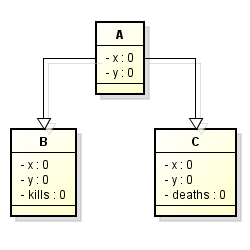
我不想让B类继承这个A类,这样我就可以在B类中进行自定义修改,但是从A类获得所有东西。
我正在制作一个名为“战场”的事件系统,也就是这个A级,我打算制作一些小游戏,比如“轰炸机”(它将是继承A类的B类),Pacman (它将是继承A类的C类),等等。我想得到所有的东西,从‘战场’类,使‘轰炸机’和‘帕克曼’与它。然后在“轰炸机”中做一些与'Pacman‘无关的定制修改,反之亦然。
示例:
B = -- B inherits A
{
  kills = 0,
}
-- So B class would have: x, y, kills

C = -- C inherits A
{
  deaths = 0,
}
-- So B class would have: x, y, deaths
回答 2
Stack Overflow用户
发布于 2021-02-14 00:57:05
我和我的朋友Kamenuvol一起研究这个问题。
我们正在寻找可读的和可维护的。
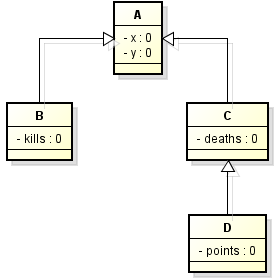
根据我们从Piglet的答案中了解到的,这是最后的结果:
function setClass(class, parentClass) -- (class[, parentClass])
  -- class.__className is required
  assert(class.__className, "Parameter '__className' is required.")

  -- Set class metatable
  setmetatable(class, {
    __index = parentClass,
    __call = function(self, instance)
      return setmetatable(instance, { __index = class })
    end
  })

  -- Attach 'is' function
  class[string.format('is%s', class.__className)] = true
end


A =
{
  __className = 'A',

  x = 0,
  y = 0,
}

setClass(A)

function A:foo1()
  return string.format('Position(%d, %d)', self.x, self.y)
end


B =
{
  __className = 'B',

  kills = 0,
}

setClass(B, A)

function B:foo2()
  return string.format('Kills(%d)', self.kills)
end


C =
{
  __className = 'C',

  deaths = 0,
}

setClass(C, A)

function C:foo3()
  return string.format('Deaths(%d)', self.deaths)
end


D =
{
  __className = 'D',

  points = 0,
}

setClass(D, C)

function D:foo4()
  return string.format('Points(%d)', self.points)
end


function A:foo5()
  return 'Hello'
end

A.foo = 'Foo'


local a = A{ x = 7 }
print(a.x) -- Prints 7
print(a.y) -- Prints 0
print(a.kills) -- Prints nil
print(a.deaths) -- Prints nil
print(a.points) -- Prints nil
print(a:foo1()) -- Prints Position(7, 0)

local b = B{ x = 8, y = 1 }
print(b.x) -- Prints 8
print(b.y) -- Prints 1
print(b.kills) -- Prints 0
print(b.deaths) -- Prints nil
print(b.points) -- Prints nil
print(b:foo1()) -- Prints Position(8, 1)
print(b:foo2()) -- Prints Kills(0)

local c = C{ x = 9, y = 2 }
print(c.x) -- Prints 9
print(c.y) -- Prints 2
print(c.kills) -- Prints nil
print(c.deaths) -- Prints 0
print(c.points) -- Prints nil
print(c:foo1()) -- Prints Position(9, 2)
print(c:foo3()) -- Prints Deaths(0)

local d = D{ x = 10, y = 3 }
print(d.x) -- Prints 10
print(d.y) -- Prints 3
print(d.kills) -- Prints nil
print(d.deaths) -- Prints 0
print(d.points) -- Prints 0
print(d:foo1()) -- Prints Position(10, 3)
print(d:foo4()) -- Prints Points(0)

print(a:foo5()) -- Prints Hello
print(b:foo5()) -- Prints Hello
print(c:foo5()) -- Prints Hello
print(d:foo5()) -- Prints Hello
print(a.foo) -- Prints Foo
print(b.foo) -- Prints Foo
print(c.foo) -- Prints Foo
print(d.foo) -- Prints Foo

print(a.isA) -- Prints true
print(a.isB) -- Prints nil
print(a.isC) -- Prints nil
print(a.isD) -- Prints nil

print(b.isA) -- Prints true
print(b.isB) -- Prints true
print(b.isC) -- Prints nil
print(b.isD) -- Prints nil

print(c.isA) -- Prints true
print(c.isB) -- Prints nil
print(c.isC) -- Prints true
print(c.isD) -- Prints nil

print(d.isA) -- Prints true
print(d.isB) -- Prints nil
print(d.isC) -- Prints true
print(d.isD) -- Prints trueStack Overflow用户
发布于 2021-02-13 10:00:53
继承是使用__index实现的。
请参阅https://www.lua.org/manual/5.4/manual.html#2.4
__index:索引访问操作表键。当表不是表或表中没有键时,就会发生此事件。这个元雪崩是在桌子的中间层向上看的。此事件的元雪崩可以是函数、表,也可以是带有__index元雪崩的任何值。如果它是一个函数,则以表和键作为参数调用它,调用的结果(调整为一个值)是操作的结果。否则,最后的结果是用键索引这个元值的结果。这个索引是规则的,而不是原始的,因此可以触发另一个__index元雪崩。
因此,无论什么东西在B中没有实现,您都可以将索引操作引用到A。
我建议你给我看一下
http://lua-users.org/wiki/InheritanceTutorial
您可以将所有的事情归结为这样的函数:
function CreateClass(...)
  -- "cls" is the new class
  local cls, bases = {}, {...}
  -- copy base class contents into the new class
  for i, base in ipairs(bases) do
    for k, v in pairs(base) do
      cls[k] = v
    end
  end
  -- set the class's __index, and start filling an "is_a" table that contains this class and all of its bases
  -- so you can do an "instance of" check using my_instance.is_a[MyClass]
  cls.__index, cls.is_a = cls, {[cls] = true}
  for i, base in ipairs(bases) do
    for c in pairs(base.is_a) do
      cls.is_a[c] = true
    end
    cls.is_a[base] = true
  end
  -- the class's __call metamethod
  setmetatable(cls, {__call = function (c, ...)
    local instance = setmetatable({}, c)
    -- run the init method if it's there
    local init = instance._init
    if init then init(instance, ...) end
    return instance
  end})
  -- return the new class table, that's ready to fill with methods
  return cls
end
如果你理解这个片段,你应该知道所有必要的东西。
https://stackoverflow.com/questions/66182231
复制相似问题
腾讯云开发者

Copyright © 2013 - 2026 Tencent Cloud. All Rights Reserved. 腾讯云 版权所有
深圳市腾讯计算机系统有限公司 ICP备案/许可证号:粤B2-20090059  粤公网安备44030502008569号
腾讯云计算(北京)有限责任公司 京ICP证150476号 | 京ICP备11018762号