
图解预测概率(logit)
目前,我正试图在r中绘制logit模型的预测概率。我遵循了这个链接的方法:https://stats.idre.ucla.edu/r/dae/logit-regression/。
考虑到利益集团类型,我已经成功地为布鲁塞尔办事处制作了地块。不过,我只想描绘个别的影响:例如,我想绘制布鲁塞尔办事处在与欧洲议会议员举行会议时的预测概率(即,当你有布鲁塞尔办事处时,与欧洲议会议员会晤的可能性是多少?)此外,我希望看到员工规模和/或组织形式对因变量的影响。
我还没有找到这样的办法。有什么建议吗?
提前谢谢你。
我的变量:
与欧洲议会议员的会议(因变量,虚拟)1是0否
利益集团类型(分类)1企业2咨询3非政府组织4公共当局5机构6工会/prof.org。7其他
布鲁塞尔办事处1是0否
组织形式1个人组织。2国家协会3欧洲协会4其他
工作人员人数(计数变量,以全时等值表示)范围为0.25至40
回答 2
Stack Overflow用户
发布于 2020-06-12 17:44:05
从昨天开始。
library(ggplot2)

# mydata <- read.csv("binary.csv")
str(mydata)
#> 'data.frame':    400 obs. of  4 variables:
#>  $ admit: int  0 1 1 1 0 1 1 0 1 0 ...
#>  $ gre  : int  380 660 800 640 520 760 560 400 540 700 ...
#>  $ gpa  : num  3.61 3.67 4 3.19 2.93 3 2.98 3.08 3.39 3.92 ...
#>  $ rank : int  3 3 1 4 4 2 1 2 3 2 ...

mydata$rank <- factor(mydata$rank)

mylogit <- glm(admit ~ gre + gpa + rank, data = mydata, family = "binomial")

summary(mylogit)
#>
#> Call:
#> glm(formula = admit ~ gre + gpa + rank, family = "binomial",
#>     data = mydata)
#>
#> Deviance Residuals:
#>     Min       1Q   Median       3Q      Max
#> -1.6268  -0.8662  -0.6388   1.1490   2.0790
#>
#> Coefficients:
#>              Estimate Std. Error z value Pr(>|z|)
#> (Intercept) -3.989979   1.139951  -3.500 0.000465 ***
#> gre          0.002264   0.001094   2.070 0.038465 *
#> gpa          0.804038   0.331819   2.423 0.015388 *
#> rank2       -0.675443   0.316490  -2.134 0.032829 *
#> rank3       -1.340204   0.345306  -3.881 0.000104 ***
#> rank4       -1.551464   0.417832  -3.713 0.000205 ***
#> ---
#> Signif. codes:  0 '***' 0.001 '**' 0.01 '*' 0.05 '.' 0.1 ' ' 1
#>
#> (Dispersion parameter for binomial family taken to be 1)
#>
#>     Null deviance: 499.98  on 399  degrees of freedom
#> Residual deviance: 458.52  on 394  degrees of freedom
#> AIC: 470.52
#>
#> Number of Fisher Scoring iterations: 4
我们将在x轴上绘制GPA图,让我们生成一些点
range(mydata$gpa) # using GPA for your staff size
#> [1] 2.26 4.00

gpa_sequence <- seq(from = 2.25, to = 4.01, by = .01) # 177 points along x axis
这是在IDRE的例子,但他们使它变得复杂。第一步构建一个数据框架,其中包含我们的GPA点序列,该列中每个条目的GRE平均值,以及我们的4个因素重复了177次。
constantGRE <- with(mydata, data.frame(gre = mean(gre), # keep GRE constant
                                       gpa = rep(gpa_sequence, each = 4), # once per factor level
                                       rank = factor(rep(1:4, times = 177)))) # there's 177

str(constantGRE)
#> 'data.frame':    708 obs. of  3 variables:
#>  $ gre : num  588 588 588 588 588 ...
#>  $ gpa : num  2.25 2.25 2.25 2.25 2.26 2.26 2.26 2.26 2.27 2.27 ...
#> $ rank: Factor w/ 4 levels "1","2","3","4": 1 2 3 4 1 2 3 4 1 2 ...对177个GPA值*4个因子水平中的每一个进行预测。将该预测放入一个名为theprediction的新列中
constantGRE$theprediction <- predict(object = mylogit,
                                      newdata = constantGRE,
                                      type = "response")
绘制每等级一条线,为线条涂上唯一的颜色。这些线不是直的,也不是完全平行的,也不是等距的。
ggplot(constantGRE, aes(x = gpa, y = theprediction, color = rank)) +
  geom_smooth()
#> `geom_smooth()` using method = 'loess' and formula 'y ~ x'
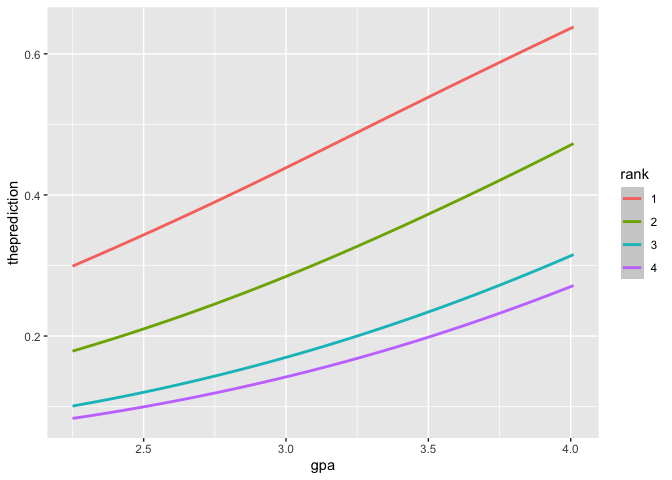
你可能会被诱惑,只是average的台词。不要。如果你想知道GPA的GRE,不包括排名,建立一个新的模型,因为(0.6357521 + 0.4704174 + 0.3136242 + 0.2700262) / 4不是正确的答案。
那,我们做吧。
# leave rank out call it new name

mylogit2 <- glm(admit ~ gre + gpa, data = mydata, family = "binomial")
summary(mylogit2)
#>
#> Call:
#> glm(formula = admit ~ gre + gpa, family = "binomial", data = mydata)
#>
#> Deviance Residuals:
#>     Min       1Q   Median       3Q      Max
#> -1.2730  -0.8988  -0.7206   1.3013   2.0620
#>
#> Coefficients:
#>              Estimate Std. Error z value Pr(>|z|)
#> (Intercept) -4.949378   1.075093  -4.604 4.15e-06 ***
#> gre          0.002691   0.001057   2.544   0.0109 *
#> gpa          0.754687   0.319586   2.361   0.0182 *
#> ---
#> Signif. codes:  0 '***' 0.001 '**' 0.01 '*' 0.05 '.' 0.1 ' ' 1
#>
#> (Dispersion parameter for binomial family taken to be 1)
#>
#>     Null deviance: 499.98  on 399  degrees of freedom
#> Residual deviance: 480.34  on 397  degrees of freedom
#> AIC: 486.34
#>
#> Number of Fisher Scoring iterations: 4
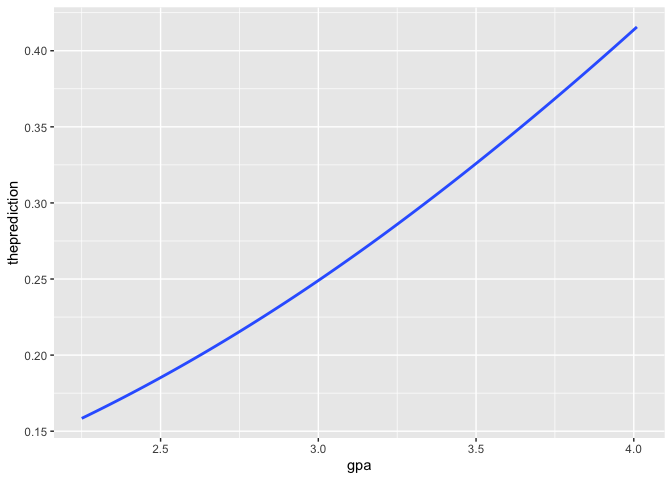
重复该过程的其余部分以获得一行
constantGRE2 <- with(mydata, data.frame(gre = mean(gre),
                                       gpa = gpa_sequence))
constantGRE2$theprediction <- predict(object = mylogit2,
                                      newdata = constantGRE2,
                                      type = "response")
ggplot(constantGRE2, aes(x = gpa, y = theprediction)) +
  geom_smooth()
#> `geom_smooth()` using method = 'loess' and formula 'y ~ x'
Stack Overflow用户
发布于 2020-06-11 22:09:21
由于您没有提供数据,所以我将使用您熟悉的UCLA示例中的dataset。你想这么做吗(假设排名是你的变量之一).
library(ggplot2)

mydata <- read.csv("binary.csv")
mydata$rank <- factor(mydata$rank)

mylogit <- glm(admit ~ gre + gpa + rank, data = mydata, family = "binomial")
summary(mylogit)
#>
#> Call:
#> glm(formula = admit ~ gre + gpa + rank, family = "binomial",
#>     data = mydata)
#>
#> Deviance Residuals:
#>     Min       1Q   Median       3Q      Max
#> -1.6268  -0.8662  -0.6388   1.1490   2.0790
#>
#> Coefficients:
#>              Estimate Std. Error z value Pr(>|z|)
#> (Intercept) -3.989979   1.139951  -3.500 0.000465 ***
#> gre          0.002264   0.001094   2.070 0.038465 *
#> gpa          0.804038   0.331819   2.423 0.015388 *
#> rank2       -0.675443   0.316490  -2.134 0.032829 *
#> rank3       -1.340204   0.345306  -3.881 0.000104 ***
#> rank4       -1.551464   0.417832  -3.713 0.000205 ***
#> ---
#> Signif. codes:  0 '***' 0.001 '**' 0.01 '*' 0.05 '.' 0.1 ' ' 1
#>
#> (Dispersion parameter for binomial family taken to be 1)
#>
#>     Null deviance: 499.98  on 399  degrees of freedom
#> Residual deviance: 458.52  on 394  degrees of freedom
#> AIC: 470.52
#>
#> Number of Fisher Scoring iterations: 4

newdata1 <- with(mydata, data.frame(gre = mean(gre), gpa = mean(gpa), rank = factor(1:4)))

newdata1
#>     gre    gpa rank
#> 1 587.7 3.3899    1
#> 2 587.7 3.3899    2
#> 3 587.7 3.3899    3
#> 4 587.7 3.3899    4

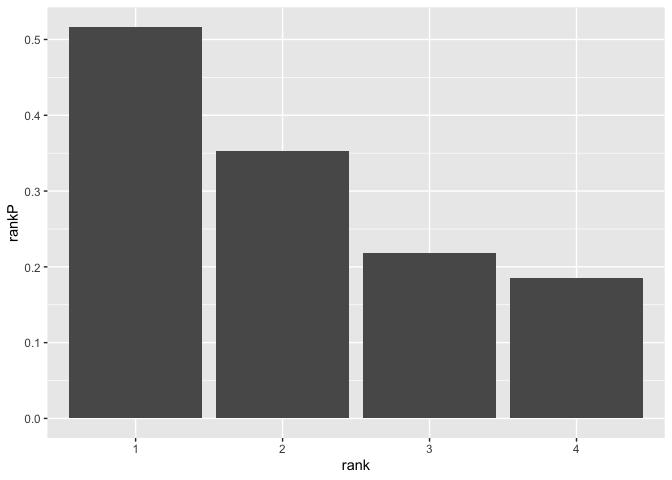
newdata1$rankP <- predict(mylogit, newdata = newdata1, type = "response")
newdata1
#>     gre    gpa rank     rankP
#> 1 587.7 3.3899    1 0.5166016
#> 2 587.7 3.3899    2 0.3522846
#> 3 587.7 3.3899    3 0.2186120
#> 4 587.7 3.3899    4 0.1846684

ggplot(newdata1, aes(x = rank, y = rankP)) +
   geom_col()
https://stackoverflow.com/questions/62331902
复制相似问题
腾讯云开发者

Copyright © 2013 - 2026 Tencent Cloud. All Rights Reserved. 腾讯云 版权所有
深圳市腾讯计算机系统有限公司 ICP备案/许可证号:粤B2-20090059  粤公网安备44030502008569号
腾讯云计算(北京)有限责任公司 京ICP证150476号 | 京ICP备11018762号