
将coroutine函数挂起,直到收到结果,然后继续
我正在慢慢地学习kotlin-coroutines,我想从简单的情况开始,在这种情况下,我遍历列表,每次调用一个API调用,等待响应,处理它,然后每次迭代都重复这个过程。
viewModelScope.launch {
     list.forEach { item ->
          Log.d("TESTING", "forEach iteration before calling test(): ${item.id}")

          test()

          Log.d("TESTING", "forEach iteration after calling test(): ${item.id}")
     }
}

suspend fun test(item.id: String) = coroutineScope {
    Log.d("TESTING", "suspend test before receiving response: ${item.id}")

    val apiRepsonse = async {
        repository.doingApiCall() {
            Log.d("TESTING", "response: ${item.id}")
        }
    }.await()

    Log.d("TESTING", "suspend test after receiving response: ${item.id}")
}所以,如果我们想象一下,list包含:{ 10, 15, 25, 35 } (id's)
我希望在logcat中收到以下信息:
Log.d("TESTING", "forEach iteration before calling test(): 10")
Log.d("TESTING", "suspend test before receiving response: 10")
Log.d("TESTING", "response: 10")
Log.d("TESTING", "suspend test after receiving response: 10")
Log.d("TESTING", "forEach iteration after calling test(): 10")
___________________
Log.d("TESTING", "forEach iteration before calling test(): 15")
Log.d("TESTING", "suspend test before receiving response: 15")
Log.d("TESTING", "response: 15")
Log.d("TESTING", "suspend test after receiving response: 15")
Log.d("TESTING", "forEach iteration after calling test(): 15")
...但是,现在我得到的是这样的东西:
Log.d("TESTING", "forEach iteration before calling test(): 10")
Log.d("TESTING", "suspend test before receiving response: 10")
Log.d("TESTING", "suspend test after receiving response: 10")
Log.d("TESTING", "forEach iteration after calling test(): 10")
Log.d("TESTING", "forEach iteration before calling test(): 15")
Log.d("TESTING", "suspend test before receiving response: 15")
Log.d("TESTING", "suspend test after receiving response: 15")
Log.d("TESTING", "forEach iteration after calling test(): 15")

Log.d("TESTING", "response: 10")
Log.d("TESTING", "response: 15")

...基本上,每个循环都会移动,而不会等待API异步响应。我以为.await()是为了这个场景而设计的,但我可能在这里遗漏了一些东西,因为它显然不像我想象的那样起作用。
回答 3
Stack Overflow用户
发布于 2020-02-24 13:19:53
变化
val apiRepsonse = async {
        repository.doingApiCall() {
            Log.d("TESTING", "response: ${item.id}")
        }
    }.await()
至
val apiRepsonse = async {
        Log.d("TESTING", "Start work in another 'thread'.")
        repository.doingApiCall() {
            Log.d("TESTING", "Finish work in another 'thread'.")
        }
    }.await()
Log.d("TESTING", "response: ${apiRepsonse.id}")
这样,您等待传递的价值就被实际使用了。
我想这能消除你对LogCat的困惑。
我试着自己解决你的问题,我已经把它写成了一个可以运行的测试,可以理解:
class TestFoo {

    @Test
    fun foo() {
        val job = GlobalScope.launch {
            listOf("10", "15").forEach { item ->
                println("TESTING forEach iteration before calling test(): ${item}")

                test(item)

                println("TESTING forEach iteration after calling test(): ${item}")
            }
        }
        while(job.isActive) {
            // wait
        }
    }

    private suspend fun test(item: String) = coroutineScope {
        println("TESTING suspend test before receiving response: ${item}")

        val apiRepsonse = async {
            delay(1000)
            println("TESTING response: ${item}")
            "Hello"
        }.await()

        println("TESTING suspend test after receiving response: ${item}")
    }

}
下面是"LogCat":
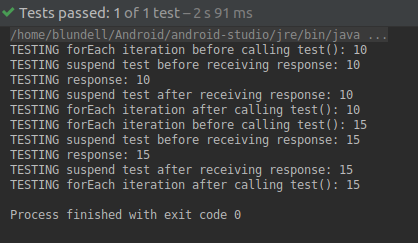
您是否因为repository.doingApiCall()中正在发生的线程处理而获得不同的日志?
Stack Overflow用户
发布于 2020-02-24 17:28:07
最有可能的是,repository.doingApiCall()不是一个适当的挂起函数,而是在不挂起协同线的情况下触发一些异步操作。看起来它需要一个lambda作为回调,这是另一个提示,即它不是一个挂起函数。
如果它是一个挂起函数,则不需要使用async来分派它。
顺便说一句,使用async并立即在其上调用await是使用withContext(Dispatchers.Default)的一种更复杂、更不优化的方法,它还可以默默地吞噬异常。
Stack Overflow用户
发布于 2020-02-24 13:41:10
没有测试,这应该有效:
// same code here
viewModelScope.launch {
     list.forEach { item ->
          Log.d("TESTING", "forEach iteration before calling test(): ${item.id}")

          test()

          Log.d("TESTING", "forEach iteration after calling test(): ${item.id}")
     }
}

suspend fun test(item.id: String) = withContext(Dispatchers.IO) {
    Log.d("TESTING", "suspend test before receiving response: ${item.id}")

    repository.doingApiCall() {
        Log.d("TESTING", "response: ${item.id}")
    }

    Log.d("TESTING", "suspend test after receiving response: ${item.id}")
}
有两件事改变了:
不要启动新的async.await,而是使用withContext()来挂起withContext()中的调用者
- ,您不需要使用
withContext()
https://stackoverflow.com/questions/60376171
复制相似问题
腾讯云开发者

Copyright © 2013 - 2026 Tencent Cloud. All Rights Reserved. 腾讯云 版权所有
深圳市腾讯计算机系统有限公司 ICP备案/许可证号:粤B2-20090059  粤公网安备44030502008569号
腾讯云计算(北京)有限责任公司 京ICP证150476号 | 京ICP备11018762号