
内部连接流数据
内部连接流数据
提问于 2020-02-19 09:02:18
所以我把这个流数据流(gps_messages)放在了pyspark中-
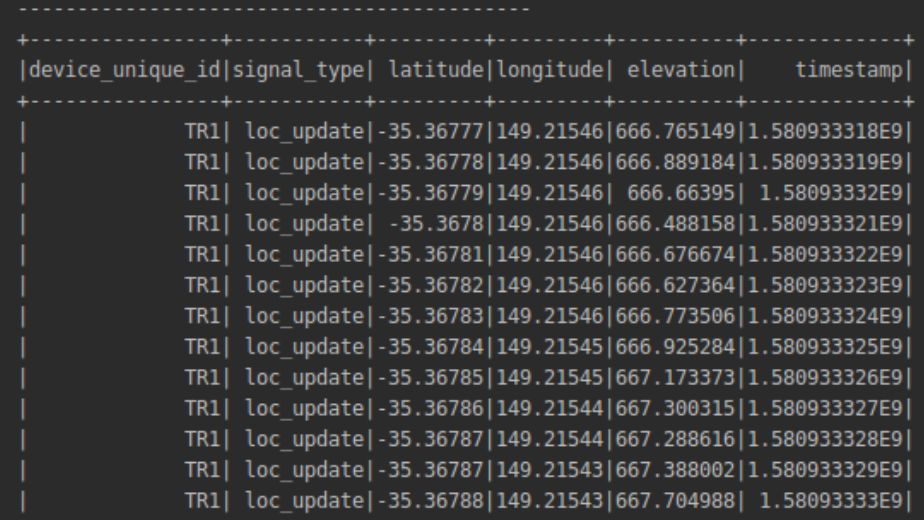
并且我希望得到的数据same有相同的(所有)列,但是对于每个具有时间戳最高值的device_unique_id,只有一个记录/行,所以基本上是这样的-
                                                              (MAX)
+----------------+-----------+--------+---------+---------+----------+
|device_unique_id|signal_type|latitude|longitude|elevation| Timestamp|
+----------------+-----------+--------+---------+---------+----------+
|       TR1      |loc_update |-35.5484|149.61684|666.47164|   12345  |  <-- *NOTE - please check below
|       TR2      |loc_update |-35.5484|149.61684|666.47164|   87251  |
|       TR3      |loc_update |-35.5484|149.61684|666.47164|   32458  |
|       TR4      |loc_update |-35.5484|149.61684|666.47164|   98274  |
+----------------+-----------+--------+---------+---------+----------+

*Note = only 1 record for TR1 from previous dataframe which had max value of timeframe among all records having 'device_unique_id'=='TR1'
到目前为止,我写了这段代码,
gps_messages.createOrReplaceTempView('gps_table')
SQL_QUERY = 'SELECT device_unique_id, max(timestamp) as timestamp ' \
            'FROM gps_table ' \
            'GROUP BY device_unique_id'

# SQL_QUERY1 = 'SELECT * ' \
#              'FROM gps_table t2 ' \
#              'JOIN (SELECT device_unique_id AS unique_id, max(timestamp) AS time ' \
#              'FROM gps_table t1 ' \
#              'GROUP BY unique_id) t1 ' \
#              'ON t2.device_unique_id = t1.unique_id ' \
#              'AND t2.timestamp = t1.time'

filtered_gps_messages = spark.sql(SQL_QUERY)

filtered_gps_messages.createOrReplaceTempView('table_max_ts')
SQL_QUERY = 'SELECT a.device_unique_id, a.signal_type, a.longitude, a.latitude, a.timestamp ' \
            'FROM table_max_ts b, gps_table a ' \
            'WHERE b.timestamp==a.timestamp AND b.device_unique_id==a.device_unique_id'

latest_data_df = spark.sql(SQL_QUERY)

query = latest_data_df \
    .writeStream \
    .outputMode('append') \
    .format('console') \
    .start()

query.awaitTermination()
把这个错误抛在脑后-
raise AnalysisException(s.split(': ', 1)[1], stackTrace)
pyspark.sql.utils.AnalysisException: 'Append output mode not supported when there are streaming aggregations on streaming DataFrames/DataSets without watermark;;\nProject [device_unique_id#25, signal_type#26, latitude#27, longitude#28, elevation#29, timestamp#30, unique_id#43, time#44]\n+- Join Inner, ((device_unique_id#25 = unique_id#43) && (timestamp#30 = time#44))\n   :- SubqueryAlias `t2`\n   :  +- SubqueryAlias `gps_table`\n   :     +- Project [json#23.device_unique_id AS device_unique_id#25, json#23.signal_type AS signal_type#26, json#23.latitude AS latitude#27, json#23.longitude AS longitude#28, json#23.elevation AS elevation#29, json#23.timestamp AS timestamp#30]\n   :        +- Project [jsontostructs(StructField(device_unique_id,StringType,true), StructField(signal_type,StringType,true), StructField(latitude,StringType,true), StructField(longitude,StringType,true), StructField(elevation,StringType,true), StructField(timestamp,StringType,true), value#21, Some(Asia/Kolkata)) AS json#23]\n   :           +- Project [cast(value#8 as string) AS value#21]\n   :              +- StreamingRelationV2 org.apache.spark.sql.kafka010.KafkaSourceProvider@49a5cdc2, kafka, Map(subscribe -> gpx_points_input, kafka.bootstrap.servers -> 172.17.9.26:9092), [key#7, value#8, topic#9, partition#10, offset#11L, timestamp#12, timestampType#13], StreamingRelation DataSource(org.apache.spark.sql.SparkSession@611544,kafka,List(),None,List(),None,Map(subscribe -> gpx_points_input, kafka.bootstrap.servers -> 172.17.9.26:9092),None), kafka, [key#0, value#1, topic#2, partition#3, offset#4L, timestamp#5, timestampType#6]\n   +- SubqueryAlias `t1`\n      +- Aggregate [device_unique_id#25], [device_unique_id#25 AS unique_id#43, max(timestamp#30) AS time#44]\n         +- SubqueryAlias `t1`\n            +- SubqueryAlias `gps_table`\n               +- Project [json#23.device_unique_id AS device_unique_id#25, json#23.signal_type AS signal_type#26, json#23.latitude AS latitude#27, json#23.longitude AS longitude#28, json#23.elevation AS elevation#29, json#23.timestamp AS timestamp#30]\n                  +- Project [jsontostructs(StructField(device_unique_id,StringType,true), StructField(signal_type,StringType,true), StructField(latitude,StringType,true), StructField(longitude,StringType,true), StructField(elevation,StringType,true), StructField(timestamp,StringType,true), value#21, Some(Asia/Kolkata)) AS json#23]\n                     +- Project [cast(value#8 as string) AS value#21]\n                        +- StreamingRelationV2 org.apache.spark.sql.kafka010.KafkaSourceProvider@49a5cdc2, kafka, Map(subscribe -> gpx_points_input, kafka.bootstrap.servers -> 172.17.9.26:9092), [key#7, value#8, topic#9, partition#10, offset#11L, timestamp#12, timestampType#13], StreamingRelation DataSource(org.apache.spark.sql.SparkSession@611544,kafka,List(),None,List(),None,Map(subscribe -> gpx_points_input, kafka.bootstrap.servers -> 172.17.9.26:9092),None), kafka, [key#0, value#1, topic#2, partition#3, offset#4L, timestamp#5, timestampType#6]\n'

Process finished with exit code 1
如果我尝试用“完全”输出模式,上面写着-
分析异常:在完全模式下不支持两个流数据文件/数据集之间的内部连接,而只在附加模式中支持。
我在这里做错什么了?有没有其他办法或解决办法?为这类问题道歉,我是新来的火花。谢谢。
回答 1
Stack Overflow用户
回答已采纳
发布于 2020-02-19 15:56:25
看看这里的=>,http://spark.apache.org/docs/latest/structured-streaming-programming-guide.html#support-matrix-for-joins-in-streaming-queries,一些连接是不支持流模式的。
也许用左外接。
而在附加模式下编写应该是很有用的。
SQL_QUERY = 'SELECT a.device_unique_id, a.signal_type, a.longitude, a.latitude, a.timestamp ' \
        'FROM table_max_ts b
         LEFT JOIN gps_table a ' \
'ON b.timestamp==a.timestamp AND b.device_unique_id==a.device_unique_id'编辑:水印是必要的,以确保查找权限数据在一个时间管理器。用于外部连接
    filtered_gps_messagesW = filtered_gps_messages.withWatermark("timestamp", "2 hours")
    gps_messagesW= gps_messages.withWatermark("timestamp", "3 hours")
然后将您的水印DS注册为tmpTables,您应该是所需的ok.Adjust时间间隔。
页面原文内容由Stack Overflow提供。腾讯云小微IT领域专用引擎提供翻译支持
原文链接:
https://stackoverflow.com/questions/60296442
复制相关文章
相似问题
腾讯云开发者

Copyright © 2013 - 2026 Tencent Cloud. All Rights Reserved. 腾讯云 版权所有
深圳市腾讯计算机系统有限公司 ICP备案/许可证号:粤B2-20090059  粤公网安备44030502008569号
腾讯云计算(北京)有限责任公司 京ICP证150476号 | 京ICP备11018762号