
checkpoint_dir和fine_tune_checkpoint在tensorflow对象检测中有什么区别?
我使用这个链接来学习windows 10上的对象检测。
我准备了400张照片,并把它们分成两类(石头和汽车)。
然后我用这个命令训练:
cd E:\test\models-master\research\object_detection 模型_dir=训练/-num_ model_main.py _model_main.py=10000
在object_detection/model_main.py中,我看到一个名为checkpoint_dir的参数。
但是我不知道如何使用checkpoint_dir.If --我的模型被训练成6000多个步骤,training文件夹如下所示:
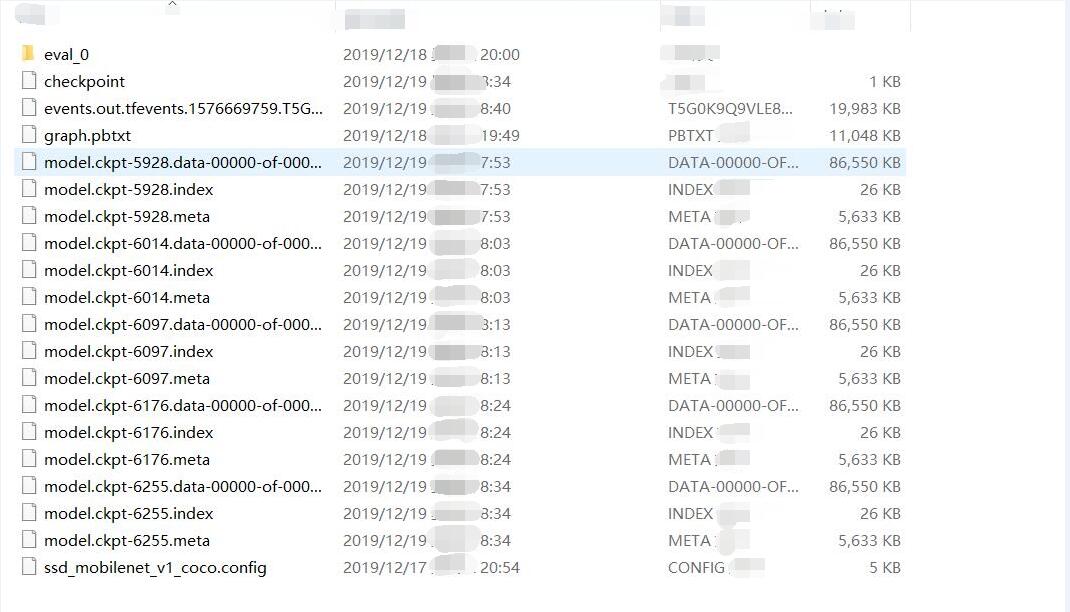
然后我停止训练我想继续训练的model.When,如何设置checkpoint_dir
我使用以下命令:
模型_dir=训练/-检查点_dir=训练/-num_ model_main.py _model_main.py=20000-alsologtostderr
当我添加--checkpoint_dir=training/时,模型没有继续训练。为什么?如何使用--checkpoint_dir?
我从ssd_mobilenet_v1_coco_2018_01_28.tar.gz下载动物园。
然后,我将ssd_mobilenet_v1_coco_2018_01_28.tar.gz解压缩到object_detection/ssd_mobilenet_v1_coco_2018_01_28文件夹。
object_detection/ssd_mobilenet_v1_coco_2018_01_28文件夹中的文件如下:
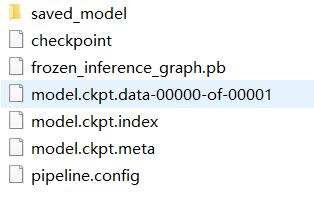
那么如何在fine_tune_checkpoint中使用training/ssd_mobilenet_v1_coco.config
training/ssd_mobilenet_v1_coco.config中的内容如下所示:
# SSD with Mobilenet v1 configuration for MSCOCO Dataset.
# Users should configure the fine_tune_checkpoint field in the train config as
# well as the label_map_path and input_path fields in the train_input_reader and
# eval_input_reader. Search for "PATH_TO_BE_CONFIGURED" to find the fields that
# should be configured.

model {
  ssd {
    num_classes: 2
    box_coder {
      faster_rcnn_box_coder {
        y_scale: 10.0
        x_scale: 10.0
        height_scale: 5.0
        width_scale: 5.0
      }
    }
    matcher {
      argmax_matcher {
        matched_threshold: 0.5
        unmatched_threshold: 0.5
        ignore_thresholds: false
        negatives_lower_than_unmatched: true
        force_match_for_each_row: true
      }
    }
    similarity_calculator {
      iou_similarity {
      }
    }
    anchor_generator {
      ssd_anchor_generator {
        num_layers: 6
        min_scale: 0.2
        max_scale: 0.95
        aspect_ratios: 1.0
        aspect_ratios: 2.0
        aspect_ratios: 0.5
        aspect_ratios: 3.0
        aspect_ratios: 0.3333
      }
    }
    image_resizer {
      fixed_shape_resizer {
        height: 300
        width: 300
      }
    }
    box_predictor {
      convolutional_box_predictor {
        min_depth: 0
        max_depth: 0
        num_layers_before_predictor: 0
        use_dropout: false
        dropout_keep_probability: 0.8
        kernel_size: 1
        box_code_size: 4
        apply_sigmoid_to_scores: false
        conv_hyperparams {
          activation: RELU_6,
          regularizer {
            l2_regularizer {
              weight: 0.00004
            }
          }
          initializer {
            truncated_normal_initializer {
              stddev: 0.03
              mean: 0.0
            }
          }
          batch_norm {
            train: true,
            scale: true,
            center: true,
            decay: 0.9997,
            epsilon: 0.001,
          }
        }
      }
    }
    feature_extractor {
      type: 'ssd_mobilenet_v1'
      min_depth: 16
      depth_multiplier: 1.0
      conv_hyperparams {
        activation: RELU_6,
        regularizer {
          l2_regularizer {
            weight: 0.00004
          }
        }
        initializer {
          truncated_normal_initializer {
            stddev: 0.03
            mean: 0.0
          }
        }
        batch_norm {
          train: true,
          scale: true,
          center: true,
          decay: 0.9997,
          epsilon: 0.001,
        }
      }
    }
    loss {
      classification_loss {
        weighted_sigmoid {
        }
      }
      localization_loss {
        weighted_smooth_l1 {
        }
      }
      hard_example_miner {
        num_hard_examples: 3000
        iou_threshold: 0.99
        loss_type: CLASSIFICATION
        max_negatives_per_positive: 3
        min_negatives_per_image: 0
      }
      classification_weight: 1.0
      localization_weight: 1.0
    }
    normalize_loss_by_num_matches: true
    post_processing {
      batch_non_max_suppression {
        score_threshold: 1e-8
        iou_threshold: 0.6
        max_detections_per_class: 100
        max_total_detections: 100
      }
      score_converter: SIGMOID
    }
  }
}

train_config: {
  batch_size: 10
  optimizer {
    rms_prop_optimizer: {
      learning_rate: {
        exponential_decay_learning_rate {
          initial_learning_rate: 0.004
          decay_steps: 800720
          decay_factor: 0.95
        }
      }
      momentum_optimizer_value: 0.9
      decay: 0.9
      epsilon: 1.0
    }
  }
  fine_tune_checkpoint: 'ssd_mobilenet_v1_coco_2018_01_28/model.ckpt'
  from_detection_checkpoint: true
  # Note: The below line limits the training process to 200K steps, which we
  # empirically found to be sufficient enough to train the pets dataset. This
  # effectively bypasses the learning rate schedule (the learning rate will
  # never decay). Remove the below line to train indefinitely.
  num_steps: 1000
  data_augmentation_options {
    random_horizontal_flip {
    }
  }
  data_augmentation_options {
    ssd_random_crop {
    }
  }
}

train_input_reader: {
  tf_record_input_reader {
    input_path:'data/train.record'
  }
  label_map_path:'data/side_vehicle.pbtxt'
}

eval_config: {
  num_examples: 8000
  # Note: The below line limits the evaluation process to 10 evaluations.
  # Remove the below line to evaluate indefinitely.
  max_evals: 10
}

eval_input_reader: {
  tf_record_input_reader {
    input_path: 'data/test.record'
  }
  label_map_path: 'data/side_vehicle.pbtxt'
  shuffle: false
  num_readers: 1
}
这两条线对吗?
fine_tune_checkpoint:‘ssd_mobilenet_v1_coco_2018_01_28/model.ckpt.coco’ from_detection_checkpoint:真
checkpoint_dir和fine_tune_checkpoint在tensorflow对象检测中有什么区别?
回答 1
Stack Overflow用户
发布于 2020-01-01 12:51:34
checkpoint_dir的功能在其名称上并不明显。此参数允许您提供模型的检查点,以便只对其进行评估,而不需要任何培训。实际上,如果您看到这个参数的帮助,您将得到
持有检查点的目录的路径。如果提供了
checkpoint_dir,那么这个二进制文件就会以唯一的形式运行,并将生成的指标写入model_dir。
另一方面,fine_tune_checkpoint是不言自明的,并且确实允许您提供一个检查点来微调。注意,如果您不设置fine_tune_checkpoint_type: "detection"和load_all_detection_checkpoint_vars: true,那么并不是所有可能的(即现有的和兼容的)变量都会被恢复。
https://stackoverflow.com/questions/59420206
复制相似问题
腾讯云开发者

Copyright © 2013 - 2026 Tencent Cloud. All Rights Reserved. 腾讯云 版权所有
深圳市腾讯计算机系统有限公司 ICP备案/许可证号:粤B2-20090059  粤公网安备44030502008569号
腾讯云计算(北京)有限责任公司 京ICP证150476号 | 京ICP备11018762号