
单周期傅里叶窗优化我的代码效率很低
日安
编辑:什么我想:从任何电流/电压波形的电力系统(PS),我希望滤波50赫兹(基本)均方根值的幅度(和有效的角度)。测量的电流包含100 as到1250 as之间的所有谐波,这取决于设备。不能用带有这些谐波的波来分析和计算,你的误差会变得如此之大(取决于设备),以至于PS保护设备计算不正确的数量。附加的信号还涉及许多其他频率分量。
My aim:PS保护继电器是特殊的,在很短的时间内计算一个20 PS的窗口。我不想弄到手。我正在使用外部记录技术和测试继电器所看到的是真实的,他们正确的操作。因此,我需要做他们所做的,只保留50赫兹的数值,没有任何谐波和直流。
重要的预期结果:给定信号中的任何频率分量,我想看到任意给定谐波的幅度(基波的150,250-3次谐波和5次谐波)以及直流的幅度。这将告诉我什么类型的PS设备可能注入这些频率。重要的是,我提供的频率和答案是一个向量的频率,只有与所有其他值过滤出来。基本的RMS与RMS不同,其因数为4000 A(仅50 of )和4500 A(包括其他频率)。
此代码计算给定频率的一个周期Fourier值(RMS)。有时我想叫傅里叶滤波器?用于电力系统50 0Hz/0HZ/150 0Hz模拟分析。(答案经过测试,是正确的基本均方根值。(https://users.wpi.edu/~goulet/Matlab/overlap/trigfs.html)
对于一个大的示例来说,代码非常慢。对于55000个数据点,它需要12秒。对于3个电压和3个电流,这是非常缓慢的。我每天看1000多张唱片。
我该如何增强它?有哪些Python技巧和技巧/库可以附加到我的列表/数组中。(也可以随意重写或使用代码)。我使用代码在给定的时间从信号中提取某些值。(这就像读取电力系统分析专用程序中的值一样)编辑:通过加载和使用文件,代码可以粘贴它:
import matplotlib.pyplot as plt
import csv
import math
import numpy as np
import cmath

# FILES ATTACHED TO POST
filenamecfg = r"E:/Python_Practise/2019-10-21 13-54-38-482.CFG"
filename = r"E:/Python_Practise/2019-10-21 13-54-38-482.DAT"

t = []
IR = []
newIR=[]
with open(filenamecfg,'r') as csvfile1:
    cfgfile = [row for row in csv.reader(csvfile1, delimiter=',')]
    numberofchannels=int(np.array(cfgfile)[1][0])
    scaleval = float(np.array(cfgfile)[3][5])
    scalevalI = float(np.array(cfgfile)[8][5])
    samplingfreq = float(np.array(cfgfile)[numberofchannels+4][0])
    numsamples = int(np.array(cfgfile)[numberofchannels+4][1])
    freq = float(np.array(cfgfile)[numberofchannels+2][0])
    intsample = int(samplingfreq/freq)
    #TODO neeeed to get number of samples and frequency and detect
#automatically
    #scaleval = np.array(cfgfile)[3]
    print('multiplier:',scaleval)
    print('SampFrq:',samplingfreq)
    print('NumSamples:',numsamples)
    print('Freq:',freq)


with open(filename,'r') as csvfile:
    plots = csv.reader(csvfile, delimiter=',')
    for row in plots:
        t.append(float(row[1])/1000000) #get time from us to s
        IR.append(float(row[6]))

newIR = np.array(IR) * scalevalI
t = np.array(t)


def mag_and_theta_for_given_freq(f,IVsignal,Tsignal,samples): #samples are the sample window size you want to caclulate for (256 in my case)
    # f in hertz, IVsignal, Tsignal in numpy.array
    timegap = Tsignal[2]-Tsignal[3]
    pi = math.pi
    w = 2*pi*f
    Xr = []
    Xc = []
    Cplx = []
    mag = []
    theta = []
    #print("Calculating for frequency:",f)
    for i in range(len(IVsignal)-samples):
        newspan = range(i,i+samples)
        timewindow = Tsignal[newspan]
        #print("this is my time: ",timewindow)
        Sig20ms = IVsignal[newspan]
        N = len(Sig20ms) #get number of samples of my current Freq
        RealI = np.multiply(Sig20ms, np.cos(w*timewindow)) #Get Real and Imaginary part of any signal for given frequency
        ImagI = -1*np.multiply(Sig20ms, np.sin(w*timewindow)) #Filters and calculates 1 WINDOW RMS (root mean square value).
        #calculate for whole signal and create a new vector. This is the RMS vector (used everywhere in power system analysis)
        Xr.append((math.sqrt(2)/N)*sum(RealI)) ### TAKES SO MUCH TIME
        Xc.append((math.sqrt(2)/N)*sum(ImagI)) ## these steps make RMS
        Cplx.append(complex(Xr[i],Xc[i]))
        mag.append(abs(Cplx[i]))
        theta.append(np.angle(Cplx[i]))#th*180/pi # this can be used to get Degrees if necessary
        #also for freq 0 (DC) id the offset is negative how do I return a negative to indicate this when i'm using MAGnitude or Absolute value
    return Cplx,mag,theta #mag[:,1]#,theta # BUT THE MAGNITUDE WILL NEVER BE zero

myZ,magn,th = mag_and_theta_for_given_freq(freq,newIR,t,intsample)

plt.plot(newIR[0:30000],'b',linewidth=0.4)#, label='CFG has been loaded!')
plt.plot(magn[0:30000],'r',linewidth=1)

plt.show()
考虑到附加的文件,粘贴的代码运行平稳。
编辑:请在这里找到一个测试CSV文件和COMTRADE测试文件: CSV:MtYAeTBm7tNQTcQkTnFWQ4LUu
商品贸易委员会( COMTRADE Ocv9x/view?usp=共享 A9GrqAgFtD/view?usp=共享 )
回答 1
Stack Overflow用户
发布于 2019-11-20 16:08:07
前言
正如我在之前的评论中所说:
您的代码主要依赖于具有大量指数化和标量操作的
for循环。您已经导入了numpy,因此您应该利用矢量化。
这个答案是你的解决方案的开始。
轻量化MCVE
首先,我们为MCVE创建了一个试用信号:
import numpy as np

# Synthetic signal sampler: 5s sampled as 400 Hz
fs = 400 # Hz
t = 5    # s
t = np.linspace(0, t, fs*t+1)

# Synthetic Signal: Amplitude is about 325V @50Hz
A = 325 # V
f = 50  # Hz
y = A*np.sin(2*f*np.pi*t) # V然后,我们可以使用通常的公式计算这个信号的均方根:
# Actual definition of RMS:
yrms = np.sqrt(np.mean(y**2)) # 229.75 V或者,我们也可以使用DFT (在numpy.fft中实现为rfft )计算它:
# RMS using FFT:
Y = np.fft.rfft(y)/y.size
Yrms = np.sqrt(np.real(Y[0]**2 + np.sum(Y[1:]*np.conj(Y[1:]))/2)) # 229.64 V这里可以找到最后一个公式起作用的原因的演示。这是有效的,因为Parseval定理暗示傅里叶变换确实节省能量。
这两个版本都使用了矢量化函数,不需要分割实部和虚部进行计算,然后重新组装成一个复数。
MCVE:窗口
我怀疑您希望将此功能作为一个长期意甲的窗口,在这里RMS值即将发生变化。然后,我们可以使用提供时间序列商品的pandas库来解决这个问题。
import pandas as pd我们封装了RMS功能:
def rms(y):
    Y = 2*np.fft.rfft(y)/y.size
    return np.sqrt(np.real(Y[0]**2 + np.sum(Y[1:]*np.conj(Y[1:]))/2))
我们产生一个阻尼信号(可变均方根)
y = np.exp(-0.1*t)*A*np.sin(2*f*np.pi*t) 为了利用rolling或resample方法,我们将试用信号封装到数据文件中:
df = pd.DataFrame(y, index=t*pd.Timedelta('1s'), columns=['signal'])你的信号的滚动均方根是:
df['rms'] = df.rolling(int(fs/f)).agg(rms)定期抽样的均方根是:
df['signal'].resample('1s').agg(rms)后一批返回:
00:00:00    2.187840e+02
00:00:01    1.979639e+02
00:00:02    1.791252e+02
00:00:03    1.620792e+02
00:00:04    1.466553e+02
信号调理
满足您只保留基本谐波(50 Hz)的需要,一个简单的解决方案可以是线性下降趋势 (消除常数和线性趋势),然后是一个巴特沃斯 过滤器 (带通滤波器)。
我们用其他频率和线性趋势产生合成信号:
y = np.exp(-0.1*t)*A*(np.sin(2*f*np.pi*t) \
     + 0.2*np.sin(8*f*np.pi*t) + 0.1*np.sin(16*f*np.pi*t)) \
     + A/20*t + A/100
然后我们给信号设定条件:
from scipy import signal
yd = signal.detrend(y, type='linear')
filt = signal.butter(5, [40,60], btype='band', fs=fs, output='sos', analog=False)
yfilt = signal.sosfilt(filt, yd)
从图形上看,它导致:
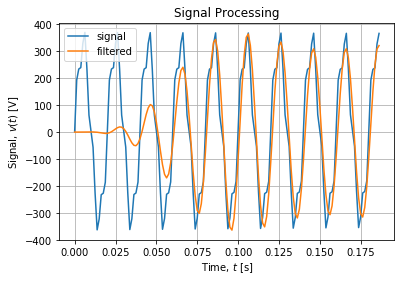
在均方根计算前恢复信号调理。
https://stackoverflow.com/questions/58953546
复制相似问题
腾讯云开发者

Copyright © 2013 - 2026 Tencent Cloud. All Rights Reserved. 腾讯云 版权所有
深圳市腾讯计算机系统有限公司 ICP备案/许可证号:粤B2-20090059  粤公网安备44030502008569号
腾讯云计算(北京)有限责任公司 京ICP证150476号 | 京ICP备11018762号