
Springboot 2 RSocket应用程序启动后立即停止,没有错误消息。
Springboot 2 RSocket应用程序启动后立即停止,没有错误消息。
提问于 2019-12-04 09:07:06
我只是使用RSocket初学者选择了一个springboot应用程序示例:
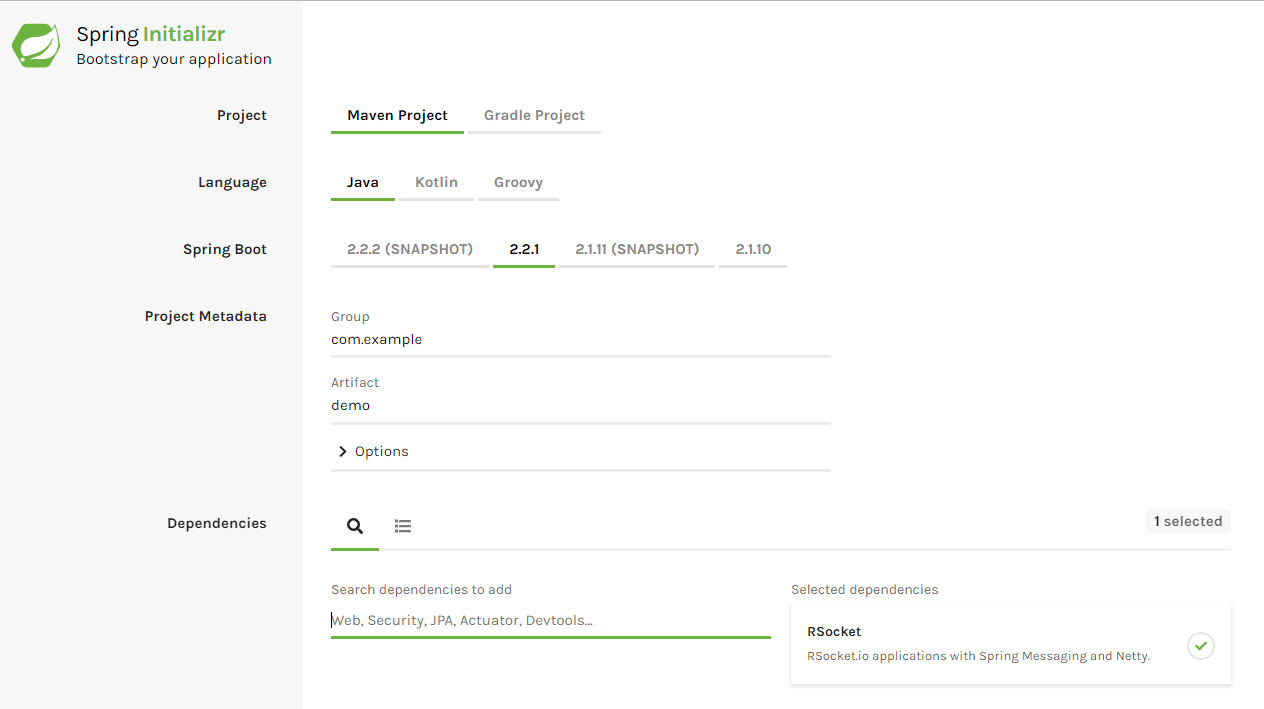
构建,然后运行可运行的jar将给出以下日志:
  .   ____          _            __ _ _
 /\\ / ___'_ __ _ _(_)_ __  __ _ \ \ \ \
( ( )\___ | '_ | '_| | '_ \/ _` | \ \ \ \
 \\/  ___)| |_)| | | | | || (_| |  ) ) ) )
  '  |____| .__|_| |_|_| |_\__, | / / / /
 =========|_|==============|___/=/_/_/_/
 :: Spring Boot ::        (v2.2.1.RELEASE)

2019-12-04 09:45:20.985  INFO 12928 --- [           main] com.example.DemoApplication         : Starting DemoApplication on XXX with PID 1234 (demo/target/classes started by me in ~/demo)
2019-12-04 09:45:20.987  INFO 12928 --- [           main] com.example.DemoApplication         : No active profile set, falling back to default profiles: default
2019-12-04 09:45:21.761  INFO 12928 --- [           main] com.example.DemoApplication         : Started DemoApplication in 1.172 seconds (JVM running for 2.378)

Process finished with exit code 0
问题是Springboot主线程不需要等待RSocket请求就会立即停止。我想问题是RSocket服务器没有启动,所以我尝试添加一个RSocket控制器,如下所示:
@Controller
public class DemoController {

    @MessageMapping("retreiveSomeData")
    public Mono<Data> retreiveAccount(String criteria) {
        return Mono.just(new Data());
    }

}
相同结果^^
任何使用RSocket和SpringBoot的人都能找到一种“漂亮”的方式来迫使Springboot线程等待?
回答 1
Stack Overflow用户
回答已采纳
发布于 2019-12-05 08:06:37
解决方案是添加一个RSocket配置。
只需添加以下application.yaml:
# application.yaml
spring:
  rsocket:
    server:
      port: 7000
然后Netty服务器将在端口7000上启动:
  .   ____          _            __ _ _
  /\\ / ___'_ __ _ _(_)_ __  __ _ \ \ \ \
  ( ( )\___ | '_ | '_| | '_ \/ _` | \ \ \ \
  \\/  ___)| |_)| | | | | || (_| |  ) ) ) )
  '  |____| .__|_| |_|_| |_\__, | / / / /
  =========|_|==============|___/=/_/_/_/
  :: Spring Boot ::        (v2.2.1.RELEASE)

INFO 4472 --- [           main] com.example.DemoApplication       : Starting DemoApplication on ...
INFO 4472 --- [           main] com.example.DemoApplication       : No active profile set, falling back to default profiles: default
INFO 4472 --- [           main] o.s.b.rsocket.netty.NettyRSocketServer   : Netty RSocket started on port(s): 7000
INFO 4472 --- [ main] com.example.DemoApplication : Started DemoApplication in 2.704 seconds (JVM running for 3.142)页面原文内容由Stack Overflow提供。腾讯云小微IT领域专用引擎提供翻译支持
原文链接:
https://stackoverflow.com/questions/59172347
复制相关文章
相似问题
腾讯云开发者

Copyright © 2013 - 2026 Tencent Cloud. All Rights Reserved. 腾讯云 版权所有
深圳市腾讯计算机系统有限公司 ICP备案/许可证号:粤B2-20090059  粤公网安备44030502008569号
腾讯云计算(北京)有限责任公司 京ICP证150476号 | 京ICP备11018762号