
多边形有开边吗?考虑R {spdep}中的完全/部分邻居
我想知道如何定义,如果多边形有一个开边或没有。我认为,如果多边形完全被邻居包围,它就没有开边。
使用奇妙的poly2nb(fc),我可以得到邻居的列表:但是,从这个列表中,我不知道有多少邻居必须被邻居完全包围?情况如下:
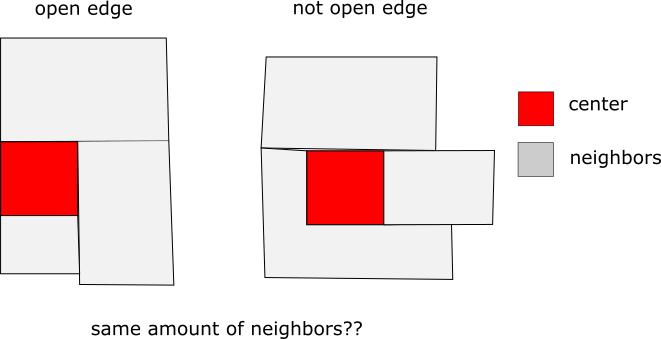
在这两种情况下,我的中心red多边形都有3个邻居,但是有开边(左),或者被邻居完全包围(右)。如果使用raster格式和皇后case,则完全包围单元需要8个邻居。如果它少了,它就是开放的细胞。但是,我可以从poly2nb(fc)和nb对象获得类似的信息吗?当然,我的数据可以包含单个多边形之间的条条和空白,所以我不想完全依赖于重叠的边缘或其他东西。
我的真实数据可以在dropbox或googleDrive上获得
以及计算邻居数量的r代码示例:
setwd("U:/Desktop/raw/myDir")

# Read input forest stand data
forest_fc = readOGR(getwd(),
                    layer = "forest_fc")

# continuity based neighbourhood:
# import whole
# shapefile, do not split it by one feature at time
nb <- poly2nb(forest_fc,
              #row.names = forest_fc,
              snap = 0) # snap to correct for the gaps/slivers

# store the number of neighbours by cell
forest_fc$nb_count<- card(nb)

plot(forest_fc,
     col = "white",
     border = "grey")
plot(nb,
     coordinates(forest_fc),
     add = T,
     lwd = 2,
     col = "black",
     pch = 16,
     cex = 0.5)
text(forest_fc, "nb_count", col = "red", cex = 1.2)
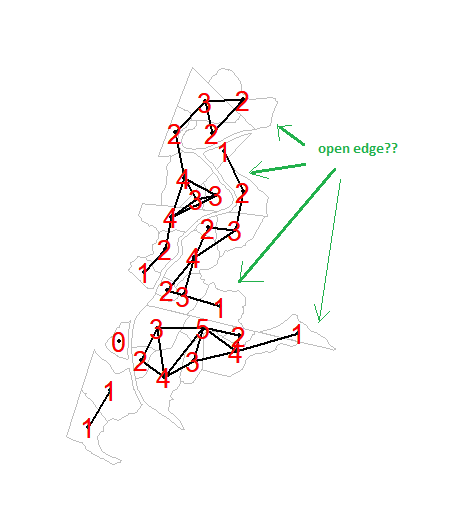
如何区分完全包围的多边形和开边的多边形?
回答 1
Stack Overflow用户
发布于 2020-03-09 14:53:59
该方案结合了邻域和基于距离的邻域。邻居是离中央看台在缓冲范围内的看台。在下列情况下,展台具有开阔的边缘:
- 没有邻居
- 近邻林分与周围林分的树高差小于5。
- 如果空间擦除‘缓冲器-邻居’大于一定值,这里我使用16米。
下面是一个考虑到开放边缘的不同情况的模式,但是它有相同数量的邻居:
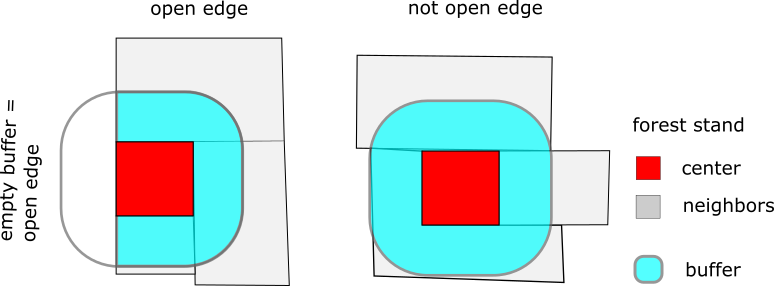
我的函数逐行遍历shapefile。对于每一行,它基于缓冲区标识一组邻居,并将其与其邻居的高度进行比较。如果差值小于5,则通过从缓冲区中擦除邻居来另外检查间隙是否存在。
以下是整个功能:
defineOpenEdge <- function(spdf, treeHeight, distance = 10, pixel.width = 16, ...) {

  # loop through the dataframe
  spdf@data$open_edge <- FALSE
  for (i in seq_along(spdf)) {

    # define stands and leftover forest
    one  = spdf[i, ]
    left = spdf[-i,]

    # Create buffer and intersectb buffer with neighbors: evalues if any are left?
    buff = buffer(one, distance)


    # Identify neighbors
    nbrs.buff <- left[which(gOverlaps(sp::geometry(buff),
                                      sp::geometry(left),
                                      byid = TRUE)),]

    # Conditions for open edge:
    #    - no neighbors
    if (nrow(nbrs.buff) == 0) {
      spdf@data[i,]$open_edge <- TRUE

    } else {  # neighbors are smaller than the stands

      # Compare the height of the stands:
      height.one  = rep(one@data$treeHeight, nrow(nbrs.buff))
      height.nbrs = nbrs.buff@data$treeHeight

      # Get the differences between the neighbouring stands
      difference = height.one - height.nbrs

      # compare here the tree heights of stands
      if(any(difference > 5)) {
        spdf@data[i,]$open_edge <- TRUE

      # Check if there is a big gap in neighborhood
      } else {

        # Get the difference between two shapefiles???
        int.buff.one = rgeos::gDifference(buff, nbrs.buff + one)

        # Is the size of the openning larger than one pixel 16x16 m?
        if (!is.null(int.buff.one) ) {

          # Calculate area of intersected data
          int.buff.one.area = gArea(int.buff.one)

          if (int.buff.one.area > 16*16) {
            spdf@data[i,]$open_edge <- TRUE
          }
        }
      }
    }
  }
 return(spdf)
}
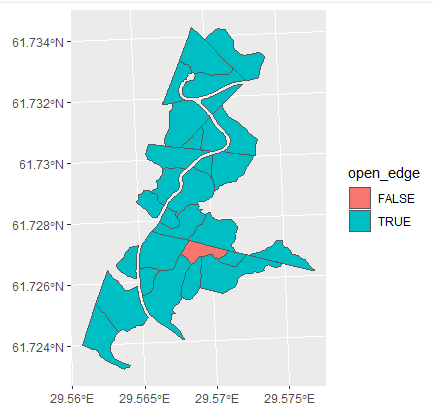
这个标识,如果站有开放的边缘或没有。在缓冲器尺寸为10米时,我的开阔地站是:
https://stackoverflow.com/questions/59928665
复制相似问题
腾讯云开发者

Copyright © 2013 - 2026 Tencent Cloud. All Rights Reserved. 腾讯云 版权所有
深圳市腾讯计算机系统有限公司 ICP备案/许可证号:粤B2-20090059  粤公网安备44030502008569号
腾讯云计算(北京)有限责任公司 京ICP证150476号 | 京ICP备11018762号