
基本电路的数据结构
基本电路的数据结构
提问于 2020-01-28 20:58:54
要创建一个非常、非常基本的电路仿真器,可以接受以下组件:
一种固定的、不改变电压的直流电池电源--零resistance
- Resistors和固定电阻的
- 线连接
我想“描述”这样的设置:
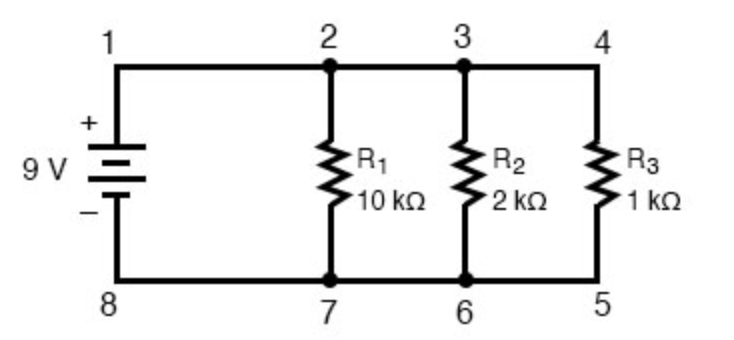
我想“组件”应该是这样的:
class Battery:
    def __init__(self, voltage=None):
        self.voltage = voltage

class Resistor:
    def __init__(self, resistance=None):
        self.resistance = resistance

class Wire:
    # how to describe variable connections?


>>> V = Battery(9)
>>> R1, R2, R3 = Resistor(10e3), Resistor(2e3), Resistor(1e3)
然后,一旦我有了这些组件,有什么例子来描述它们是如何‘连接’的呢?
回答 1
Stack Overflow用户
回答已采纳
发布于 2020-01-28 21:08:48
您可以添加start和end参数,这些参数指示电路中组件的位置。
class BaseComponent:
    def __init__(self, start, end):
        self.start = start
        self.end = end

    def __repr__(self):
        return f'<{self.__class__.__name__} start={self.start} end={self.end} at 0x{id(self):x}>'

    def __eq__(self, other):
        if not type(self)==type(other):
            return False
        return all(v==getattr(other, k) for k, v in self.__dict__.items())

class Battery(BaseComponent):
    def __init__(self, start, end, voltage=None):
        super().__init__(start, end)
        self.voltage = voltage

class Resistor(BaseComponent):
    def __init__(self, start, end, resistance=None):
        super().__init__(start, end)
        self.resistance = resistance

class Wire(BaseComponent):
    def __init__(self, start, end):
        super().__init__(start, end)
然后,您可以通过以下方式进行布局:
V = Battery(8, 1, voltage=9)
w1, w2, w3 = Wire(1, 2), Wire(2, 3), Wire(3, 4)
R1, R2, R3 = Resistor(2, 7, 10e3), Resistor(3, 6, 2e3), Resistor(4, 5, 1e3)
w5, w6, w7 = Wire(5, 6), Wire(6, 7), Wire(7, 8)
如果你想得到花哨,你也可以把它变成一个图形。
class Circuit:
    """A directed graph structure for building circuits"""

    def __init__(self):
        """Creates the graph.  Note only one edge is allowed between nodes"""
        self._outward = {}
        self._inward = {}

    @staticmethod
    def _norm(name):
        return str(name)

    def add_node(self, name):
        """
        Adds a single node to the graph. The `name` is converted to a string.
        """
        node = self._norm(name)
        # check for existance
        if node in self._outward:
            return node
        self._outward.setdefault(node, {})
        self._inward.setdefault(node, {})
        return node

    def add_component(self, component):
        """
        Adds a circuitry component to the circuit.
        """
        s = self._norm(component.start)
        e = self._norm(component.end)
        if self.has_edge(s, e):
            raise KeyError(f'A link from {s} to {e} already exists')
        start = self.add_node(component.start)
        end = self.add_node(component.end)
        self._outward[start][end] = component
        self._inward[end][start] = component

    def has_node(self, node):
        return self._norm(node) in self._outward

    def has_component(self, component):
        start = self._norm(component.start)
        end = self._norm(component.end)
        return component==self._outward.get(start, {}).get(end)

    def has_edge(self, start, end):
        s = self._norm(start)
        e = self._norm(end)
        return bool(e in self._outward.get(s, {}))

    def __iadd__(self, other):
        self.add_component(other)
        return self
从这里你可以通过以下方式建立电路:
circuit = Circuit()
for c in (V, w1, w2, w3, R1, R2, R3, w5, w6, w7):
circuit.add_component(c)页面原文内容由Stack Overflow提供。腾讯云小微IT领域专用引擎提供翻译支持
原文链接:
https://stackoverflow.com/questions/59956935
复制相关文章
相似问题
腾讯云开发者

Copyright © 2013 - 2026 Tencent Cloud. All Rights Reserved. 腾讯云 版权所有
深圳市腾讯计算机系统有限公司 ICP备案/许可证号:粤B2-20090059  粤公网安备44030502008569号
腾讯云计算(北京)有限责任公司 京ICP证150476号 | 京ICP备11018762号