
Python功能工程师移动数据
嗨,我正在尝试设计一个从运动水平到病人级别的病人数据集。
原始df如下所示:
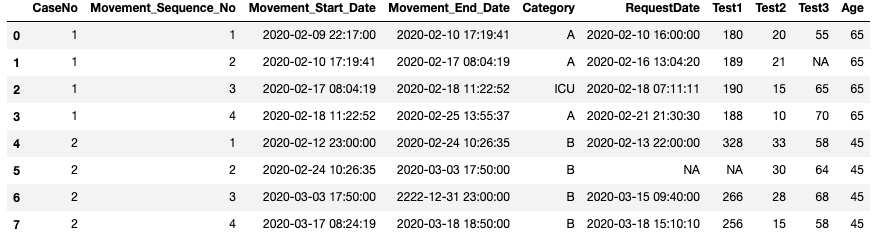
条件:
1)创建Last Test<n> Change cols -用于遇到Category值“ICU”的CaseNo,在“ICU”值之前进行Test<n>更改( Test1值为189-180,CaseNo 1),否则采用最新的Test<n>更改( Test1、CaseNo 2为256-266)。
2)创建Test<n>_Pattern cols --对于遇到Category值‘Category’的CaseNo,将所有的Test<n>值从开始到“ICU”值之前进行传递。否则,将所有Test<n>值从开始到结束。
3)创建Last Test<n> Count cols -对于遇到Category值‘Category’的CaseNo,在“ICU”相遇之前取最后一个Test<n>值。否则,取最后一个Test<n>值。
预期结果

我怎么用Python来做这件事?
用于df的代码
df = pd.DataFrame({'CaseNo':[1,1,1,1,2,2,2,2],
                    'Movement_Sequence_No':[1,2,3,4,1,2,3,4],
                    'Movement_Start_Date':['2020-02-09 22:17:00','2020-02-10 17:19:41','2020-02-17 08:04:19',
                                           '2020-02-18 11:22:52','2020-02-12 23:00:00','2020-02-24 10:26:35',
                                           '2020-03-03 17:50:00','2020-03-17 08:24:19'],
                    'Movement_End_Date':['2020-02-10 17:19:41','2020-02-17 08:04:19','2020-02-18 11:22:52',
                                         '2020-02-25 13:55:37','2020-02-24 10:26:35','2020-03-03 17:50:00',
                                         '2222-12-31 23:00:00','2020-03-18 18:50:00'],
                    'Category':['A','A','ICU','A','B','B','B','B'],
                    'RequestDate':['2020-02-10 16:00:00','2020-02-16 13:04:20','2020-02-18 07:11:11','2020-02-21 21:30:30',
                                   '2020-02-13 22:00:00','NA','2020-03-15 09:40:00','2020-03-18 15:10:10'],
                    'Test1':['180','189','190','188','328','NA','266','256'],
                    'Test2':['20','21','15','10','33','30','28','15'],
                    'Test3':['55','NA','65','70','58','64','68','58'],
                    'Age':['65','65','65','65','45','45','45','45']})
预期结果:
df2 = pd.DataFrame({'CaseNo':[1, 2],
                    'Last Test1 Change':[9, -10],
                    'Test1 Pattern':['180, 189', '328, 266, 256'],
                    'Last Test1 Count':[189, 256],
                    'Last Test2 Change':[1, -13],
                    'Test2 Pattern':['20, 21', '33, 30, 28, 15'],
                    'Last Test2 Count':[21, 15],
                    'Last Test3 Change':[10, -10],
                    'Test3 Pattern':['55', '58, 64, 68, 58'],
                    'Last Test3 Count':[55, 58],
'Age':[65, 45]})回答 2
Stack Overflow用户
发布于 2020-05-28 13:36:39
试着这样做:
df = pd.DataFrame({'CaseNo':[1,1,1,1,2,2,2,2],
                    'Movement_Sequence_No':[1,2,3,4,1,2,3,4],
                    'Movement_Start_Date':['2020-02-09 22:17:00','2020-02-10 17:19:41','2020-02-17 08:04:19',
                                           '2020-02-18 11:22:52','2020-02-12 23:00:00','2020-02-24 10:26:35',
                                           '2020-03-03 17:50:00','2020-03-17 08:24:19'],
                    'Movement_End_Date':['2020-02-10 17:19:41','2020-02-17 08:04:19','2020-02-18 11:22:52',
                                         '2020-02-25 13:55:37','2020-02-24 10:26:35','2020-03-03 17:50:00',
                                         '2222-12-31 23:00:00','2020-03-18 18:50:00'],
                    'Category':['A','A','ICU','A','B','B','B','B'],
                    'RequestDate':['2020-02-10 16:00:00','2020-02-16 13:04:20','2020-02-18 07:11:11','2020-02-21 21:30:30',
                                   '2020-02-13 22:00:00','NA','2020-03-15 09:40:00','2020-03-18 15:10:10'],
                    'Test1':['180','189','190','188','328','NA','266','256'],
                    'Test2':['20','21','15','10','33','30','28','15'],
                    'Test3':['55','NA','65','70','58','64','68','58'],
                    'Age':['65','65','65','65','45','45','45','45']})

# simple data management
df = df.replace('NA', np.nan)
df[['Test1','Test2','Test3','Age']] = df[['Test1','Test2','Test3','Age']].astype(float)

# create empty df to store results
results = pd.DataFrame()

# split original df in groups based on CaseNo
for jj,(j,gr) in enumerate(df.groupby('CaseNo')):

    group = gr.copy()
    # idenfify the presence of ICU
    group['Category'] = (group['Category'].values == 'ICU').cumsum()
    # replace NaN value with the next useful value
    # this is useful to fill NaN in Test1, Test2, Test3
    group_fill = group.fillna(method='bfill')
    # select part of df before the first ICU matched
    group_fill = group_fill[group_fill.Category == 0]
    group = group[group.Category == 0]
    # at this point we have two copy of our group df (group and group_fill)
    # group contains the raw (inclused NaN) values for a selected CaseNo
    # group_fill contains the filled values for a selected CaseNo

    # create empty df to store partial results
    partial = pd.DataFrame()
    # select unique CaseNo
    partial['CaseNo'] = group['CaseNo'].unique()

    # for loop to make operation on Test1, Test2 and Test3
    for i in range(1,4):

        # these are simply the operation you required
        # NB: 'Last TestN Change' is computed on the group df without NaN
        # this is important to avoid errors when the last obsevarion is NaN
        # 'TestN Pattern' and 'Last TestN Count' can be computed on the filled group df
        partial[f'Last Test{i} Change'] = group_fill[f'Test{i}'].tail(2).diff().tail(1).values
        partial[f'Test{i} Pattern'] = [group[f'Test{i}'].dropna().to_list()]
        partial[f'Last Test{i} Count'] = group[f'Test{i}'].dropna().tail(1).values

    # select unique age
    partial['Age'] = group['Age'].unique()
    # create correct index for the final results
    partial.index = range(jj,jj+1)
    # append partial results to final results df
    results = results.append(partial)

# print final results df
results

Stack Overflow用户
发布于 2020-05-26 04:45:50
我只想告诉你怎么用一般的方法来处理你的问题。
对于第一个条件,您可以通过cumsum创建一个助手索引,以便在ICU之后过滤掉数据:
df["helper"] = df.groupby("CaseNo")["Category"].transform(lambda d: d.eq("ICU").cumsum())我不太清楚n代表什么,但是如果您只想获取一定数量的数据,请使用groupby和tail
s = df.loc[df["helper"].eq(0)].groupby("CaseNo").tail(4).filter(regex="CaseNo|Test.*|Age")

print (s)

   CaseNo  Test1  Test2  Test3 Age
0       1  180.0   20.0   55.0  65
1       1  189.0   21.0    NaN  65
4       2  328.0   33.0   58.0  45
5       2    NaN   30.0   64.0  45
6       2  266.0   28.0   68.0  45
7 2 256.0 15.0 58.0 45最后,pivot您的数据:
res =  (pd.pivot_table(s, index=["CaseNo", "Age"],
                       aggfunc=["last", list]).reset_index())

print (res)

  CaseNo Age   last                                    list
              Test1 Test2 Test3                       Test1                     Test2                     Test3
0      1  65  189.0  21.0  55.0              [180.0, 189.0]              [20.0, 21.0]               [55.0, nan]
1      2  45  256.0  15.0  58.0  [328.0, nan, 266.0, 256.0]  [33.0, 30.0, 28.0, 15.0]  [58.0, 64.0, 68.0, 58.0]
从这里开始,你可以朝着你的最终目标努力。
https://stackoverflow.com/questions/62014338
复制相似问题
腾讯云开发者

Copyright © 2013 - 2026 Tencent Cloud. All Rights Reserved. 腾讯云 版权所有
深圳市腾讯计算机系统有限公司 ICP备案/许可证号:粤B2-20090059  粤公网安备44030502008569号
腾讯云计算(北京)有限责任公司 京ICP证150476号 | 京ICP备11018762号