
AWS步骤函数:如何访问在catch块中生成异常的状态的输入?
我试图使用状态机语言中定义的并行和Catch块在我的step函数流中添加错误处理。
以下是我的step函数的流程图:
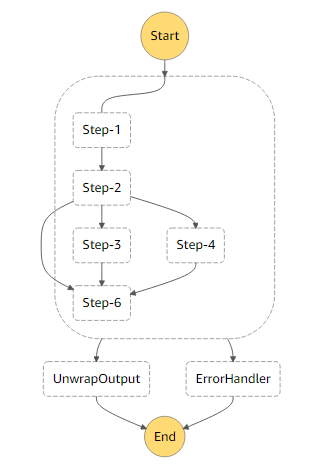
由于我希望为所有step函数设置一个公共错误处理程序,所以我已经将它们封装在一个并行块中,并添加了一个公共Catch块来捕获任何step函数中的任何错误。在查看各种示例和博客时,我遵循了这链接并实现了类似的方法。
我观察到的是,每当任何状态引发异常时,该控件都会进入catch块。catch块的输入是引发的异常,该异常包含JSON对象中的错误和原因。由于我想要错误以及传递给该状态的输入,所以我在catch块中添加了ResultPath作为"$.error"。下面是定义状态机的JSON规范。
    {
  "StartAt": "Try",
  "States": {
    "Try": {
      "Type": "Parallel",
      "Branches": [
        {
          "StartAt": "Step-1",
          "States": {
            "Step-1": {
              "Type": "Task",
              "Resource": "arn:aws:lambda:eu-west-1:1234:function:step-1-lambda",
              "Next": "Step-2"
            },
            "Step-2": {
              "Type": "Choice",
              "Choices": [
                {
                  "Variable": "$.some_variable",
                  "StringEquals": "some_string",
                  "Next": "Step-3"
                },
                {
                  "Variable": "$.some_variable",
                  "StringEquals": "some_other_string",
                  "Next": "Step-4"
                }
              ],
              "Default": "Step-6"
            },
            "Step-3": {
              "Type": "Task",
              "Resource": "arn:aws:lambda:eu-west-1:1234:function:step-3-lambda",
              "Next": "Step-6"
            },
            "Step-4": {
              "Type": "Task",
              "Resource": "arn:aws:lambda:eu-west-1:1234:function:step-4-lambda",
              "Next": "Step-6"
            },
            "Step-6": {
              "Type": "Task",
              "Resource": "arn:aws:lambda:eu-west-1:1234:function:step-6-lambda",
              "End": true
            }
          }
        }
      ],
      "Catch": [
        {
          "ErrorEquals": [
            "States.ALL"
          ],
          "ResultPath": "$.error",
          "Next": "ErrorHandler"
        }
      ],
      "Next": "UnwrapOutput"
    },
    "UnwrapOutput": {
      "Type": "Pass",
      "InputPath": "$[0]",
      "End": true
    },
    "ErrorHandler": {
      "Type": "Task",
      "Resource": "arn:aws:lambda:eu-west-1:1234:function:step-7-lambda",
      "End": true
    }
  }
}
例如,假设步骤4生成异常。这种状态的输入是:
{
   "foo": "abc",
   "bar": "def"
}
用来触发状态机的输入是:
{
  "boo": "jkl",
   "baz": "mno"
}
在ErrorHandler中,当步骤4生成一个异常时,我期望ErrorHandler状态的输入是:
{
  "foo": "abc",
   "bar": "def",
   "error": {
       "Error": "SomeError",
       "Cause": "SomeCause"
   }
}
但是,接收到的输入由用于触发流的原始输入组成。
{
  "boo": "jkl",
   "baz": "mno",
   "error": {
       "Error": "SomeError",
       "Cause": "SomeCause"
   }
}
我需要访问导致ErrorHandler异常的状态的输入字段。它使用"$“提供用于触发流的输入。我有办法做到这一点吗?
任何帮助都将不胜感激,我很久以来一直在努力解决这个问题。
回答 1
Stack Overflow用户
发布于 2021-06-07 14:44:25
我只晚了10个月,没有那么多哈哈,但我希望你已经找到了一个解决方案,在任何情况下,我将分享我的两分钱,这样我可以帮助另一个开发,甚至更好,有人可以告诉我一个更好的方法来做这件事!
首先,让我们看看我们有哪些场景:
- Sych作业执行
- 同步作业执行
我们的目标:访问触发错误的作业。
第一种解决方案-适用于所有方案:
- 基本上,在所有作业资产中添加自定义的try catch's,换句话说,您的lambda函数应该抛出一个错误,提供有关它正在使用的作业的信息。我不太喜欢这种方法,因为您正在更改您的独立函数,以便在状态机中实现一些逻辑。最后,您正在耦合两个分离的概念,您的状态机不需要外部工具来操作和记录它自己的上下文。我可能错了,但这只是我的两分钱,随便冒犯我的家人(开玩笑,但纠正我,如你所愿)。
第二个解决方案-应用于Sych作业执行
- 当您在状态机中添加"addCatch“时,默认行为是覆盖步骤输入的错误输出。为了解决这个问题,您只需要更改addCatch resultPath,这样就可以将错误输出存储在步骤输入旁边。 例:"ErrorEquals":[{ "States.All“,"Next":"ErrorHandler”"ResultPath":“$..error info”}]
但为什么这很重要?
- 这样,您就能够访问errorHandlerJob中的步骤输入,这意味着您始终可以将stepName传递到下一步输入,这样您就可以始终知道哪个作业失败了。您不会通过直接更改lambda函数来做到这一点,而是通过使用作业的属性来解决耦合问题!但是这在ASYNC场景中是行不通的,下面我将解释。
第三种解决方案--应用于同步作业执行
- 前面的解决方案在这里不起作用,因为在本例中,您只能访问原始输入,因为您使用的是并行分支。所以我在这里所做的和上一个案子相似。我在并行分支中添加了Pass状态,这些Pass状态负责同步调用我的作业,而且我的所有作业都有自己的errorHandlingJob而不是不同的LAMBDA函数。我没有在AWS上创建新的资源,只有一个HandleError Lambda函数,所以我可以将监视的重点放在这个特定的函数上。但是,我使用它为我的状态机必须执行的每个作业创建一个errorHandlingJob。
- 缺点是你的状态机现在拥有巨大的图表,但好的部分是你现在能够记录哪个作业失败了。
如果没有任何抽象,就会出现类似于“使用CDK”的情况。
    const job1 = new tasks.LambdaInvoke(scope, 'First Job -- PASS', {
        lambdaFunction: function1,
        outputPath: '$.Payload'
    })

    const job2 = new tasks.LambdaInvoke(scope, 'Second Job -- PASS', {
        lambdaFunction: function2,
        outputPath: '$.Payload'
    })

    const job3 = new tasks.LambdaInvoke(scope, 'Third Job -- PASS', {
        lambdaFunction: function3,
        outputPath: '$.Payload'
    })

    const generateHandleErrorJob = () => new tasks.LambdaInvoke(scope, `Handle Error Job ${Math.random() * 160000000}`, {
        lambdaFunction: functionError,
        outputPath: '$.Payload'
    })

    const jobToThrowError = new tasks.LambdaInvoke(scope, 'Job To Throw Error -- PASS', {
        lambdaFunction: fucntionThrowError,
        outputPath: '$.Payload',
    })

    const generatePassCheckSetep = (stepName: string) => new sfn.Pass(scope, `Pass: ${stepName}`, {
        resultPath: '$.step-info',
        result: sfn.Result.fromObject({
            step: stepName
        })
    })

    const definition = new sfn.Parallel(scope, 'Parallel Execution -- PASS')
        .branch(generatePassCheckSetep('job1').next(job1.addCatch(generateHandleErrorJob(), {resultPath: '$.error-info'})))
        .branch(generatePassCheckSetep('jobToThrowError').next(jobToThrowError.addCatch(generateHandleErrorJob(), {resultPath: '$.error-info'})))
        .branch(generatePassCheckSetep('job2').next(job2.addCatch(generateHandleErrorJob(), {resultPath: '$.error-info'})))
        .next(job3)

    new sfn.StateMachine(scope, id, {
        definition,
        timeout: cdk.Duration.minutes(3)
    })
但是我还创建了一个抽象的"ParallelStateMachineCatch“,这样您就可以像这样使用:
this.definition = new ParallelStateMachineCatch(this,
}, handleErrorFunction)
  .branchCatch(job1)
  .branchCatch(job2)
  .branchCatch(job3)
  .branchCatch(job4)
  .branchCatch(job5)
  .branchCatch(job6)
  .next(final)
}
以下是ParallelStateMachineCatch代码:
import { Construct, Duration } from 'monocdk'
import { NodejsFunction } from 'monocdk/aws-lambda-nodejs'
import { Pass,Result, Parallel, ParallelProps } from 'monocdk/aws-stepfunctions'
import { LambdaInvoke } from 'monocdk/aws-stepfunctions-tasks'

export interface DefinitionProps {
  sonosEnvironment: string
  region: string
  accountNumber: string
}

export class ParallelStateMachineCatch extends Parallel {
  private errorHandler: NodejsFunction

  constructor(scope: Construct, id: string, props: ParallelProps, errorHandler: NodejsFunction) {
    super(scope, id, props)
    this.errorHandler = errorHandler
  }


  branchCatch(task: LambdaInvoke): ParallelStateMachineCatch {
    const randomId = Math.random().toString().replace('0.', '')
    const passInputJob = ParallelStateMachineCatch.generatePassInput(this, task.id, randomId)
    const handleErrorJob = ParallelStateMachineCatch.generateHandleErrorJob(this, this.errorHandler, randomId)
    const resultPath = '$.error-info'

    this.branch(passInputJob.next(task.addCatch(handleErrorJob, { resultPath })))

    return this
  }

  private static generateHandleErrorJob(scope: Construct, errorHandler: NodejsFunction, randomId: string): LambdaInvoke {
    return new LambdaInvoke(scope, `Handle Error ${ randomId }`, {
      lambdaFunction: errorHandler,
      outputPath: '$.Payload',
      timeout: Duration.seconds(5),
    })
  }

  private static generatePassInput(scope: Construct, stepName: string, randomId: string): Pass {
    return new Pass(scope, `Pass Input ${ randomId }`, {
      resultPath: '$.step-info',
      result: Result.fromObject({
        name: stepName
      })
    })
  }

}
不管怎样,我希望我能在这件事上帮助别人,这就是我解决这个问题的方法。请随便教我更好的方法!Tks好运和好代码
https://stackoverflow.com/questions/63303181
复制相似问题
腾讯云开发者

Copyright © 2013 - 2026 Tencent Cloud. All Rights Reserved. 腾讯云 版权所有
深圳市腾讯计算机系统有限公司 ICP备案/许可证号:粤B2-20090059  粤公网安备44030502008569号
腾讯云计算(北京)有限责任公司 京ICP证150476号 | 京ICP备11018762号