
OpenAPI -如何描述查询参数?
我试图找出如何在OpenAPI中记录我的两个查询参数。
滤波
我的筛选遵循JSON:API的建议,其形式如下:
?filter[post]=1,2,3?filter[post]=1,2,3&filter[author]=5
filter键是一个关联数组,可以在my中包含一组资源名称列表。分配给每个筛选键的值要么是单个id,要么是逗号分隔的id列表。
排序
排序也遵循JSON:API建议,所以如下所示:
?sort=age?sort=age,-height
sort查询参数被指定为一个排序字段或逗号分隔的排序字段列表的值。请注意,height字段前缀的减号指示降序排序。
问题
如何表示我的OpenAPI中的过滤和排序
例如,我不确定我是否能够指定过滤器键是一个关联数组,或者它是否接受一个逗号分隔的it列表。排序几乎同样的问题:如何表示逗号分隔的排序字段列表?
回答 2
Stack Overflow用户
发布于 2021-03-27 09:04:59
这可能有点老了,但我目前正在记录一个API,它的排序、筛选和动态关系包括遵守JSON规范,我刚刚想出了如何正确地记录filter查询参数。下面是用JSON编写的,但我希望如果您正在编写YAML,您将能够根据您的需要对其进行修改
{
    "schema": {
      "type": "object",
      "additionalProperties": false,
      "properties": {
        "id": {
          "description": "Id of the user",
          "type": "string"
        },
        "referrer_id": {
          "description": "The id of the user that referred the user",
          "type": "string"
        },
        "email_verified": {
          "description": "Whether the user has verified their email address",
          "type": "boolean"
        },
        "trashed": {
          "description": "Whether the user has been soft deleted",
          "type": "string",
          "enum": [
            "with",
            "only"
          ]
        }
      }
    },
    "in": "query",
    "name": "filter",
    "description": "Really long description.........",
    "style": "deepObject",
    "explode": true,
    "allowReserved": true
}要进行文档排序,可以遵循包含这里的示例,该示例也是在下面编写的
parameters:
  - in: query
    name: ids
    description: One or more IDs
    required: true
    schema:
      type: array
      items:
        type: integer
    style: form
    explode: false
    examples:
      oneId:
        summary: Example of a single ID
        value: [5]   # ?ids=5
      multipleIds:
        summary: Example of multiple IDs
value: [1, 5, 7] # ?ids=1,5,7Stack Overflow用户
发布于 2020-09-24 11:13:43
下面的方法应该会有所帮助
parameters:
  - in: query
    name: fields
    style: deepObject
    allowReserved: true
    schema:
      type: object
      properties:
        post:
          type: string
        author:
          type: string
  - in: query
    name: sort
    schema:
      type: array
      items:
        type: string
        enum:
          - age
          - height
其中的一部分类似于“海伦”所提出的问题。它将使您能够使用它,如下图所示
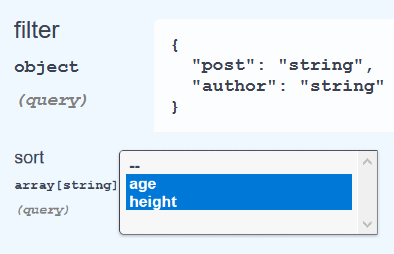
和相应的cURL命令
curl -X GET "https://editor.swagger.io/user?filter[post]=1,2&filter[author]=3,4&sort=age&sort=height" -H "accept: */*"您还可以通过以下方式定义filter参数
parameters:
  - in: query
    name: filter
    style: deepObject
    allowReserved: true
    schema:
      type: object
      properties:
        post:
          type: array
          items:
            type: string
        author:
          type: array
          items:
            type: string
这将导致UI更全面,如下所示
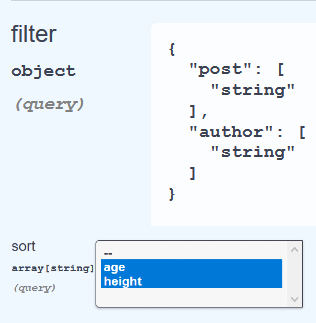
然后,cURL请求如下所示
curl -X GET "https://editor.swagger.io/user?filter[post]=1&filter[post]=2&filter[author]=3&filter[author]=4&sort=age&sort=height" -H "accept: */*"当方法可能返回基类的对象或它的任何子类时,您可能不需要anyOf,因为它与继承有关。
有关它的更多信息,请参考任何一种所有的非OpenAPI规范。
https://stackoverflow.com/questions/63862351
复制相似问题
腾讯云开发者

Copyright © 2013 - 2026 Tencent Cloud. All Rights Reserved. 腾讯云 版权所有
深圳市腾讯计算机系统有限公司 ICP备案/许可证号:粤B2-20090059  粤公网安备44030502008569号
腾讯云计算(北京)有限责任公司 京ICP证150476号 | 京ICP备11018762号