
来自Trax的AttentionQKV
来自Trax的AttentionQKV
提问于 2020-09-30 00:36:05
Trax实现的AttentionQKV层如下所示:AttentionQKV
def AttentionQKV(d_feature, n_heads=1, dropout=0.0, mode='train'):
  """Returns a layer that maps (q, k, v, mask) to (activations, mask).
  See `Attention` above for further context/details.
  Args:
    d_feature: Depth/dimensionality of feature embedding.
    n_heads: Number of attention heads.
    dropout: Probababilistic rate for internal dropout applied to attention
        activations (based on query-key pairs) before dotting them with values.
    mode: One of `'train'`, `'eval'`, or `'predict'`.
  """
  return cb.Serial(
      cb.Parallel(
          core.Dense(d_feature),
          core.Dense(d_feature),
          core.Dense(d_feature),
      ),
      PureAttention(  # pylint: disable=no-value-for-parameter
          n_heads=n_heads, dropout=dropout, mode=mode),
      core.Dense(d_feature),
  )
特别是,三个平行致密层的目的是什么?这个层的输入是q,k,v,掩码。为什么q,k,v被放置在稠密层中?
回答 1
Stack Overflow用户
回答已采纳
发布于 2020-09-30 08:19:05
这个代码片段是注意是你所需要的文件第5页上等式的一个实现,该文件在2017年引入了变压器模型。计算结果如图2所示:
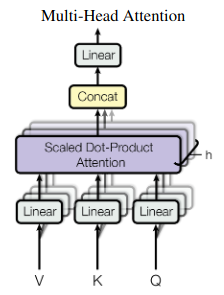
隐藏状态被投影到h注意头中,从而并行地进行缩放的点积注意。投影可以解释为提取与头部相关的信息。然后,每个头根据不同的(学习)标准进行概率检索。
页面原文内容由Stack Overflow提供。腾讯云小微IT领域专用引擎提供翻译支持
原文链接:
https://stackoverflow.com/questions/64129393
复制相关文章
相似问题
腾讯云开发者

Copyright © 2013 - 2026 Tencent Cloud. All Rights Reserved. 腾讯云 版权所有
深圳市腾讯计算机系统有限公司 ICP备案/许可证号:粤B2-20090059  粤公网安备44030502008569号
腾讯云计算(北京)有限责任公司 京ICP证150476号 | 京ICP备11018762号