
加载tensorflow图像并创建补丁
我使用目录将一个非常大的RGB图像数据集从磁盘加载到一个数据集中。例如,
dataset = tf.keras.preprocessing.image_dataset_from_directory(
    <directory>,
    label_mode=None,
    seed=1,
    subset='training',
validation_split=0.1)例如,该数据集有100000幅图像分组成32大小的批次,生成了一个带有规范tf.data.Dataset的(batch=32, width=256, height=256, channels=3)。
我想从图像中提取补丁,创建一个图像空间维数为64x64的新tf.data.Dataset。
因此,我想要创建一个新的数据集,该数据集的400000个补丁仍在32的批处理中,其中包含一个带有规范tf.data.Dataset的(batch=32, width=64, height=64, channels=3)。
我已经看过窗户方法和补丁函数,但是从文档中还不清楚如何使用它们来创建一个新的数据集,我需要开始有关补丁的培训。window似乎面向一维张量,而extract_patches似乎适用于数组而不是数据集。
对于如何做到这一点,有什么建议吗?
更新:
只是为了澄清我的需要。我试图避免手动创建磁盘上的修补程序。第一,这将是无法维持的磁盘智慧。二,补丁大小不是固定的。实验将在几个贴片尺寸上进行。因此,我不希望在磁盘上手动执行修补程序创建,也不希望手动加载内存中的映像并执行修补程序。我更愿意让tensorflow作为管道工作流的一部分来处理补丁创建,以减少磁盘和内存的使用。
回答 2
Stack Overflow用户
发布于 2020-10-12 23:41:42
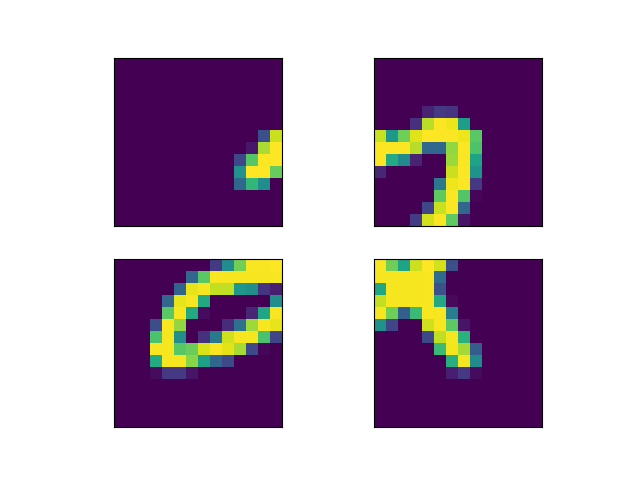
你要找的是tf.image.extract_patches。下面是一个例子:
import tensorflow as tf
import tensorflow_datasets as tfds
import matplotlib.pyplot as plt
import numpy as np

data = tfds.load('mnist', split='test', as_supervised=True)

get_patches = lambda x, y: (tf.reshape(
    tf.image.extract_patches(
        images=tf.expand_dims(x, 0),
        sizes=[1, 14, 14, 1],
        strides=[1, 14, 14, 1],
        rates=[1, 1, 1, 1],
        padding='VALID'), (4, 14, 14, 1)), y)

data = data.map(get_patches)

fig = plt.figure()
plt.subplots_adjust(wspace=.1, hspace=.2)
images, labels = next(iter(data))
for index, image in enumerate(images):
    ax = plt.subplot(2, 2, index + 1)
    ax.set_xticks([])
    ax.set_yticks([])
    ax.imshow(image)
plt.show()
Stack Overflow用户
发布于 2020-10-12 23:37:59
我相信您可以使用python类生成器。如果需要,可以将此生成器传递给model.fit函数。实际上,我曾经用它来做标签预处理。
我编写了以下数据集生成器,该生成器从数据集加载批处理,根据tile_shape参数将批处理中的图像分割为多个图像。如果有足够的图像,将返回下一批图像。
在本例中,我使用了一个简单的dataset from_tensor_slices进行简化。当然,你可以用你的代替。
import tensorflow as tf

class TileDatasetGenerator:

    def __init__(self, dataset, batch_size, tile_shape):
        self.dataset_iterator = iter(dataset)
        self.batch_size = batch_size
        self.tile_shape = tile_shape
        self.image_queue = None

    def __iter__(self):
        return self

    def __next__(self):
        if self._has_queued_enough_for_batch():
            return self._dequeue_batch()

        batch = next(self.dataset_iterator)
        self._split_images(batch)
        return self.__next__()

    def _has_queued_enough_for_batch(self):
        return self.image_queue is not None and tf.shape(self.image_queue)[0] >= self.batch_size

    def _dequeue_batch(self):
        batch, remainder = tf.split(self.image_queue, [self.batch_size, -1], axis=0)
        self.image_queue = remainder
        return batch

    def _split_images(self, batch):
        batch_shape = tf.shape(batch)
        batch_splitted = tf.reshape(batch, shape=[-1, self.tile_shape[0], self.tile_shape[1], batch_shape[-1]])
        if self.image_queue is None:
            self.image_queue = batch_splitted
        else:
            self.image_queue = tf.concat([self.image_queue, batch_splitted], axis=0)


dataset = tf.data.Dataset.from_tensor_slices(tf.ones(shape=[128, 64, 64, 3]))
dataset.batch(32)
generator = TileDatasetGenerator(dataset, batch_size = 16, tile_shape = [32,32])

for batch in generator:
tf.print(tf.shape(batch))编辑:如果需要,可以将生成器转换为tf.data.Dataset,但需要向返回迭代器的生成器添加__call__函数(在本例中为self)。
new_dataset = tf.data.Dataset.from_generator(generator, output_types=(tf.int64))https://stackoverflow.com/questions/64326029
复制相似问题
腾讯云开发者

Copyright © 2013 - 2026 Tencent Cloud. All Rights Reserved. 腾讯云 版权所有
深圳市腾讯计算机系统有限公司 ICP备案/许可证号:粤B2-20090059  粤公网安备44030502008569号
腾讯云计算(北京)有限责任公司 京ICP证150476号 | 京ICP备11018762号