
Flink检查点模式ExactlyOnce没有按预期工作
如果我的理解是错误的,我将向flink道歉,我正在构建一个数据流应用程序,并且该流包含多个数据流,这些数据流检查传入的DataStream中是否存在所需的字段。我的应用程序验证传入的数据,如果数据被成功验证,它应该将数据附加到给定的文件中,如果数据已经存在的话。我试图模拟在一个DataStream中是否发生任何异常,其他数据流不应该受到影响,因为我在其中一个流中显式抛出一个异常。在下面的示例中,为了简单起见,我使用windows文本文件来追加数据。
注意:我的流没有状态,因为我没有任何东西可以存储在状态
public class ExceptionTest {

    public static void main(String[] args) throws Exception {

        StreamExecutionEnvironment env = StreamExecutionEnvironment.getExecutionEnvironment();

        // start a checkpoint every 1000 ms
        env.enableCheckpointing(1000);

       // env.setParallelism(1);

        //env.setStateBackend(new RocksDBStateBackend("file:///C://flinkCheckpoint", true));

        // to set minimum progress time to happen between checkpoints
        env.getCheckpointConfig().setMinPauseBetweenCheckpoints(500);

        // checkpoints have to complete within 5000 ms, or are discarded
        env.getCheckpointConfig().setCheckpointTimeout(5000);

        // set mode to exactly-once (this is the default)
        env.getCheckpointConfig().setCheckpointingMode(CheckpointingMode.EXACTLY_ONCE);

        // allow only one checkpoint to be in progress at the same time
        env.getCheckpointConfig().setMaxConcurrentCheckpoints(1);

        // enable externalized checkpoints which are retained after job cancellation
        env.getCheckpointConfig().enableExternalizedCheckpoints(CheckpointConfig.ExternalizedCheckpointCleanup.RETAIN_ON_CANCELLATION);  // DELETE_ON_CANCELLATION

        env.setRestartStrategy(RestartStrategies.fixedDelayRestart(
                3, // number of restart attempts
                Time.of(10, TimeUnit.SECONDS) // delay
        ));

        DataStream<String> input1 = env.fromElements("hello");

        DataStream<String> input2 = env.fromElements("hello");


        DataStream<String> output1 = input.flatMap(new FlatMapFunction<String, String>() {
            @Override
            public void flatMap(String value, Collector<String> out) throws Exception {
                //out.collect(value.concat(" world"));
                throw new Exception("=====================NO VALUE TO CHECK=================");
            }
        });


        DataStream<String> output2 = input.flatMap(new FlatMapFunction<String, String>() {
            @Override
            public void flatMap(String value, Collector<String> out) throws Exception {
                out.collect(value.concat(" world"));
            }
        });

       output2.addSink(new SinkFunction<String>() {
           @Override
           public void invoke(String value) throws Exception {
               try {
                File myObj = new File("C://flinkOutput//filename.txt");
                if (myObj.createNewFile()) {
                    System.out.println("File created: " + myObj.getName());
                    BufferedWriter out = new BufferedWriter(
                            new FileWriter("C://flinkOutput//filename.txt", true));
                    out.write(value);
                    out.close();
                    System.out.println("Successfully wrote to the file.");
                } else {
                    System.out.println("File already exists.");
                    BufferedWriter out = new BufferedWriter(
                            new FileWriter("C://flinkOutput//filename.txt", true));
                    out.write(value);
                    out.close();
                    System.out.println("Successfully wrote to the file.");
                }
            } catch (IOException e) {
                System.out.println("An error occurred.");
                e.printStackTrace();
            }
           }
       });

        env.execute();

    }
以下我几乎没有疑问。
- 当我在output1流中抛出异常时,即使在遇到异常并将数据写入本地文件之后,第二个流output2仍在运行,但当我检查该文件时,输出如下 你好世界你好世界
- 根据我从flink文档中得到的理解,如果我使用检查点模式作为EXACTLY_ONCE,它不应该将数据写入文件的时间不超过一次,因为这个过程已经完成,并且将数据写入文件。但这在我的情况下不会发生,如果我做错了什么,我也不会得到。
请帮助我消除我对检查点的疑虑,以及如何实现我在flink中读到的EXACTLY_ONCE机制,但我没有得到如何实现它的任何示例。
正如@Mikalai建议的那样,我在下面实现了StreamingSinkFunction
与StreamingSinkFunction
public class ExceptionTest {

    public static void main(String[] args) throws Exception {

        StreamExecutionEnvironment env = StreamExecutionEnvironment.getExecutionEnvironment();

        // start a checkpoint every 1000 ms
        env.enableCheckpointing(1000);

       // env.setParallelism(1);

        //env.setStateBackend(new RocksDBStateBackend("file:///C://flinkCheckpoint", true));

        // to set minimum progress time to happen between checkpoints
        env.getCheckpointConfig().setMinPauseBetweenCheckpoints(500);

        // checkpoints have to complete within 5000 ms, or are discarded
        env.getCheckpointConfig().setCheckpointTimeout(5000);

        // set mode to exactly-once (this is the default)
        env.getCheckpointConfig().setCheckpointingMode(CheckpointingMode.EXACTLY_ONCE);

        // allow only one checkpoint to be in progress at the same time
        env.getCheckpointConfig().setMaxConcurrentCheckpoints(1);

        // enable externalized checkpoints which are retained after job cancellation
        env.getCheckpointConfig().enableExternalizedCheckpoints(CheckpointConfig.ExternalizedCheckpointCleanup.RETAIN_ON_CANCELLATION);  // DELETE_ON_CANCELLATION

        env.setRestartStrategy(RestartStrategies.fixedDelayRestart(
                3, // number of restart attempts
                Time.of(10, TimeUnit.SECONDS) // delay
        ));

        DataStream<String> input1 = env.fromElements("hello");

        DataStream<String> input2 = env.fromElements("hello");


        DataStream<String> output1 = input.flatMap(new FlatMapFunction<String, String>() {
            @Override
            public void flatMap(String value, Collector<String> out) throws Exception {
                //out.collect(value.concat(" world"));
                throw new Exception("=====================NO VALUE TO CHECK=================");
            }
        });


        DataStream<String> output2 = input.flatMap(new FlatMapFunction<String, String>() {
            @Override
            public void flatMap(String value, Collector<String> out) throws Exception {
                out.collect(value.concat(" world"));
            }
        });


        String outputPath = "C://flinkCheckpoint";

        final StreamingFileSink<String> sink = StreamingFileSink
                .forRowFormat(new Path(outputPath), new SimpleStringEncoder<String>("UTF-8"))
                .withRollingPolicy(
                        DefaultRollingPolicy.builder()
                                .withRolloverInterval(TimeUnit.MINUTES.toMillis(15))
                                .withInactivityInterval(TimeUnit.MINUTES.toMillis(5))
                                .withMaxPartSize(1)
                                .build())
                .build();


        output2.addSink(sink);


       });

        env.execute();

    }
但是,当我检查检查点文件夹时,我可以看到它创建了四个正在进行中的部分文件,如下所示
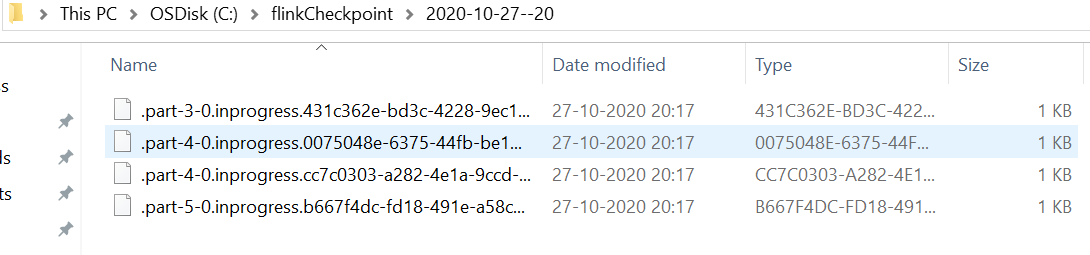
有什么是我正在做的,因为它创建多部分文件吗?
回答 1
Stack Overflow用户
发布于 2020-10-27 13:52:32
为了保证端到端精确地一次记录传递(除了精确地-一次状态语义),数据接收器需要参与检查点机制(以及数据源)。
如果要将数据写入文件,则可以使用StreamingFileSink,它向桶内的FileSystem文件发出输入元素。这与检查点机制集成在一起,提供精确的一次语义跳出框.
如果要实现自己的接收器,则接收器函数必须实现CheckpointedFunction接口,并正确实现在请求检查点快照并刷新当前应用程序状态时调用的snapshotState(FunctionSnapshotContext context)方法。此外,我建议在完成分布式检查点后通知CheckpointListener接口。
Flink已经提供了一个抽象的TwoPhaseCommitSinkFunction,它是所有打算精确实现一次语义的SinkFunction的推荐基类。它是通过在CheckpointedFunction和CheckpointListener之上实现两阶段提交算法来实现的。例如,您可以查看FlinkKafkaProducer.java源代码。
https://stackoverflow.com/questions/64553439
复制相似问题
腾讯云开发者

Copyright © 2013 - 2026 Tencent Cloud. All Rights Reserved. 腾讯云 版权所有
深圳市腾讯计算机系统有限公司 ICP备案/许可证号:粤B2-20090059  粤公网安备44030502008569号
腾讯云计算(北京)有限责任公司 京ICP证150476号 | 京ICP备11018762号