
在DataFrame中的一个列包含另一个列的子字符串时,是否有一种方法只保留该数据帧中的行?
在DataFrame中的一个列包含另一个列的子字符串时,是否有一种方法只保留该数据帧中的行?
提问于 2020-11-10 12:09:25
我有一个数据集:
                                  id                                   key            value
24                Apple Inc_Desktops    revenue_rgs_category_-_pc_monitors              nan
2                 Apple Inc_Desktops  revenue_rgs_category_-_mobile_phones 142381000000.000
46                Apple Inc_Desktops     revenue_rgs_category_-_smart_tech  24482000000.000
13                Apple Inc_Desktops    revenue_rgs_category_-_desktop_pcs  12870000000.000
35                Apple Inc_Desktops        revenue_rgs_category_-_tablets  21280000000.000
1                  Apple Inc_Laptops  revenue_rgs_category_-_mobile_phones 142381000000.000
45                 Apple Inc_Laptops     revenue_rgs_category_-_smart_tech  24482000000.000
23                 Apple Inc_Laptops    revenue_rgs_category_-_pc_monitors              nan
34                 Apple Inc_Laptops        revenue_rgs_category_-_tablets  21280000000.000
12                 Apple Inc_Laptops    revenue_rgs_category_-_desktop_pcs  12870000000.000
25            Apple Inc_MobilePhones    revenue_rgs_category_-_pc_monitors              nan
14            Apple Inc_MobilePhones    revenue_rgs_category_-_desktop_pcs  12870000000.000
36            Apple Inc_MobilePhones        revenue_rgs_category_-_tablets  21280000000.000
47            Apple Inc_MobilePhones     revenue_rgs_category_-_smart_tech  24482000000.000
3 Apple Inc_MobilePhones revenue_rgs_category_-_mobile_phones 142381000000.000当列key包含来自id列的子字符串时,我只想保留行。例如,如下图所示,我只想保留索引13,3的行,因为对于那些行,'key‘列包含id列的一部分--例如,对于带有index 3的行,’index‘列包含在key列中。
所以我想要的输出是:
                                  id                                   key            value
13                Apple Inc_Desktops    revenue_rgs_category_-_desktop_pcs  12870000000.000
3             Apple Inc_MobilePhones  revenue_rgs_category_-_mobile_phones 142381000000.000
我尝试创建一个新的,指示'key‘列是否包含'id’列的子字符串,但运气不好:
comp_rev_long['check'] = comp_rev_long['key'].str.contains('|'.join(comp_rev_long['id']),case=False)有什么办法能有效地做到这一点吗?提前感谢你。
回答 2
Stack Overflow用户
回答已采纳
发布于 2020-11-10 14:11:19
下面是一些可以帮助您入门的代码:
import numpy as np
import pandas as pd

np.random.seed(1)
# I create a simple DataFrame
df = pd.DataFrame({"id": np.random.choice(["apple", "banana", "cherry"], 15),
                   "key":  np.random.choice(["apple pie", "banana pie", "cherry pie"], 15),
"value": np.random.randint(0,20, 15)})df看起来是这样的:
        id         key  value
0   banana  cherry pie     13
1    apple  banana pie      9
2    apple  cherry pie      9
3   banana   apple pie      7
4   banana   apple pie      1
5    apple  cherry pie      0
6    apple   apple pie     17
7   banana  banana pie      8
8    apple  cherry pie     13
9   banana  cherry pie     19
10   apple   apple pie     15
11  cherry  banana pie     10
12  banana  banana pie      8
13  cherry  cherry pie      7
14   apple   apple pie      3
这里有一个简单的选项,只选择满足特定条件的行。
# create a function that checks if a row satisfies your condition
check_condition = lambda row: row["id"] in row["key"]

# create a new column that determines whether you keep the row
# by applying the check_condition function row wise (-> axis=1)
df["keep_row"] =  df.apply(check_condition, axis=1)

# finally select and keep only the desired rows
df = df[df["keep_row"]]现在,df看起来如下:
        id         key  value  keep_row
6    apple   apple pie     17      True
7   banana  banana pie      8      True
10   apple   apple pie     15      True
12  banana  banana pie      8      True
13  cherry  cherry pie      7      True
14   apple   apple pie      3      True
最后一个问题是如何检查子字符串是否包含在另一个字符串中。有几种方法可以解决这个问题。
- 替换这些值,这样操作就变得琐碎了,例如。如果您只需要知道
row["id"] in row["key"] - Make是
mobile还是pc创建了一个新的“设备”列,那么 - 只是对其进行编码,尽管
有点麻烦。
这个check_condition可能会正常工作,可以查看您的数据,但我当然不能确定。
def check_condition(row):
    for i in row["id"].lower().split('_'):
        if i in row["key"].lower():
            return True
        elif i[:-1] in row["key"].lower(): # account for the final 's'
            return True
    return False
2注:
- --这不是lambda函数,但在本例中它相当于一个函数,因此您可以用这个函数替换lambda
check_condition-function。 - 还注意到,在"id“和"key”列中,有些词以'-s‘结尾,而有些则不需要考虑。
Stack Overflow用户
发布于 2020-11-10 12:58:33
解决您的问题的一个解决方案是检查索引列中是否存在键列中的字符串。在下面的示例中,我构造了一个df (因为您没有提供一个df,其中一个列中包含字符串,另一个列中包含字符串):
import pandas as pd

a1,b2,c3 = 'ANDGFEEHsdsdSHSHS','FKDsdsdKSDKSDKS','DSLDJSLffsfsKDdSLDJS'
s1, s2, s3 = 1,3,1
e1, e2, e3 = 3,6,6
df = pd.DataFrame({'key':[a1,b2,c3],'start': [s1, s2, s3],'end': [e1, e2, e3]})

df = df[['key', 'start', 'end']]
df['sliced'] = df.apply(fn, axis = 1)
aa1,bb2,cc3 = 'ANDGFEEHsdsdSHSHS','FKDsdsdKSDKSDKS','DSLDJSLffsfsKDdSLDJS'
ss1, ss2, ss3 = 2,2,2
ee1, ee2, ee3 = 1,1,1
df2 = pd.DataFrame({'key':[aa1,bb2,cc3],'start': [ss1, ss2, ss3],'end': [ee1, ee2, ee3]})
df2 = df2[['key', 'start', 'end']]
dff = df.append(df2)
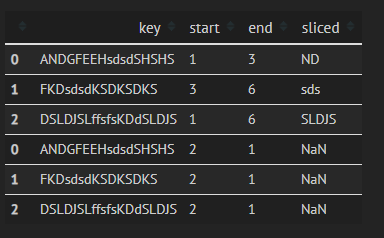
将此应用于确定key中是否存在一个列中的字符串。
df['Check'] = df.apply(lambda x: x.sliced in x.key, axis=1)
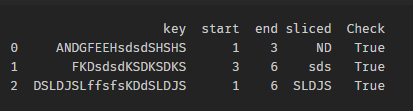
并为True切片。
页面原文内容由Stack Overflow提供。腾讯云小微IT领域专用引擎提供翻译支持
原文链接:
https://stackoverflow.com/questions/64768674
复制相关文章
相似问题
腾讯云开发者

Copyright © 2013 - 2026 Tencent Cloud. All Rights Reserved. 腾讯云 版权所有
深圳市腾讯计算机系统有限公司 ICP备案/许可证号:粤B2-20090059  粤公网安备44030502008569号
腾讯云计算(北京)有限责任公司 京ICP证150476号 | 京ICP备11018762号