
确定巨蟒中细胞的邻域为菱形
确定巨蟒中细胞的邻域为菱形
提问于 2020-11-13 14:50:58
我有一个大小为1的矩阵变量,其中1表示单元格,例如:
Cells   = [[0,0,0,0,0],
           [0,0,0,0,0],
           [0,0,1,0,0],
           [0,0,0,0,0],
           [0,0,0,0,0],
]我需要找到一个参数大小的钻石形状的邻居。不是一个框作为答案给出的here或不是一个固定大小的1钻石,答案给定here。例如,N=2,我想知道下面的列,行:
Mask    = [[0,0,1,0,0],
           [0,1,1,1,0],
           [1,1,0,1,1],
           [0,1,1,1,0],
           [0,0,1,0,0],
          ]
函数应该接收被请求的列和行的x和y,(对于上面我将输入2,2)和N(输入2)菱形的大小。函数应该返回给定钻石大小的元组列表(x,y)。
我很难把形状定义为x,y和k的函数,在for循环中。我需要知道numpy (如果有任何帮助)和非numpy解决方案。
回答 3
Stack Overflow用户
回答已采纳
发布于 2020-11-13 15:01:53
对于迭代方法,您只需构造菱形:
def get_neighbors(center, n=1):
    ret = []
    for dx in range(-n, n + 1):
        ydiff = n - abs(dx)
        for dy in range(-ydiff, ydiff + 1):
            ret.append((center[0] + dx, center[1] + dy))
    return ret
get_neighbors((2, 2), 2)结果
[(0, 2), (1, 1), (1, 2), (1, 3), (2, 0), (2, 1), (2, 2), (2, 3), (2, 4), (3, 1), (3, 2), (3, 3), (4, 2)]或者,对于递归方法:
dirs = [(1, 0), (0, 1), (-1, 0), (0, -1)]

def add_tuples(a, b):
    return tuple([x + y for (x, y) in zip(a, b)])

def get_neighbors(center, n=1, seen=set()):
    seen.add(center)
    if n <= 0:
        return seen
    for dir in dirs:
        newpos = add_tuples(center, dir)
        if newpos in seen:
            continue
        get_neighbors(newpos, n - 1, seen)
return seenStack Overflow用户
发布于 2020-11-13 15:06:20
首先,我要取出一个“子矩阵”,它是可以包含结果单元格的最小方格。这是numpy应该能帮忙的部分。
然后定义一个函数,计算两个单元格(abs(x - x_p) + abs(y - y_p))之间的曼哈顿距离,并遍历子矩阵的单元格,并返回从原点起曼哈顿距离小于N的值。
Stack Overflow用户
发布于 2020-11-13 15:48:59
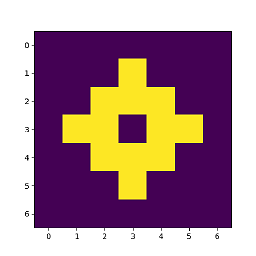
用rotation
- Convolute细胞制作
- 掩码和掩码
- 修正结果
import numpy as np
from scipy.ndimage import rotate, convolve
import matplotlib.pyplot as plt


def diamond_filter(radius):
    s = radius * 2 + 1
    x = np.ones((s, s), dtype=int)
    x[radius, radius] = 0
    return rotate(x, angle=45)


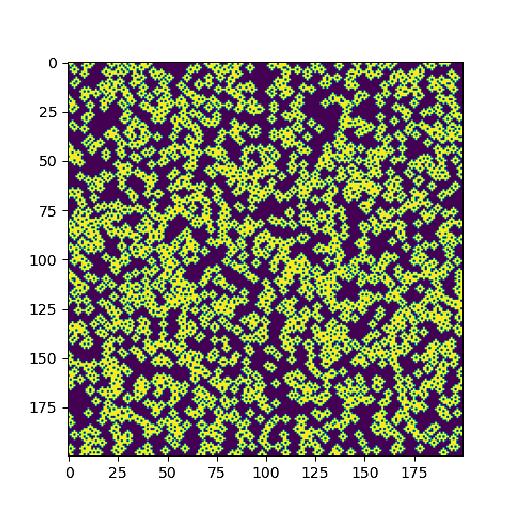
def make_diamonds(x, radius):
    filter = diamond_filter(radius)
    out = convolve(x, filter)
    out[out > 1] = 1
    out -= x
    out[out < 0] = 0
    return out


def plot(x):
    plt.imshow(x)
    plt.show()
    plt.close()


def main():
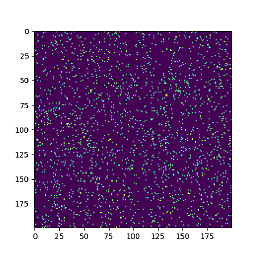
    cell = np.random.choice([0, 1], size=(200, 200), p=[0.95, 0.05])
    plot(diamond_filter(2))
    plot(cell)
    result = make_diamonds(cell, 2)
    plot(result)


if __name__ == '__main__':
main()页面原文内容由Stack Overflow提供。腾讯云小微IT领域专用引擎提供翻译支持
原文链接:
https://stackoverflow.com/questions/64823023
复制相关文章
相似问题
腾讯云开发者

Copyright © 2013 - 2026 Tencent Cloud. All Rights Reserved. 腾讯云 版权所有
深圳市腾讯计算机系统有限公司 ICP备案/许可证号:粤B2-20090059  粤公网安备44030502008569号
腾讯云计算(北京)有限责任公司 京ICP证150476号 | 京ICP备11018762号