
带约束的产品特征优化
我已经训练过一个Lightgbm模型来学习排序数据集。该模型预测样本的相关得分。所以预测越高越好。既然模型已经学会了,我想找到一些功能的最佳值,这些功能给了我最高的预测分数。
因此,假设我有特性u,v,w,x,y,z,而我想优化的特性是x,y,z。
maximize f(u,v,w,x,y,z) w.r.t features x,y,z where f is a lightgbm model
subject to constraints :
y = Ax + b
z = 4 if y < thresh_a else 4-0.5 if y >= thresh_b  else 4-0.3
thresh_m < x <= thresh_n
这些数字是随机合成的,但约束是线性的。
关于x的目标函数如下所示:
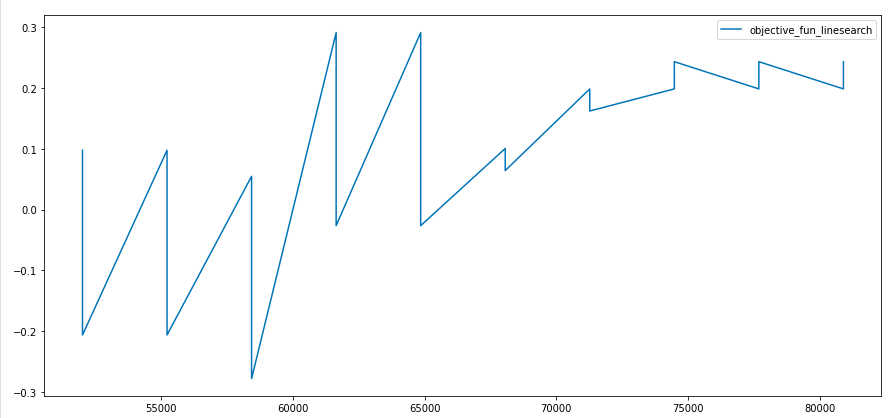
所以功能非常尖利,不光滑。我也没有梯度信息,因为f是lightgbm模型。
使用Nathan's answer,我写下了以下类:
class ProductOptimization:

    def __init__(self, estimator,  features_to_change, row_fixed_values,
                 bnds=None):
        self.estimator = estimator
        self.features_to_change = features_to_change
        self.row_fixed_values = row_fixed_values
        self.bounds = bnds

    def get_sample(self, x):

        new_values = {k:v for k,v in zip(self.features_to_change, x)}

        return self.row_fixed_values.replace({k:{self.row_fixed_values[k].iloc[0]:v}
                                  for k,v in new_values.items()})

    def _call_model(self, x):

        pred = self.estimator.predict(self.get_sample(x))
        return pred[0]

    def constraint1(self, vector):
        x = vector[0]
        y = vector[2]
        return # some float value

    def constraint2(self, vector):
        x = vector[0]
        y = vector[3]
        return #some float value

    def optimize_slsqp(self, initial_values):

        con1 = {'type': 'eq', 'fun': self.constraint1}
        con2 = {'type': 'eq', 'fun': self.constraint2}
        cons = ([con1,con2])


        result = minimize(fun=self._call_model,
                          x0=np.array(initial_values),
                          method='SLSQP',
                          bounds=self.bounds,
                          constraints=cons)
        return result
我得到的结果总是在最初猜测的范围内。我认为这是因为函数的非光滑性和没有任何梯度信息,这对于SLSQP优化器来说是很重要的。有什么建议,我应该如何处理这种问题?
回答 1
Stack Overflow用户
发布于 2020-12-21 10:51:51
自从我上次写了一些严肃的代码以来,这是一个很好的时刻,所以我同意如果不完全清楚所有的事情都做什么,请尽管要求更多的解释。
进口:
from sklearn.ensemble import GradientBoostingRegressor
import numpy as np
from scipy.optimize import minimize
from copy import copy
首先,我定义了一个新类,它允许我轻松地重新定义值。这个类有5个输入:
- 值:这是“基本”值。在您的等式
y=Ax + b中,它是b部件 - minimum :这是该类型将计算为
- 最大值的最小值:这是该类型将计算的最大值,这是第一个棘手的值。它是其他InputType对象的列表。第一种是输入类型,第二种是乘法器。在您的示例中,
[[x, A], [z, B], [d, C]] - relations:是
[[x, A]],如果方程是y=Ax + Bz + Cd,那么它将是最棘手的一个。它也是其他InputType对象的列表,它有四项:第一项是输入类型,第二项定义是否是使用min的上边界,如果是使用max的下边界。列表中的第三个项是边界的值,第四个是连接到它的输出值(
)。
小心,如果定义输入值太奇怪,我肯定会有奇怪的行为。
class InputType:

    def __init__(self, value=0, minimum=-1e99, maximum=1e99, multipliers=[], relations=[]):
        """

        :param float value: base value
        :param float minimum: value can never be lower than x
        :param float maximum: value can never be higher than y
        :param multipliers: [[InputType, multiplier], [InputType, multiplier]]
        :param relations: [[InputType, min, threshold, output_value], [InputType, max, threshold, output_value]]
        """
        self.val = value
        self.min = minimum
        self.max = maximum
        self.multipliers = multipliers
        self.relations = relations

    def reset_val(self, value):
        self.val = value

    def evaluate(self):
        """
        - relations to other variables are done first if there are none then the rest is evaluated

        - at most self.max
        - at least self.min
        - self.val + i_x * w_x
        i_x is input i, w_x is multiplier (weight) of i
        """
        for term, min_max, value, output_value in self.relations:
            # check for each term if it falls outside of the expected terms
            if min_max(term.evaluate(), value) != term.evaluate():
                return self.return_value(output_value)

        output_value = self.val + sum([i[0].evaluate() * i[1] for i in self.multipliers])
        return self.return_value(output_value)

    def return_value(self, output_value):
return min(self.max, max(self.min, output_value))使用此方法,可以修复从优化器发送的输入类型,如_call_model所示
class Example:

    def __init__(self, lst_args):
        self.lst_args = lst_args

        self.X = np.random.random((10000, len(lst_args)))
        self.y = self.get_y()
        self.clf = GradientBoostingRegressor()
        self.fit()

    def get_y(self):
        # sum of squares, is minimum at x = [0, 0, 0, 0, 0 ... ]
        return np.array([[self._func(i)] for i in self.X])

    def _func(self, i):
        return sum(i * i)

    def fit(self):
        self.clf.fit(self.X, self.y)

    def optimize(self):
        x0 = [0.5 for i in self.lst_args]
        initial_simplex = self._get_simplex(x0, 0.1)
        result = minimize(fun=self._call_model,
                          x0=np.array(x0),
                          method='Nelder-Mead',
                          options={'xatol': 0.1,
                                   'initial_simplex': np.array(initial_simplex)})
        return result

    def _get_simplex(self, x0, step):
        simplex = []
        for i in range(len(x0)):
            point = copy(x0)
            point[i] -= step
            simplex.append(point)

        point2 = copy(x0)
        point2[-1] += step
        simplex.append(point2)
        return simplex

    def _call_model(self, x):
        print(x, type(x))
        for i, value in enumerate(x):
            self.lst_args[i].reset_val(value)

        input_x = np.array([i.evaluate() for i in self.lst_args])
        prediction = self.clf.predict([input_x])
return prediction[0]我可以定义您的问题,如下面所示的(请确保按照与最终列表相同的顺序定义输入,否则并不是所有的值都会在优化器中得到正确的更新!)
A = 5
b = 2
thresh_a = 5
thresh_b = 10
thresh_c = 10.1
thresh_m = 4
thresh_n = 6

u = InputType()
v = InputType()
w = InputType()
x = InputType(minimum=thresh_m, maximum=thresh_n)
y = InputType(value = b, multipliers=([[x, A]]))
z = InputType(relations=[[y, max, thresh_a, 4], [y, min, thresh_b, 3.5], [y, max, thresh_c, 3.7]])


example = Example([u, v, w, x, y, z])
将结果称为:
result = example.optimize()
for i, value in enumerate(result.x):
    example.lst_args[i].reset_val(value)
print(f"final values are at: {[i.evaluate() for i in example.lst_args]}: {result.fun)}")https://stackoverflow.com/questions/65382539
复制相似问题
腾讯云开发者

Copyright © 2013 - 2026 Tencent Cloud. All Rights Reserved. 腾讯云 版权所有
深圳市腾讯计算机系统有限公司 ICP备案/许可证号:粤B2-20090059  粤公网安备44030502008569号
腾讯云计算(北京)有限责任公司 京ICP证150476号 | 京ICP备11018762号