
实际OOM和2GB对象OOM之间的区别?
我想知道为实际OOM抛出的OOM异常(内存耗尽)和当达到2GB对象限制抛出的异常是否有什么区别。
我有以下导致OOM的代码(没有app.config更改,gcAllowVeryLargeObjects默认设置为false):
struct Data
{
    double a;
    double b;
}

// Causes OOM due to the 2GB object limit.
List<Data> a = new List<Data>(134217725);

// Causes OOM due to actual OOM.
List<Data[]> b = new List<Data[]>();
for (int i = 0; i < 13421772; i++)
{
    b.Add(new Data[134217724]);
}
现在,我已经从Visual执行了代码,并得到了以下异常:
- 2GB对象限制
System.OutOfMemoryException
  HResult=0x8007000E
  Message=Exception of type 'System.OutOfMemoryException' was thrown.
  Source=mscorlib
  StackTrace:
   at System.Collections.Generic.List`1..ctor(Int32 capacity)
at ConsoleApp1.Program.Main(String[] args)- 实际OOM
System.OutOfMemoryException
  HResult=0x8007000E
  Message=Exception of type 'System.OutOfMemoryException' was thrown.
  Source=ConsoleApp1
  StackTrace:
   at ConsoleApp1.Program.Main(String[] args)
从这里看,这两个异常(除了堆栈跟踪/源之外)似乎没有明显的区别。
另一方面,我从LINQPad中执行了完全相同的操作,得到了以下内容:
- 2GB限制
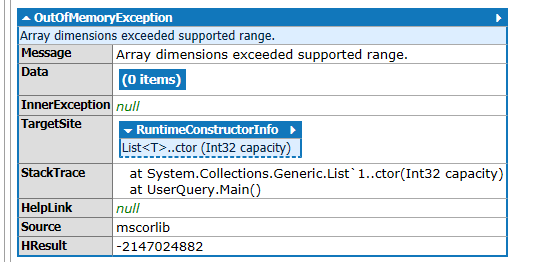
- 实际OOM
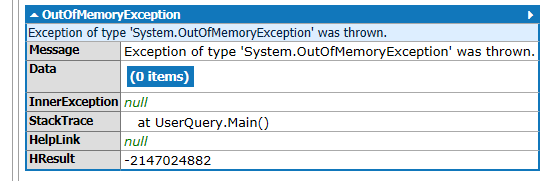
从两个地方执行RuntimeInformation.FrameworkDescription将导致.NET Framework 4.8.4341.0
我的问题是检测/区分这两种情况,尽管我也很好奇为什么LINQPad和VS执行之间的错误信息不同。
回答 1
Stack Overflow用户
发布于 2021-03-05 14:04:08
我可以解释LinqPad和Visual之间的区别:
如果运行x86 DEBUG和RELEASE .Net Framework4.8,则生成以下代码:
static void Main()
{
    try
    {
        List<Data> a = new List<Data>(134217725);
    }

    catch (Exception e)
    {
        Console.WriteLine(e.Message);
    }

    try
    {
        List<Data[]> b = new List<Data[]>();

        for (int i = 0; i < 13421772; i++)
        {
            b.Add(new Data[134217724]);
        }
    }

    catch (Exception e)
    {
        Console.WriteLine(e.Message);
    }
}对于RELEASE构建,您可以得到:
Array dimensions exceeded supported range.
Exception of type 'System.OutOfMemoryException' was thrown.对于DEBUG构建,您可以得到:
Exception of type 'System.OutOfMemoryException' was thrown.
Exception of type 'System.OutOfMemoryException' was thrown.这意味着LINQPAD版本为RELEASE,Visual版本为DEBUG。
所以答案是:是的,很明显有一些不同,但是:
- 只有消息不同
- 我们不应该依赖这种永不改变的状态。
- 它在
DEBUG和RELEASE构建之间有所不同。
撇开:
在我的PC上,上面测试代码的DEBUG构建立即抛出两个OutOfMemoryException异常。
然而,RELEASE构建会很快抛出第一个OutOfMemoryException,但在抛出第二个异常之前还需要几秒钟。在此期间,它的内存使用量增加(根据任务管理器)。
因此很明显,至少对于.Net Framework4.8,遮罩下还有其他一些不同之处。我还没有在.Net 5或.Net Core中尝试过这一点。
https://stackoverflow.com/questions/66493512
复制相似问题
腾讯云开发者

Copyright © 2013 - 2026 Tencent Cloud. All Rights Reserved. 腾讯云 版权所有
深圳市腾讯计算机系统有限公司 ICP备案/许可证号:粤B2-20090059  粤公网安备44030502008569号
腾讯云计算(北京)有限责任公司 京ICP证150476号 | 京ICP备11018762号