
比较R中的两个表,找出客户在一组条件下没有购买的产品
比较R中的两个表,找出客户在一组条件下没有购买的产品
提问于 2021-06-03 17:35:48
我有两张表如下:
Cust_list <- data.frame(
stringsAsFactors = FALSE,
Customer = c("Mike S.","Tim P.","Steve Z."),
Type = c("Shoes","Socks", "Shoes"),
Product_ID = c(233,6546,296)
)


Product_Table <- data.frame(
stringsAsFactors = FALSE,
Product_ID = c(233,256,296,8536,6546,8946),
Type = c("Shoes","Shoes","Shoes", "Socks","Socks","Socks"),
SubType = c("Basketball", "Basketball", "Baseball", "Ankle", "Knee-High", "Mid")
)
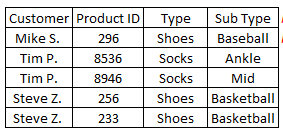
我希望识别“客户”在“类型”内没有购买的"Product_ID“。
例如,Steve Z.购买了Product = "296“和Type = "Shoes”,而没有购买Product = "233“和"256”。由于Steve .没有购买Type = "Socks",这将不包括在输出中。
另外,如果客户购买与SubType =“篮球”相关的产品ID,请不要输出与“篮球”相关的产品ID。由于Mike已经购买了篮球鞋,与篮球鞋相关的其他产品ID不包括在输出中。
输出表在下面。
在这里输入图像描述
回答 1
Stack Overflow用户
回答已采纳
发布于 2021-06-03 19:47:55
基于Onyambu为原始帖子提供的答案,您可以如下所示。
library(dplyr)

out <- Cust_list %>%
  left_join(Product_Table) %>%
  select(Customer, SubType) %>%
  filter(SubType == 'Basketball')

select(Cust_list, -Product_ID) %>%
  left_join(Product_Table) %>%
  anti_join(Cust_list) %>%
  anti_join(out)

#   Customer  Type Product_ID    SubType
# 1  Mike S. Shoes        296   Baseball
# 2   Tim P. Socks       8536      Ankle
# 3   Tim P. Socks       8946        Mid
# 4 Steve Z. Shoes        233 Basketball
# 5 Steve Z. Shoes 256 Basketball页面原文内容由Stack Overflow提供。腾讯云小微IT领域专用引擎提供翻译支持
原文链接:
https://stackoverflow.com/questions/67826184
复制相关文章
相似问题
腾讯云开发者

Copyright © 2013 - 2026 Tencent Cloud. All Rights Reserved. 腾讯云 版权所有
深圳市腾讯计算机系统有限公司 ICP备案/许可证号:粤B2-20090059  粤公网安备44030502008569号
腾讯云计算(北京)有限责任公司 京ICP证150476号 | 京ICP备11018762号