
聚合查询优化Mongodb
聚合查询优化Mongodb
提问于 2021-06-18 14:01:26
用户模式
我一直在构建一个社交媒体应用程序,我必须编写一个返回用户的查询。用户的架构如下所示。
const userSchema = Schema(
  {
    email: {
      type: String,
      unique: true,
      required: [true, "Email is required"],
      index: true,
    },
    active: {
      type: Boolean,
      default: true,
    },
    phone: {
      type: String,
      unique: true,
      required: [true, "Phone is required"],
      index: true,
    },
    name: {
      required: true,
      type: String,
      required: [true, "Name is required"],
    },
    bio: {
      type: String,
    },
    is_admin: {
      type: Boolean,
      index: true,
      default: false,
    },
    is_merchant: {
      type: Boolean,
      index: true,
      default: false,
    },
    password: {
      type: String,
      required: [true, "Password is required"],
    },
    profile_picture: {
      type: String,
    },
    followers: [
      // meaning who has followed me
      {
        type: Types.ObjectId,
        ref: "user",
        required: false,
      },
    ],
    followings: [
      // meaning all of them who I followed
      {
        type: Types.ObjectId,
        ref: "user",
        required: false,
      },
    ],
  },
  {
    timestamps: { createdAt: "created_at", updatedAt: "updated_at" },
    toObject: {
      transform: function (doc, user) {
        delete user.password;
      },
    },
    toJSON: {
      transform: function (doc, user) {
        delete user.password;
      },
    },
  }
);
后续/后续执行
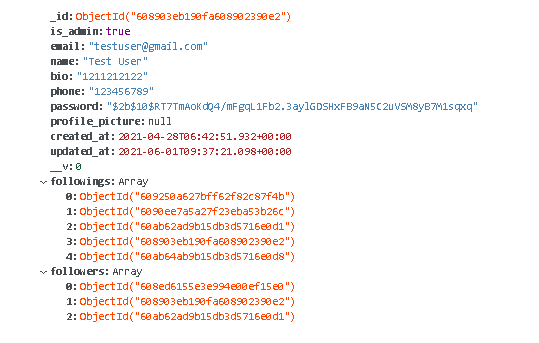
我使用如下所示的逻辑实现了后续/跟随。每次用户跟踪另一个用户。它将执行两个查询。一个是使用findOneAndUpdate({push:followee._id})更新跟随者部分,另一个是更新followee用户部分的查询。
查询响应模式
我编写了一个查询,该查询应该返回响应,并将以下响应附加到每个用户
{
  doesViewerFollowsUser: boolean // implying if person we are viewing profile of follows us
  doesUserFollowsViewer: boolean // implying if person we are viewing profile of follows us
}
实际查询
查询必须如下所示
userModel
    .aggregate([
      {
        $match: {
          _id: {
            $in: [new Types.ObjectId(userId), new Types.ObjectId(viewerId)],
          },
        },
      },

      {
        $addFields: {
          order: {
            $cond: [
              {
                $eq: ["$_id", new Types.ObjectId(viewerId)], // testing for viewer
              },
              2,
              1,
            ],
          },
        },
      },
      {
        $group: {
          _id: 0,
          subjectFollowings: {
            $first: "$followings",
          },
          viewerFollowings: {
            $last: "$followings",
          },
          viewerFollowers: {
            $last: "$followers",
          },
        },
      },
      {
        $lookup: {
          from: "users",
          localField: "subjectFollowings",
          foreignField: "_id",
          as: "subjectFollowings",
        },
      },
      {
        $project: {
          subjectFollowings: {
            $map: {
              input: "$subjectFollowings",
              as: "user",
              in: {
                $mergeObjects: [
                  "$$user",
                  {
                    doesViewerFollowsUser: {
                      $cond: [
                        {
                          $in: ["$$user._id", "$viewerFollowers"],
                        },
                        true,
                        false,
                      ],
                    },
                  },
                  {
                    doesUserFollowsViewer: {
                      $cond: [
                        {
                          $in: ["$$user._id", "$viewerFollowings"],
                        },
                        true,
                        false,
                      ],
                    },
                  },
                ],
              },
            },
          },
        },
      },
      {
        $project: {
          "subjectFollowings.followings": 0,
          "subjectFollowings.followers": 0,
          "subjectFollowings.bio": 0,
          "subjectFollowings.password": 0,
          "subjectFollowings.is_admin": 0,
          "subjectFollowings.is_merchant": 0,
          "subjectFollowings.email": 0,
          "subjectFollowings.phone": 0,
          "subjectFollowings.created_at": 0,
          "subjectFollowings.updated_at": 0,
          "subjectFollowings.__v": 0,
        },
      },
    ])
问题所在
我不认为当前的查询规模太大。此查询的最坏情况复杂性达到0(n^2) (近似)。所以,请帮我优化这个查询。
回答 1
Stack Overflow用户
发布于 2021-06-19 04:36:57
问题在于您的数据建模。不能在数组中存储跟随者/跟随者,因为:
document
- Arrays Mongodb对每个文档都有16 to的硬限制,这意味着您可以在单个查找中存储有限的数据将需要线性时间;数组越大,查询它所需的时间就越长。
您可以做的是拥有一个用户关系集合,如下所示:
follower: user id
followee: user id
然后,您可以创建一个复合索引的追随者-折叠和查询有效地检查谁跟随谁。您还可以在这里启用时间戳。为了获得用户的所有追随者,只需在followee键上创建一个索引,这也将很快解决。
页面原文内容由Stack Overflow提供。腾讯云小微IT领域专用引擎提供翻译支持
原文链接:
https://stackoverflow.com/questions/68036544
复制相关文章
相似问题
腾讯云开发者

Copyright © 2013 - 2026 Tencent Cloud. All Rights Reserved. 腾讯云 版权所有
深圳市腾讯计算机系统有限公司 ICP备案/许可证号:粤B2-20090059  粤公网安备44030502008569号
腾讯云计算(北京)有限责任公司 京ICP证150476号 | 京ICP备11018762号