
SImscape:在熔断器温度达到熔化温度(脱扣情况)后,如何生成熔断器的降温曲线?
我试图从Simscape的热电等效电路模型中得到10A熔断器的温度-电流曲线。为此,我创建了一个自定义开关和可变电阻。
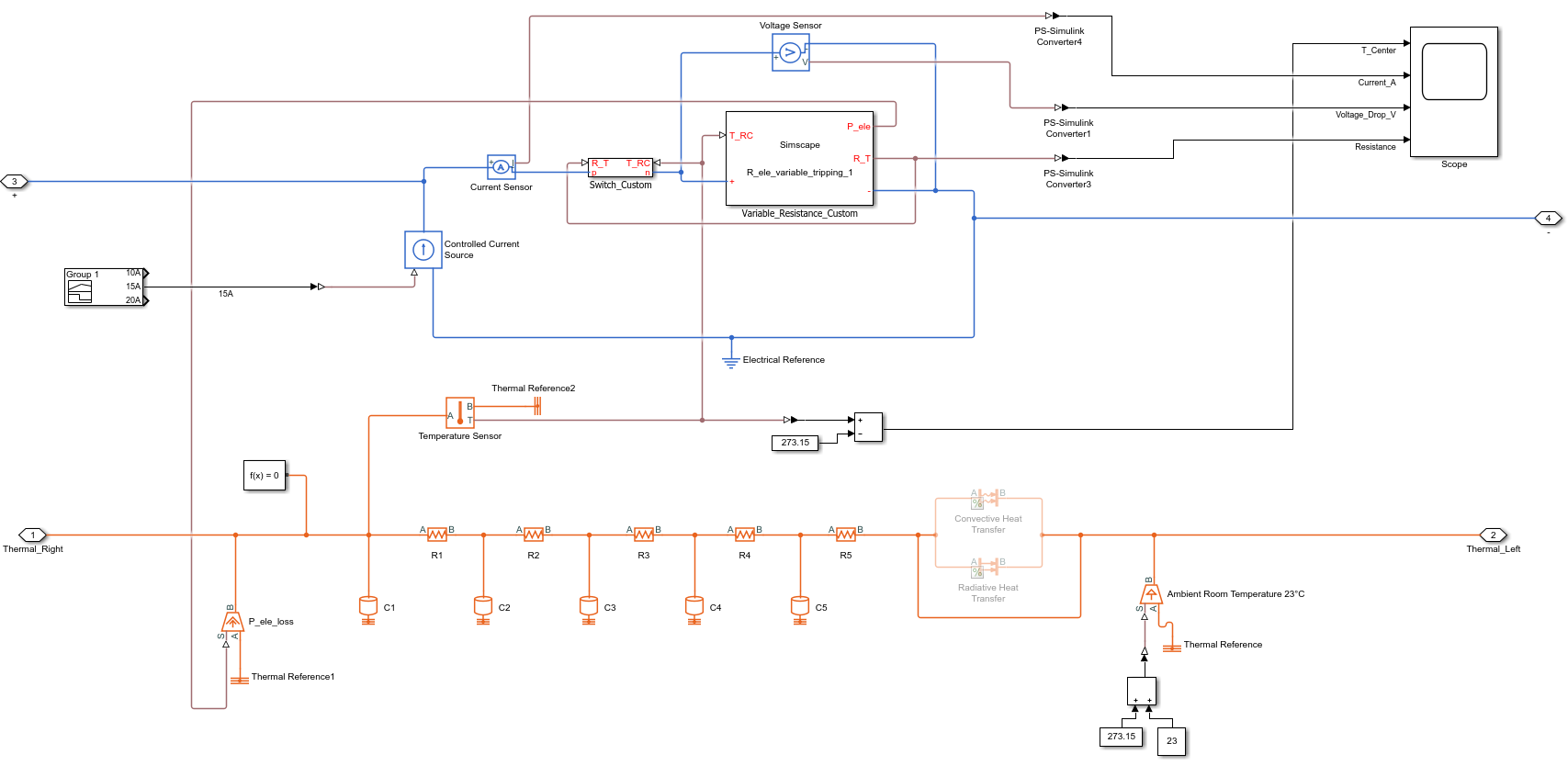
将热RC Cauer模型分为不同的RC连接单元,并由此计算熔断器的温度。
Variable_Resistance_Custom)模型中的
- 温度相关电阻
方程式:
R0*(1+alpha*(T-T0))
- P_electric_loss = i_R_R
.ssc脚本
component R_ele_variable
% Variable Resistor
% Resistor is an electrical component that reduces the electric current.
% The resistor's ability to reduce the current is called resistance.
%
% Resistance: Temperature Coefficient resistance could be expected to
% increase with temperature, since there  will be more collisions.
% (R-R0)/R0 = alpha*(T-T0)

inputs
T =  { 0.0, 'K' }; % T_RC:left
end

outputs
P_ele = {0, 'W'}; % P_ele:right
R_T = {0, 'Ohm'}; % R_T:right
end

nodes
p = foundation.electrical.electrical; % +:left
n = foundation.electrical.electrical; % -:right
end

parameters
R0 = {7,75e-3,'Ohm'};           % Nominal resistance
T0 = {296.15,'K'};        % Reference temperature
alpha = {3.527e-3,'1/K'};    % Temperature coefficient
end

variables
i = { 0, 'A' }; % Current
end

branches
   i : p.i -> n.i;
end

equations
assert(R0>=0)
assert(T0>0)
assert(alpha>=0)
let
    % Calculate R, protecting against negative values
    Rdem = R0*(1+alpha*(T-T0));
    R = if Rdem > 0, Rdem else {0,'Ohm'} end;
in
    R*i == p.v-n.v; % Electrical equation
    P_ele == R*i*i;
    R_T == R;
end
end
end- 是一个控制熔断器的开关,每当温度达到熔化温度(在我的例子中是3.49秒左右)时,它应该打开电路(在模型:Switch_Custom中),然后保险丝的温度将下降到环境温度(室温: 23°C),按照以下公式:
- T = e^((-t)/(R∗C)),这里R= R1 + R2 + R3 + R4 + R5 &C= C1+ C2 + C3 + C4 + C5 (来自热模型)
开关的.ssc曲线
component switch_custom_tripping_1
% Switch_custom_tripping_1
% The block represents a switch controlled by an external physical
% signal. If the external physical signal PS is less than the threshold,
% then the switch is closed, otherwise the switch is open.

inputs
T = { 0.0, 'K' }; % T_RC:bottom
R = {0.0, 'Ohm'}; % R_T:top
end

nodes
p = foundation.electrical.electrical; % p:top
n = foundation.electrical.electrical; % n:bottom
end

parameters
T_melting = { 661.15, 'K' };       % Threshold
C_th = { 5035.9938, 'J/K' };          % Thermal Capacitance
R_th = { 215.45, 'K/W' };          % Thermal Resistance
end

variables
i = { 0, 'A' }; % Current
v = { 0, 'V' }; % Voltage
end

branches
i : p.i -> n.i;
end

equations
assert(T>0)
assert(T_melting>0)
assert(R>0)
v == p.v - n.v;
if T < T_melting      % Switch is close
    v == i*R;
else     % Switch is open
    T == T_melting*exp(-{1,'s'}/(R_th*C_th));
%         R == {Inf, 'Ohm'};
end
end
end
在此模型中,给定缺省电流: 15A熔断器熔化温度: 388°C (661.15开尔文)
错误: 1)时间为3.495038669135668的瞬态初始化,求解一致的状态和模式,未能收敛。非线性求解器:线性代数误差。未能使用迭代矩阵进行求解。
在达到融化温度后,如何才能将这个温度调到室温呢?
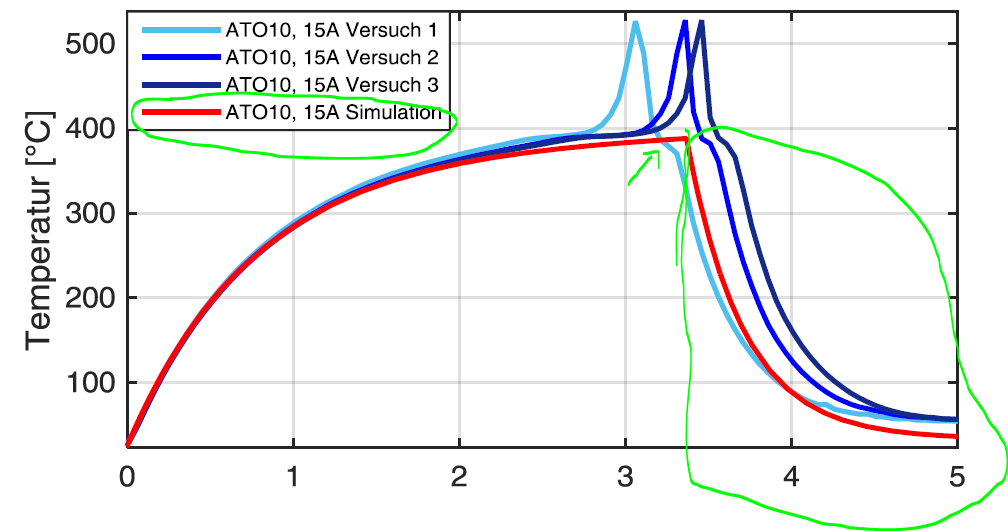
我应该创建单独的函数来计算减温,还是可以在Variable_Resistor_Custom中包含这个减温方程?
回答 1
Stack Overflow用户
发布于 2021-12-03 19:40:34
我试图通过将保险丝分解成多个组件来理解您尝试了什么,但并没有真正理解它。
除此之外,你还设置了电流,但打开保险丝。当保险丝打开时,这不再是真的了。
高水平,非常简化,指导方针:
你的保险丝有一个热容量right
- Independent
- 热容量根据电损耗来接收热能,你已经计算出保险丝是否熔化了,它与周围环境有一个交换,使它冷却下来(除非你在金星或like)
- Depending上的电池熔化状态,你修改融化的情况下的温度
- 系数,电阻变无限。理论上,方程中与温度有关的部分仍然存在,你只需改变你的R0或任何你将来可能想要使用的高级模型。
为了测试这一点,你不能使用电流源,因为你基本上改变了电阻太大了,所以电压会非常高,并且可能会引起数值问题。
我建议有一个控制电压源与一些电流限制电阻器。
控制电压源,你可以控制与PI控制器,优化的室温和可能名义电流的保险丝。
https://stackoverflow.com/questions/68115351
复制相似问题
腾讯云开发者

Copyright © 2013 - 2026 Tencent Cloud. All Rights Reserved. 腾讯云 版权所有
深圳市腾讯计算机系统有限公司 ICP备案/许可证号:粤B2-20090059  粤公网安备44030502008569号
腾讯云计算(北京)有限责任公司 京ICP证150476号 | 京ICP备11018762号