
从多个混合args返回列表
从多个混合args返回列表
提问于 2021-07-29 07:49:29
我试图编写一个函数,它接受一个数字列表,或者作为一个数字或一个范围,预期的输入语法是: 1,2 ,3-5,7,9 -4
该函数将返回字符串'numbers‘的列表。
这将是:'1','2','3','4','5','7','9','8','7','6','5','4‘。空间应该移除。
它将删除重复:'1','2','3','4','5','7','9','8','6‘。
如果能让这些命令升序,那就太好了,但是可以选择。
方法
我的第一个问题似乎是接受3-5作为一个字符串,它自动返回为-2,因此需要识别它并将其发送到list(map(str, range(3, 5))) +1,因为它的python这个范围可以添加到列表l中。
任何单个数字都可以附加到列表中。
副本被移除(解决)。
列表将被返回。
我的大纲
def get_list(*args):
    # input 1-10,567,32, 45-78 # comes in as numbers, but should be treated as string
    l=[] # new empty list
    n=str(args) # get the args as a string

    # if there is a '-' between 2 numbers get the range
    # perhaps convert the list to a np.array() then loop through?
    # I will need n.split(',') somewhere?
    l = list(map(str, range(3, 5)))

    # if just a single number append to list
    l.append()

    # remove duplicates from list
    def remove_list_duplicates(l):
        return list(dict.fromkeys(l))

    l = remove_list_duplicates(l)


return l回答 1
Stack Overflow用户
发布于 2021-07-29 08:43:19
这是我对你的问题的解决方案:
ranges = input()
ranges = ranges.split(',')    # i split the user input on ',' as i expect the user to specify the arguments with a ',' else you can split it on ' '(space)

def get_list(*ranges):
    return_list = []    # initialize an empty list
    for i in ranges:
        try:    # as these are strings and we need to process these exceptions may occur useexception handling
            return_list.append(int(i))    # add the number to the list directly if it can be converted to an integer
        except:
            num_1,num_2 = map(int,i.split('-'))    # otherwise get the two numbers for the range and extend the range to the list
            if(num_1 > num_2):
                return_list.extend([j for j in range(num_2,num_1 + 1 ,1)])
            else:
                return_list.extend([j for j in range(num_1,num_2 + 1 ,1)])
    return list(set(return_list))    # to return a sorted and without duplicates list use the set method

print(get_list(*ranges))    # you need to use the spread operator as the split method on input returns a list
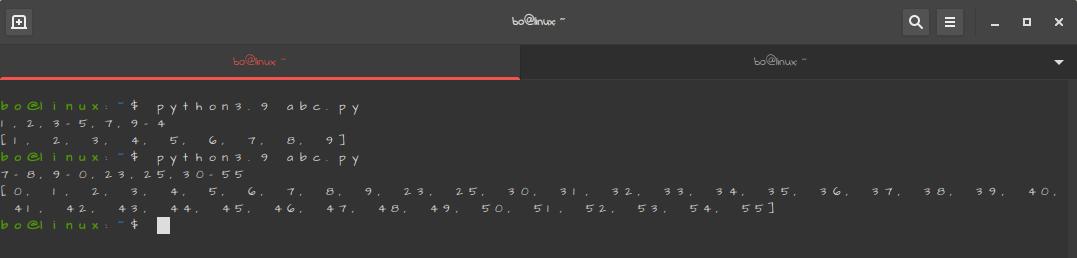
外置:
页面原文内容由Stack Overflow提供。腾讯云小微IT领域专用引擎提供翻译支持
原文链接:
https://stackoverflow.com/questions/68572093
复制相关文章
相似问题
腾讯云开发者

Copyright © 2013 - 2026 Tencent Cloud. All Rights Reserved. 腾讯云 版权所有
深圳市腾讯计算机系统有限公司 ICP备案/许可证号:粤B2-20090059  粤公网安备44030502008569号
腾讯云计算(北京)有限责任公司 京ICP证150476号 | 京ICP备11018762号